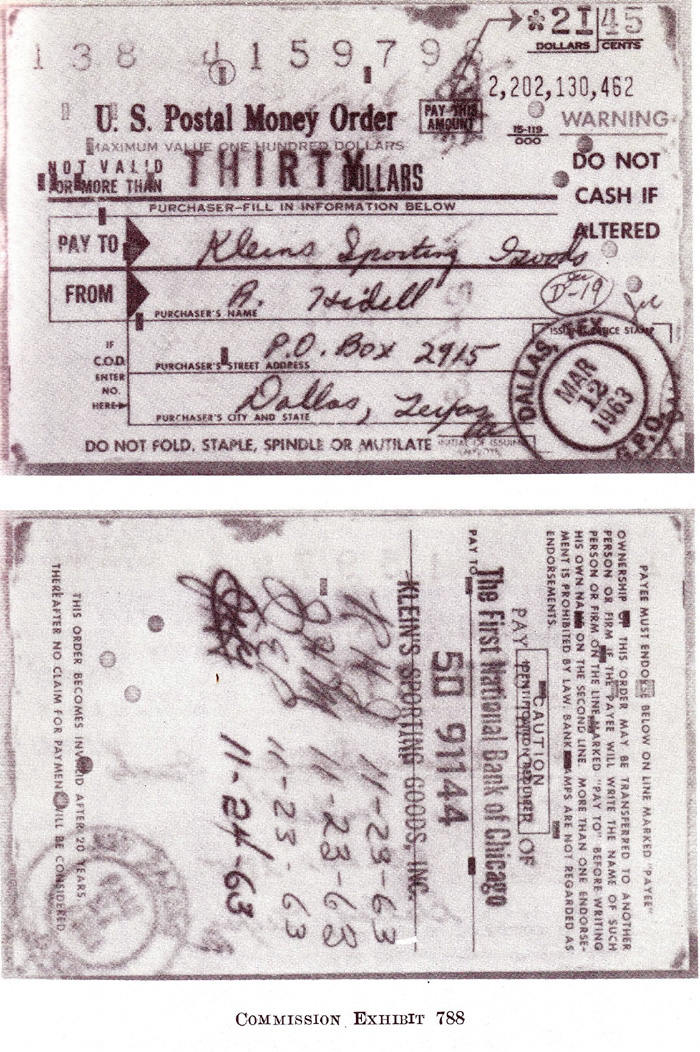
Read it and weep, CTers ...
My exchange with Tim on the Boggs thread made me decide to share as briefly as I can what I know about the Postal Money Order (PMO) by which Oswald purchased the Carcano from Klein’s Sporting Goods in Chicago. This is largely off the top of my head, but I have a Ph.D. in PMO Studies. Less than a year ago, I was nearly finished with a definitive, journal-quality article on this issue, which was intended for publication. I spent as much time on the silly thing as I would’ve spent on an appellate brief in an antitrust case. Before that, I had duked it out with Sandy Larsen (RIP) at the Ed Forum until I simply gave up to preserve my sanity. I will briefly highlight here where Sandy (an engineer of some sort, I believe) went awry.
In case you don’t know, John Armstrong of
Harvey & Lee fame insists a valid PMO that has made its way through the banking system should have “bank stamps” – basically meaning bank endorsements – on the back. Since the Klein’s PMO doesn’t have these, it’s a fraud. This is utter nonsense. Sandy was a big
H&L guy. In the thread about his recent death, Jim DiEugenio fondly recalls Sandy’s excellent work on the money order. See if you agree.
I invite you to read the page Sandy created for the
H&L site:
https://harveyandlee.net/Guns/PMO/Money_Orders.html. As with much
H&L stuff, it’s authoritative-sounding nonsense. Utter bilge. If you stay with me here, you’ll understand why.
OK, here we go …
PMOs have been around since 1864. The annual Post Office manuals (all of which can be found online) have had a section on PMOs since that time.
PMOs were originally not very user-friendly. They could only be cashed at a Post Office branch. The early Post Office manuals thus said nothing about bank stamps. Banks simply weren’t part of the process.
PMOs were never intended to be what is called “negotiable instruments” like bank checks. A check, as you know, can be endorsed over to several people before it is finally deposited in the final endorsee’s bank (or presented directly by him to the issuing bank for payment). From the start, the PMO regulations said a PMO could be endorsed only once. The original payee, Fred, could endorse it to Bob, and Bob could present it to the Post Office for payment – but that was it. Bob could not endorse it to Joe. If he did, there was some cumbersome process whereby Joe had to apply to get a new PMO issued to him.
At some point early on, banks started accepting PMOs as a courtesy to their customers and then presenting the PMOs to the Post Office for payment. The bank, of course, would stamp the PMO to show it had paid it. This presented an issue: If Fred had already endorsed the PMO to Bob, and Bob’s bank then paid the PMO, was the bank’s stamp when it presented the PMO to the Post Office a prohibited second endorsement? (Actually, that would be a potential third endorsement. The second endorsement issue would arise if the bank had simply paid Fred.)
Sometime in the 1880s (as I recall), the postal regulations were amended to say “bank stamps will not be considered endorsements.” (They sometimes said “indorsements,” which means the same thing.) This language thus started appearing in the Post Office manual way back then. Sandy latched onto a Post Office manual from 1925 (as I recall) that – unsurprisingly – had this language. In Sandy’s non-lawyerly mind, this “proved” that Armstrong was correct; all PMOs deposited in banks must have bank stamps.
Wrong, at least after 1942 – as you will now see.
The Federal Reserve System was created in 1913. Not all banks, then or now, are part of the Federal Reserve System. Thousands of state-chartered banks and credit unions are not part of the Federal Reserve System. Banks that are not part of the Federal Reserve System deal with the Federal Reserve through what are called “clearinghouse” banks. A clearinghouse bank is simply a middleman for non-member banks.
This became significant in 1942. That year, the Treasury Department and the Postal Service reached an agreement for the Federal Reserve to act as the agent for the Postal Service in the processing of PMOs. If I am Fred’s authorized agent, then when you deal with me it’s as though you’re dealing with Fred himself. That’s what it means to be an authorized agent.
The Klein’s PMO was deposited by Klein’s in its account at the First National Bank of Chicago, a Federal Reserve member bank. This is apparent from the Klein’s stamp (endorsement) on the back of the PMO: “Pay to the Order of the First National Bank of Chicago.”
Under the Federal Reserve regulations, PMOs were treated as “cash items” and could be bundled together by a member bank, without listing them individually, and sent on to the regional Federal Reserve Bank governing its district (there are 12). (Cash items also included government checks and eventually even Food Stamps.) The First National Bank of Chicago thus sent the Klein’s PMO to the Federal Reserve Bank of Chicago in its daily “cash letter,” just business as usual. The PMO was then sent on to the Treasury Department in Washington for the First National Bank to be reimbursed by the Treasury.
Under the 1942 agreement between the Treasury Department and the Postal Service, the Federal Reserve as a mere agent did not concern itself with the authenticity or legitimacy of a PMO. Only if the depository Federal Reserve bank – here, the First National Bank of Chicago – was itself negligent would there be any further Federal Reserve involvement. Theft, fraud and that sort of thing was the Postal Service's problem. Hence, the Postal Service did audit PMOs for obvious problems before they were placed into storage. (More on this later, another area where Sandy went awry.)
Because a claim of theft or fraud might arise even after auditing, and the original PMO might be needed as evidence, it had to be retained at the federal records center for some period of time after being placed into storage. The retention period was quite short. As I recall, it was only six months but at one time it might have been as long as two years.
If you’ve been paying attention, you will have noticed one critically important thing: The Klein’s PMO was
never outside the Federal Reserve System. It was deposited in a Federal reserve member bank, sent as a cash item to the regional Federal Reserve Bank, sent on to the Treasury Department, audited by the Postal Service, and placed into storage at the federal records center. It was
never outside the system that was the authorized agent of the Postal Service.But wait, what about state-chartered banks that are
not part of the Federal Reserve System? Ah, now we can talk about bank stamps. If a state-chartered bank paid a PMO, it had to get the PMO
into the Federal Reserve System because that system was responsible for processing and paying the PMO as the agent for the Postal Service. The state-chartered bank did this via a clearinghouse bank that had a relationship with the Federal Reserve. The state-chartered bank (and possibly the clearinghouse bank – I’m not sure) would indeed have to stamp the PMO, but under the postal regulations its stamp would not be considered a prohibited second endorsement. The regional Federal Reserve Bank, as agent for the Postal Service, would then know that the state-chartered bank had paid the PMO and was to be reimbursed by the Treasury Department; with a PMO paid by a member bank like the First National Bank of Chicago, this issue simply would not exist.
Armstrong and Sandy insist the Klein’s PMO should have been endorsed (bank stamped) by the First National Bank of Chicago, the Federal Reserve Bank of Chicago and even the Treasury Department itself! This is lunacy. The entire process was simply one of an authorized agent of the Postal Service paying and processing the PMO pursuant to an agency agreement.
Their error is apparent in Sandy’s discussion of the IBM machines for processing punch card PMOs (which I discovered, thank you). Sandy says at the
H&L site, “All postal money orders had to be date stamped/endorsed by the bank receiving the deposit. Without the endorsement, the Federal Reserve would have no way of knowing to which bank the money order was to be credited.” No way of knowing? The Klein’s PMO not only has the bank name in Klein’s endorsement on the back (“Pay to the Order of the First National Bank of Chicago”), but the bank, a Federal Reserve member, packaged the PMO as a cash item and sent it on with many other such items to the regional Federal Reserve Bank of Chicago as it did every day.
No way of knowing? There were not going to be any items in the cash letter transmittal that were
not from the First National Bank of Chicago. This statement would make sense if the depository bank were a non-member state-chartered bank and the PMO had entered the Federal Reserve System via a clearinghouse bank, as discussed above, but it is silly in the context of the First National Bank.
Bear in mind as well that a PMO could still be presented to the Post Office for payment. It didn’t (and doesn’t) have to enter the banking system at all, ever.
Clear so far?
In 1951, there was a sea change in the processing of PMOs. The Postal Service went to the punch card design we see with the Klein’s PMO. Bear in mind, PMOs used to be extremely popular. Millions and millions were processed every year (200,000,000 were sold in 1963, and that was down from prior years). The punch card design allowed PMOs to be processed far more quickly and efficiently. If a PMO later needed to be retrieved from the records center, this could be done in minutes (precisely as occurred with the Klein’s PMO).
Now my claim to fame: If you look at the image below, you will see some large numbers right across the top of the Klein’s PMO: 138 159796 (possibly a 4 before the second 1, but I’m not sure). I could find no mention of these in the online discussions of the PMO, which seemed downright weird.
What are they? I wondered.
A 1951 article explaining the new punch card system provided the answer: This is the File Locator Number assigned at the federal records center so the PMO can be retrieved in minutes if needed. What did this mean? It meant the PMO had been processed through the Federal Reserve System, audited by the Postal Service, and placed into storage! This pretty well killed Armstrong’s “missing bank stamps” argument – or so I thought in my naivete as to how CTers operate.
Sandy was barely fazed. You can guess where the goal posts were moved next: Yes, the PMO had been
planted! It was either actually planted at the federal records center in Alexandria, Virginia to be found the evening of the assassination, in which case assorted clerical folks must have been part of the conspiracy, or the FBI and SS had simply pretended it was found there. (There are a variety of real-time communications detailing the FBI’s and SS’s independent quests for the PMO on the evening of the assassination, so these would’ve had to have been faked in rather unlikely circumstances.)
Wait, I asked, flush with my new status as a "JFKA researcher": They went to all this trouble to plant the Klein’s PMO but somehow failed to include the bank stamps that you insist are the red flags showing the PMO is bogus? Yes, it’s that Three Stooges thing again – the conspirators were geniuses at step 4, idiots at step 5.
Sandy’s big thing was that a real PMO would’ve been found at the Postal Service accounting center in Kansas City. He had articles about the huge improvements made in 1955 for the Postal Service’s auditing of PMOs. PMOs had previously been audited at 12 auditing centers around the country but now would all be audited at a new facility in Kansas City.
You will note that Sandy’s articles say
nothing about
storage. PMOs were not stored at the auditing center. As is explained above, the Postal Service does perform an auditing function before PMOs are placed into storage. This apparently encompasses all PMOs – i.e., those paid through the Federal Reserve system and those paid by the Postal Service itself. As I recall, on the evening of the assassination one of the investigating agencies was first referred to the auditing center in Kansas City (which no longer exists). But all PMOs were ultimately stored at the federal records center in Alexandria, Virginia, where the Klein’s PMO was found. There is no mystery.
The above is 98% from memory. You would not
believe the effort I put into this project. I read law review articles, court cases, anything I could find. I did more Google searches than I could count. I undertook a massive search for a paid PMO from 1942 or later – looking at collector sites, auction catalogs, historical collections. I am astonished that some enterprising employee at the records center didn’t keep a paid PMO with Mickey Mantle’s or Marilyn Monroe’s signature, but I found
none. I communicated with the Postal Museum and the authors of authoritative articles on the history of PMOs. I finally abandoned my definitive paper as more trouble than it was worth and now develop tics if someone even mentions the Klein’s PMO. Only three Guinness Stouts are getting me through this post.
In any event, I am confident the above is correct in all the essentials, there is no mystery at all, and Sandy and his Ed Forum cheerleaders were and are simply wrong.
I tell ya, the life of a Caped Factoid Buster is never easy.