@John Mytton
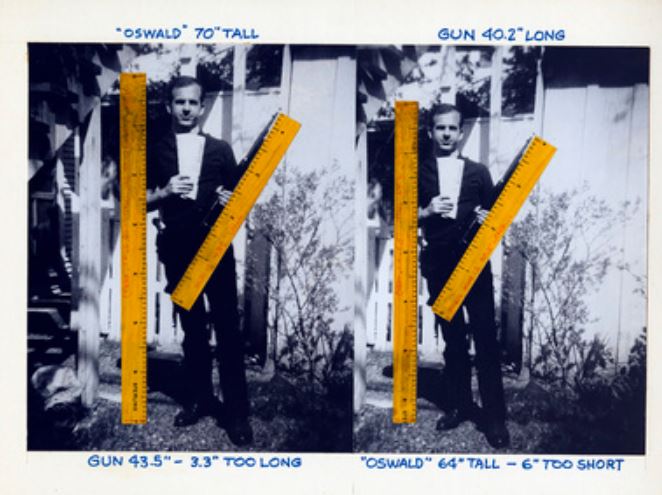
Hey, John, to prove the rifle in the BYP is 40” long, all you have to do is overlay a graphic ruler measuring Oswald’s body that’s divided into 7 equal segments.
From top of Oswalds hair plus with shoes on = approx 70” tall (5’10”) so each segment of the 7 segment ruler will be 10”.
Then take 4 of those same exact length segments and overlay those on the rifle image and I’m sure that the rifle will be 4 segments in length which therefore is 40”.
Note: You may already have posted this graphic measurement in the past but I can’t remember what thread it was.
Hi Zeon, calculating precise measurements from two dimensional images without allowing for perspective and angle is a fools errand.
Jack White produced the following image but as the HSCA photo panel explained that without standard photogrammetry principles, the result is worthless.
The HSCA PP used these examples as a reason why White's methodology was flawed.
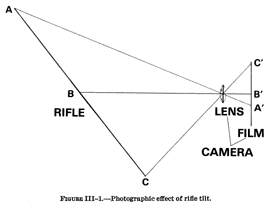
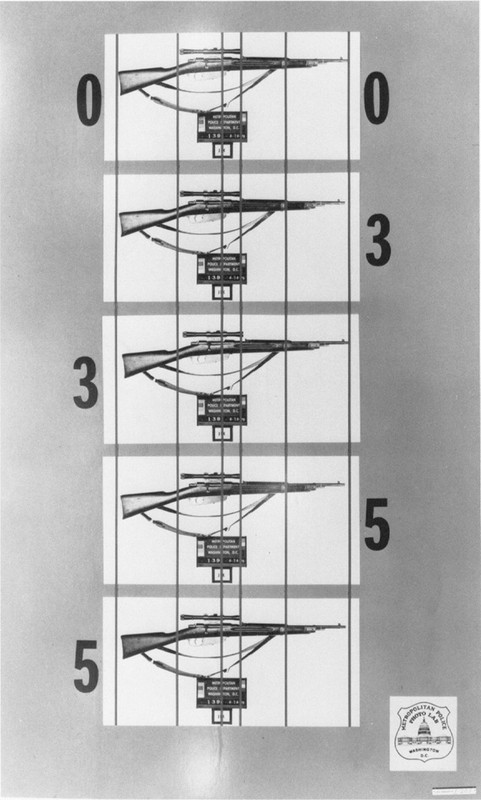
And finally here is White's explanation of his reasoning and even though he had never heard of photogrammetry, the concepts of interpreting 2D images must be followed.
Mr. GOLDSMITH. I see that you have taken a ruler and placed it by Oswald's body and also by his rifle; is that correct?
Mr. WHITE. Yes.
Mr. GOLDSMITH. Mr. White, do you believe that an object photographed can be measured simply by placing a ruler against the image in the photograph?
Mr. WHITE. No.
Mr. GOLDSMITH. When you measured the object in this photograph, what did you do beyond using the ruler?
Mr. WHITE. This is strictly a two-dimensional measurement. Obviously I did not take into consideration any perspective which might exist or any other considerations. It is just a mere measurement of the body from the weightbearing foot to the top of the head in each case and of the rifle from the muzzle to the butt.
Mr. GOLDSMITH. Without giving any account to other factors?
Mr. WHITE. That is true. I am not a physicist or any sort of a scientist who could determine anything relating to the perspective. We don't know how close the rifle is to his body. We don't know how close the camera is to the subject, so it would be virtually impossible for just a plain citizen like me to interpret the perspective of this photograph.
Mr. GOLDSMITH. Have you had any training in analytical photogrammetry?
Mr. WHITE. No.
Mr. GOLDSMITH. Have you had any formal training in forensic photography?
Mr. WHITE. No.
[...]
Mr. GOLDSMITH. Mr. White, you have made reference to several points in these photographs that suggest that Oswald's head is disproportionately----
I withdraw the question.
That the body of Oswald is not consistent in the various photographs in light of the head size; is that correct?
Mr. WHITE. Yes.
Mr. GOLDSMITH. To what extent, if any, did you compute photogrammetrically the effect of an object's tilt on its apparent length in the photograph?
Mr. WHITE. As I said, I am not a scientist. I don't indulge in that sort of thing.
[...]
Mr. GOLDSMITH. Mr. White, I just have one question.
Mr. WHITE. All right.
Mr. GOLDSMITH. When you did this study, did you compute photogrammetrically the effect of tilt on the way that the length of an object appears in a photograph?
Mr. WHITE. I conducted a study by photographing a yardstick from three different-
Mr. GOLDSMITH. Mr. White, answer my question. Did you compute photogrammetrically----
Mr. WHITE. What is "photogrammetrically"? Describe to me what "photogrammetrically" is.
Mr. GOLDSMITH. I just have one more question Mr. White. Do you know what photogrammetry is?
Mr. WHITE. No.
Mr. GOLDSMITH. I have no further questions. Thank you. JohnM

