First off, yes, I stand corrected about the conclusions of the HSCA handwriting experts on the note's handwriting. I got that claim from the usually reliable 22november1963.org.uk website. I should have gone back and double-checked the handwriting experts' report, which the 22november1963 folks actually cite with a link. Clearly, they either misread the report or chose to misrepresent it.
And, oh yes, I see, not surprisingly, that a bunch of WC apologists are hooting and posturing over my mistake, labeling it as proof of my many supposed "lies," etc., etc. Unlike you folks, when I make a mistake, I admit it. You guys have made many egregious errors that I have documented for you, but you have never once acknowledged any of them.
Two, I note that you once again failed to address the fact (1) that the one eyewitness saw two men hurriedly leave and said neither man resembled Oswald, and (2) that none of the several fingerprints on the note were Oswald's or Marina's prints. In all your excitement over being able to pounce on one of my rare errors, perhaps you just forgot about these two key facts. So let me discuss them again:
The one eyewitness, Walter Coleman, said he saw two men hurriedly leave the church parking lot next to Walker's house and that neither man looked like Oswald. Coleman said he had seen numerous pictures of Lee Harvey Oswald, and he was shown a photograph of Oswald among several other photographs. He said that neither of the men he saw resembled Oswald, and that he had never seen anyone in or around the Walker residence before or after the night of the shooting who resembled Oswald.
I should add that Robert Surrey reported that days before the Walker shooting he saw two men sitting in a car near Walker's house and that the men later seemed to be inspecting the windows and area surrounding the Walker home. Surrey said that neither of these men resembled Oswald (https://www.tpaak.com/walker-allegations).
And, not one of the several fingerprints on the goodbye note belonged to Oswald or Marina. Seven fingerprints were found on the note, but none of them belonged to Oswald or his wife. How do you write a note and not leave a single fingerprint on it? How did Marina read the note without leaving a single print on it?
Three, yes, Walker said the bullet was mangled, but he also made it clear that the bullet was not a WCC Carcano FMJ bullet. He was adamant on this point:
During the HSCA investigation in the 1970’s, General Walker himself said that
the bullet in evidence was not the same bullet that was found in his house on 10th
April 1963. He wrote to the Attorney General in February 1979 and said that it was
“a ridiculous substitute.” He went on to state that “I saw the hunk of lead, picked up
by a policeman in my house, and I took it from him and I inspected it carefully.
There is no mistake. There has been a substitution for the bullet fired by Oswald and
taken out of my house.”
(https://www.kennedysandking.com/john-f-kennedy-articles/oswald-and-the-shot-at-walker-redressing-the-balance)
Also, the first police description of the bullet said it "was a steel jacket bullet," and the supposed Walker bullet in evidence, CE 573, does not contain Lt. Day's chain-of-evidence mark. Cole and Gram discuss some of the evidence that CE 573 is not the Walker bullet:
The original and official DPD reports described a relatively rare “steel jacketed”
slug found in the Walker home, on April 10, 1963, the night of the shooting.
The bullet was handled and initialed through inscribing by four DPD officers.
But CE 573—the WC’s purported Walker Bullet—is obviously copper-jacketed.
The extremely thin Warren Commission questioning of FBI agent Frazier, as to
how and why the Walker Bullet could ever be described as “steel jacketed” by
DPD detectives. Frazier answered that “some individuals refer to all rifle bullets
as steel jacketed,” a novel and unique observation. There is nothing in police or
FBI literature to suggest police detectives or FBI special agents anywhere ever
described “all rifle bullets” as steel jacketed—especially when copper-jacketed
rifle bullets were and are the norm.
Lt. Day of the Dallas Police Department, stating unequivocally to the FBI and
then to the WC that he had carved the true Walker slug with his name “DAY” and a
cross. No such markings can be seen on CE 573, even under a microscope.
The lack of same-day April 10, 1963, or indeed any Dallas Police Department
photographs of the true Walker Bullet. The true Walker Bullet was never
photographed or, if it was, the photographs have disappeared. Moreover, there
are no surviving written DPD lab reports on the Walker Bullet that describe the
slug as steel- or copper-jacketed.
The weak chain of evidence confirmation by the FBI-WC on the provenance
of CE 573. The FBI in 1964 showed a slug purported to be the Walker Bullet
only to Norvell, the DPD patrolman, who at best handled the slug briefly 14
months earlier. The FBI did not show the purported Walker Bullet to detectives
McElroy or Van Cleave.
(https://www.kennedysandking.com/john-f-kennedy-articles/1408)
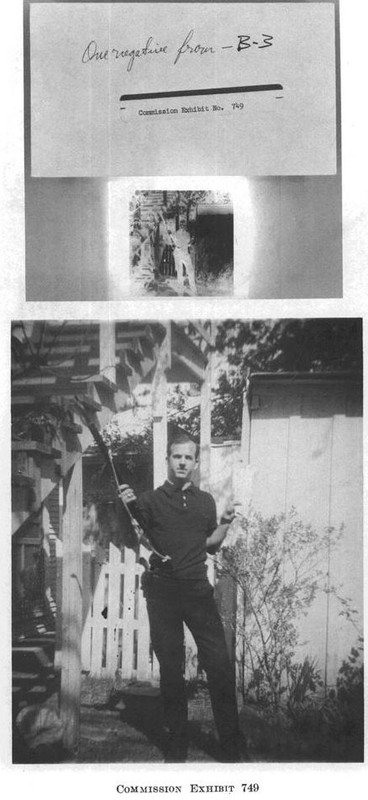
Four, I see that Mytton is once again trotting out the backyard rifle photos as supposed proof of Oswald's guilt in both the Walker shooting and the JFK shooting. Those photos are as phony as a three-dollar bill. See
The HSCA and Fraud in the Backyard Rifle Photos
https://drive.google.com/file/d/1JiOqKWO-XJSO-z_lk6bSgUBXq_vD1yZs/view
Are you guys ever, ever, ever going to deal with the parallax measurements showing the impossibly microscopic differences in distances between objects in the backgrounds of the photos? There is no way on this planet that photos taken with a cheap handheld camera that was supposedly handed back and forth to advance the film would have such impossibly tiny differences in the distances between the objects in the backgrounds in the photos. This is not to mention that the variant shadows in the photos have never been duplicated, among other problems with the photos.
Five, apparently it has not occurred to any of you to wonder how your supposed skilled "sharpshooter" assassin managed to miss Walker from less than 120 feet away while having all the time in the world to aim and fire. Yet, you claim this is the same guy who performed a shooting feat against JFK that the three Master-rated riflemen in the WC's shooting simulation, using the alleged murder weapon, did not even come close to duplicating, even though they fired from only 30 feet up, fired at a stationary target boards, and took as much time as they wanted for their first shot.
Six, the attempts to explain why Oswald would try to shoot the rabid right-winger Walker and then turn around and shoot the man whom Walker had publicly condemned, i.e., JFK, border on incoherent.
Seven, the NAA testing that supposedly linked the Walker bullet to Oswald's rifle was discredited nearly 20 years ago.
https://www.nbcnews.com/id/wbna18709539
https://www.osti.gov/servlets/purl/900118
Two, I note that you once again failed to address the fact (1) that the one eyewitness saw two men hurriedly leave and said neither man resembled Oswald, and (2) that none of the several fingerprints on the note were Oswald's or Marina's prints. In all your excitement over being able to pounce on one of my rare errors, perhaps you just forgot about these two key facts. So let me discuss them again:
The one eyewitness, Walter Coleman, said he saw two men hurriedly leave the church parking lot next to Walker's house and that neither man looked like Oswald. Coleman said he had seen numerous pictures of Lee Harvey Oswald, and he was shown a photograph of Oswald among several other photographs. He said that neither of the men he saw resembled Oswald, and that he had never seen anyone in or around the Walker residence before or after the night of the shooting who resembled Oswald.
I should add that Robert Surrey reported that days before the Walker shooting he saw two men sitting in a car near Walker's house and that the men later seemed to be inspecting the windows and area surrounding the Walker home. Surrey said that neither of these men resembled Oswald (https://www.tpaak.com/walker-allegations).
Real interesting but where to start?
My quick notes based on the Police and FBI reports
Kirk Coleman on the day after tells Police the only description was the man who got in the 1949 or 1950 Ford was middle sized with long black hair, Kirk tells the FBI almost a full year later(with a sudden photographic like recollection) that the white man was real skinny, dark bushy hair, a thin face, with a large nose, about 5'10 19 years old and about 130 pounds wearing Khaki pants and a sports shirt, gets into a 1950 white or beige Ford and drives away in a hurry. Later tells FBI that car drives off at normal rate of speed.
The other man 6'1 200 pounds, no age, long sleeve shirt with dark pants, Tells Police the man in the other car doesn't seem to be in a hurry, the only description of the car is black with a white stripe and later tells the FBI the 2nd man is leaning into the back seat of an open door, 2 door black over white 1958 Chevrolet sedan, Kirk doesn't see 2nd man leave.
Coleman initially tells the Police that the lights in the car park were not on and later tells the FBI that he was able to observe this even though it was night time because the car park was lit by a flood light.Besides two men occupying the same car park on a church meeting night, who at one point were about ten yards apart of each other, I can not find any meaningful connection?Robert Surrey on the night of the 8th( two days before) says the men were in their 30's and between 5'10 and 6 foot and one was 160 and the other 190 pounds.
They were well dressed in suits, dress shirts and ties.
They got out of a 1963 4 door Ford dark brown or maroon. They walk up alley to the Walker house and look through the windows and Leave about half an hour later, Surrey gets into car and checks glovebox for ID? (a new 1963 car was left unlocked?)
Tells FBI he was not certain if he could identify either man again, but was of the opinion that neither man was identical to Lee Harvey Oswald.
Links
Police report for Kirk Coleman
https://texashistory.unt.edu/ark:/67531/metapth338185/m1/15/?q=General%20Edwin%20WalkerFBI report for both Surrey and Coleman.
https://www.maryferrell.org/showDoc.html?docId=60410#relPageId=117&search=%22Robert_Surrey%22And, not one of the several fingerprints on the goodbye note belonged to Oswald or Marina. Seven fingerprints were found on the note, but none of them belonged to Oswald or his wife. How do you write a note and not leave a single fingerprint on it? How did Marina read the note without leaving a single print on it?
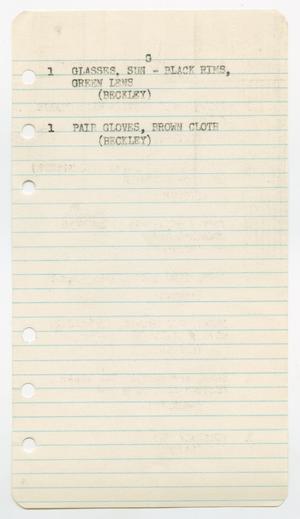
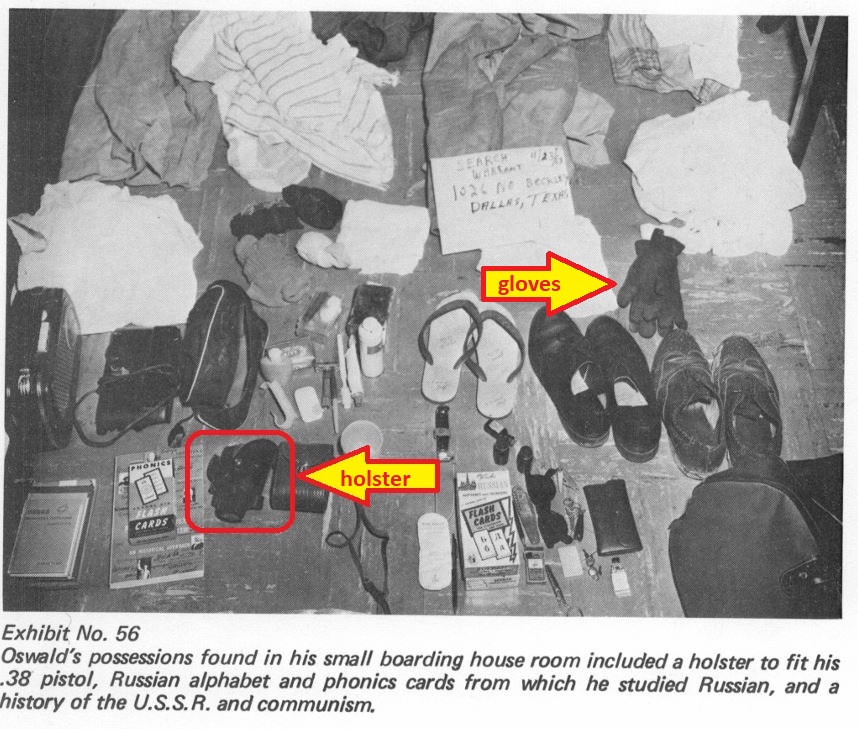
And secondly, real life isn't like TV's CSI, legible fingerprints from crime scenes can be difficult to recover from non-porous surfaces and especially difficult from porous surfaces like paper. For instance from Oswald's rifle bag, only two relatively small prints were recovered.
From Google AI
Recovering fingerprints at crime scenes can be challenging due to various factors, including the surface type, environmental conditions, and the age and quality of the fingerprint itself. While some surfaces like glass are relatively easy to process, others like textured or curved surfaces, or those exposed to heat or harsh conditions, present significant difficulties.
Factors Affecting Fingerprint Recovery:
Surface Type:
Porous surfaces (like paper) absorb fingerprint residue, making it harder to lift. Non-porous surfaces (like glass or metal) are generally easier to work with, but even these can be problematic if textured or contaminated.
Environmental Conditions:
Heat, humidity, and exposure to the elements can degrade or destroy fingerprints, especially if they are exposed for extended periods.
Age of the Print:
The longer a fingerprint has been exposed, the more likely it is to be degraded or obscured by dust, dirt, or other contaminants.
Quality of the Print:
Partial prints, smudged prints, or prints with poor ridge detail are difficult to process and analyze.
Nature of the Crime:
Fingerprints on items like fired ammunition casings, knives, or bomb fragments may be difficult to recover due to heat and potential damage.
Challenges in Fingerprint Recovery:
Difficult Surfaces:
Textured surfaces (like fabrics or rough metals) and curved surfaces (like bottles) present challenges in applying and lifting fingerprint powder or other enhancement techniques.
Contamination:
Fingerprints can be contaminated by other substances, making them difficult to visualize and lift.
Heat and Damage:
Fingerprints on items exposed to high temperatures (like fired bullet casings) may be damaged or destroyed.
Partial Prints:
Partial fingerprints may not contain enough detail for reliable identification.
Complex Backgrounds:
Fingerprints on complex backgrounds (like patterned surfaces or cluttered areas) can be difficult to distinguish. Latona the FBI's fingerprint expert says that prints tested on the sniper's nest boxes have a relatively short life, and how long was it before Marina and/or Oswald handled the note? In my research some prints from some types of paper can be recovered after what appears to be years but as noted above and below, many factors must be considered.
Mr. EISENBERG. That would be the outermost limit that you can testify concerning?
Mr. LATONA. We have, run some tests, and usually a minimum of 24 hours on a material of this kind, depending upon how heavy the sweat was, to try to say within a 24-hour period would be a guess on my part.
Mr. EISENBERG. I am not sure I understand your reference to a minimum of 24 hours.
Mr. LATONA. We have conducted tests with various types of materials as to how long it could be before we would not develop a latent print.
Mr. EISENBERG. Yes?
Mr. LATONA. Assuming that the same print was left on an object or a series of similar prints were left on an object, and powdering them, say, at intervals of every 4 hours or so, we would fail to develop a latent print of that particular type on that particular surface, say, within a 24-hour period.
Mr. EISENBERG. So that is a maximum of 24 hours?
Mr. LATONA. That is right.But at the end of the day, Experts did in fact positively linked Oswald's writing to the Walker note. Sorry bout that.
And besides, wouldn't conspirators clearly spell out the Walker connection with Walker's name, a clear date and more incriminating evidence?
Are you guys ever, ever, ever going to deal with the parallax measurements showing the impossibly microscopic differences in distances between objects in the backgrounds of the photos? There is no way on this planet that photos taken with a cheap handheld camera that was supposedly handed back and forth to advance the film would have such impossibly tiny differences in the distances between the objects in the backgrounds in the photos. This is not to mention that the variant shadows in the photos have never been duplicated, among other problems with the photos.
Griffith get a grip, you have fake photos, films, x-rays, autopsy photos, forged documents, the list is endless and quite pathetic. Anyway, I have dealt with the vast differences in parallax caused by Marina's changing POV, which conclusively show that the photos were NOT taken on a tripod and that there was more than a solitary backdrop. Marina stood in 1 position and took at least three photos. Do the experiment yourself before you make yourself look the Fool yet again!
Look closely at the relative movement between background objects, like the shutters, stairs, roof behind and ETC, and there is massive amounts of parallax happening right before your eyes.
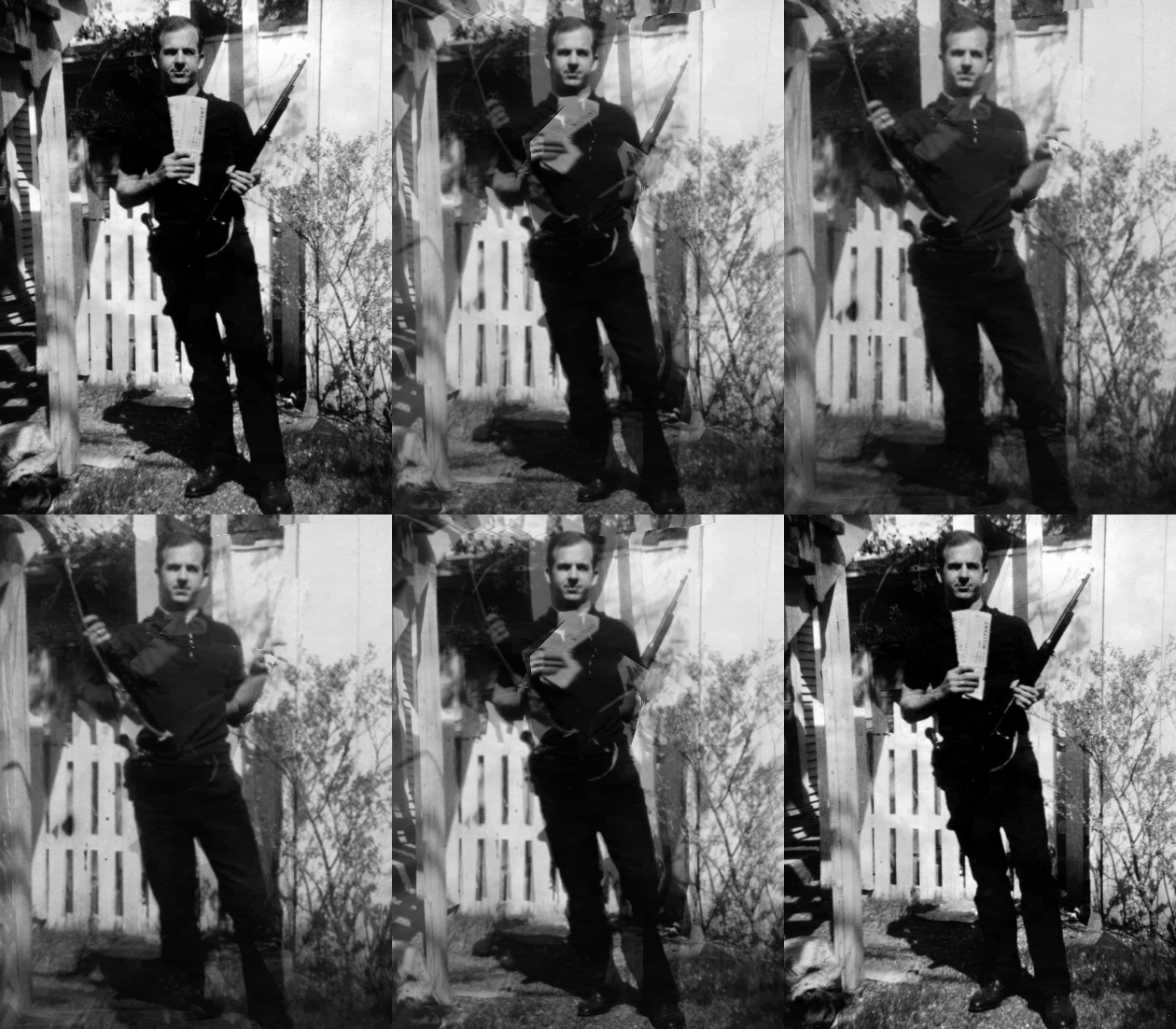
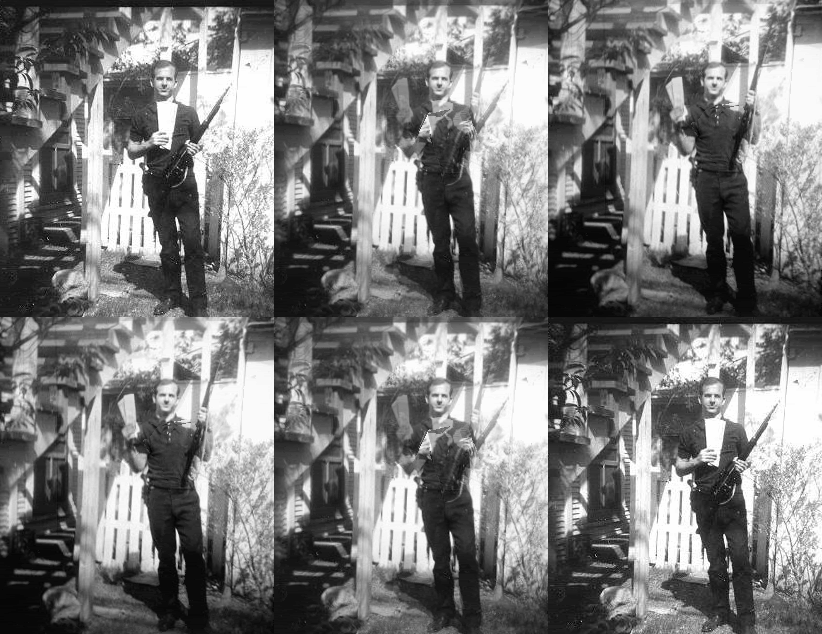
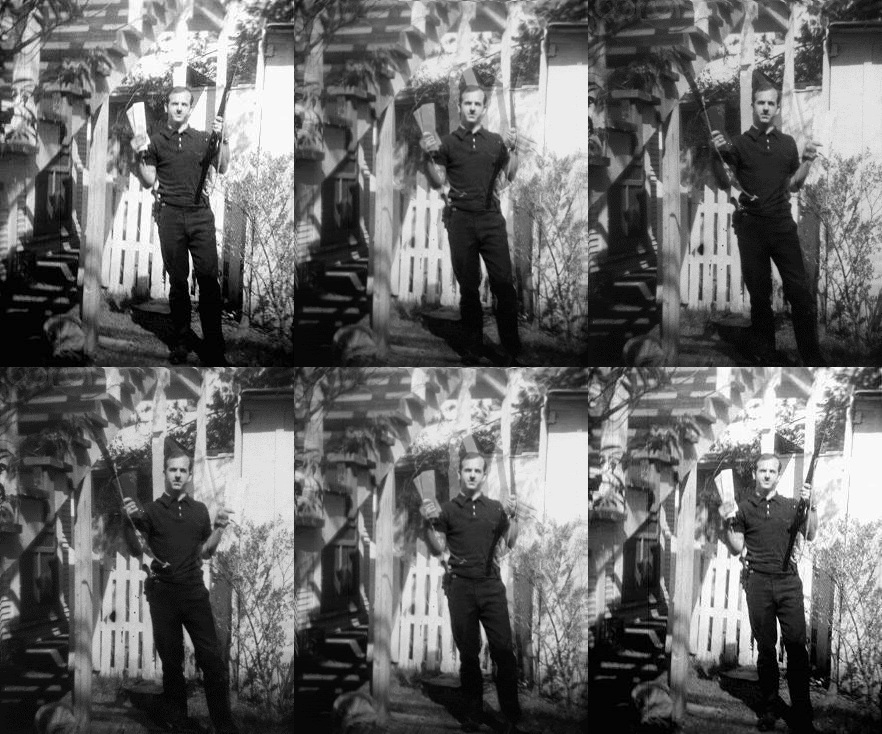
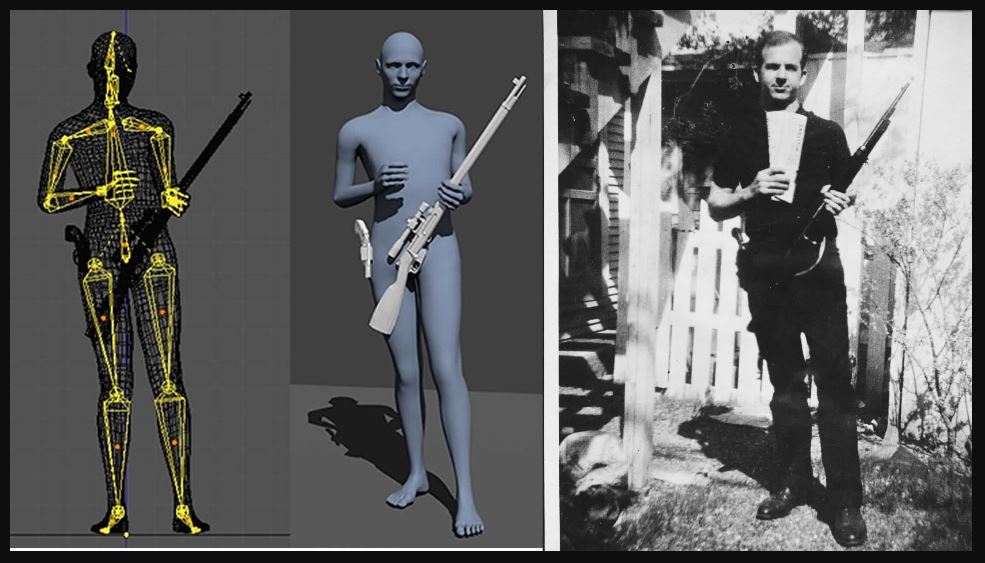
And not the shadows again(yawn), this has been recreated at the scene and by advanced CGI.
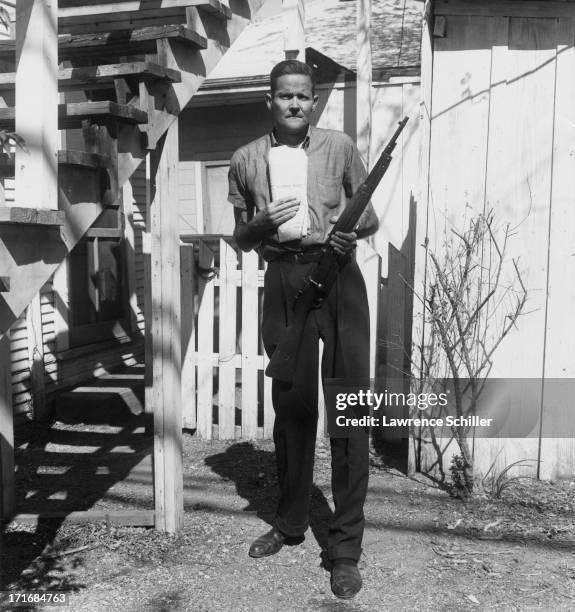
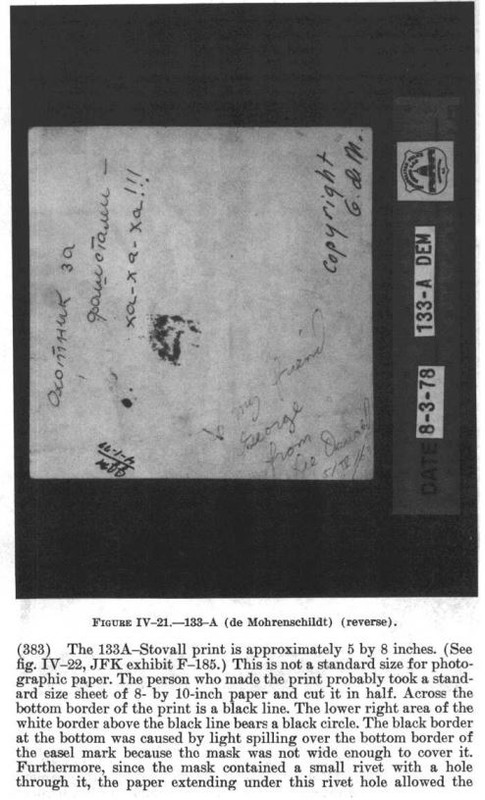
George de Mohrenschildt's backyard photo signed by Oswald.
And to top it off, a photographic negative exists which came directly from Oswald's camera which is definitive proof of the authenticity of the photo. As they say in the classics, That's All Folks!!
JohnM

