T.F. Bowley, A Wind-Up Wristwatch & 1:17

Users Currently Browsing This Topic:
0 Members

Author Topic: T.F. Bowley, A Wind-Up Wristwatch & 1:17  (Read 61792 times)

Online Bill Brown

  • Hero Member
  • *****
  • Posts: 2024
Re: T.F. Bowley, A Wind-Up Wristwatch & 1:17
« Reply #21 on: April 04, 2024, 11:50:51 PM »
why not debate me live either thru Skype or Youtube this week?

And do what exactly? Do you propose to repeat the same flawed claims and expect another outcome, or do you have anything more than what you claimed and said in the mini-debate?

I don't have anything more, but I also don't need anymore as the facts are obvious and against you. But, as stated earlier, you will never accept that, so what would be the point in going over the same information?

This wouldn't be a case of you simply not being able to get over having been proven wrong, would it?

How can I be any more clear?  Let's debate the shooting death of J.D. Tippit and Oswald's relationship to that death.  The entire case, Callaway, Butler, loading the body and everything else.  You'd be worthy, unlike someone like Iacoletti who would spend the entire debate saying things like "Oswald's gun LOL".  I know you'd at least discuss the case, which I can respect.

You.
Me.
Tippit.
Oswald.
Youtube.
Skype.
This week.
Next week.
Recorded live and then posted here for all to listen to.
Cool?

Online Dan O'meara

  • Hero Member
  • *****
  • Posts: 3774
Re: T.F. Bowley, A Wind-Up Wristwatch & 1:17
« Reply #22 on: April 05, 2024, 09:22:16 PM »
Mr. Benavides: No; afterward. You know, I told your---I told him, he asked me when we went, when Ted Callaway got around there, he opened the car door and picked up the phone and called in and told them there was an officer that had been killed. But the officer on the other side of the radio told him to hang up the phone to keep the lines clear, or something of that sort.
Then he jumped out and ran around and he asked me did I see what happened, and I said yes. And he said let's chase him, and I said no.
Mr. Belin: Why did you say "No"?
Mr. Benavides: Well, he was reaching down and getting the gun out of the policeman's hand, and I didn't think he should bother to go like that. So he then turned around and went to the cab that was sitting on the corner.

According to Benevides, Tippit was still lying in the road after Callaway had made his call.

Online Bill Brown

  • Hero Member
  • *****
  • Posts: 2024
Re: T.F. Bowley, A Wind-Up Wristwatch & 1:17
« Reply #23 on: April 05, 2024, 09:52:41 PM »
Mr. Benavides: No; afterward. You know, I told your---I told him, he asked me when we went, when Ted Callaway got around there, he opened the car door and picked up the phone and called in and told them there was an officer that had been killed. But the officer on the other side of the radio told him to hang up the phone to keep the lines clear, or something of that sort.
Then he jumped out and ran around and he asked me did I see what happened, and I said yes. And he said let's chase him, and I said no.
Mr. Belin: Why did you say "No"?
Mr. Benavides: Well, he was reaching down and getting the gun out of the policeman's hand, and I didn't think he should bother to go like that. So he then turned around and went to the cab that was sitting on the corner.

According to Benevides, Tippit was still lying in the road after Callaway had made his call.

Yes.  I sent John Mytton a private message on what Benavides had said way back when Weidmann and I were participating in the mini-debate thread.  I was wondering if Weidmann was ever going to bring up what Benavides said but he never did.

However, the police tapes obviously don't mention the body being loaded into the ambulance, but the tapes do tell us when the ambulance was leaving the scene en route to Methodist Hospital.  The tapes tell us that the ambulance was leaving the scene as Callaway was making his report on the squad car radio.

Online Dan O'meara

  • Hero Member
  • *****
  • Posts: 3774
Re: T.F. Bowley, A Wind-Up Wristwatch & 1:17
« Reply #24 on: April 05, 2024, 10:39:44 PM »
Yes.  I sent John Mytton a private message on what Benavides had said way back when Weidmann and I were participating in the mini-debate thread.  I was wondering if Weidmann was ever going to bring up what Benavides said but he never did.

However, the police tapes obviously don't mention the body being loaded into the ambulance, but the tapes do tell us when the ambulance was leaving the scene en route to Methodist Hospital.  The tapes tell us that the ambulance was leaving the scene as Callaway was making his report on the squad car radio.

According to Callaway, Tippit was loaded into the ambulance after he made the call.
According to Benevides, Tippit was loaded into the ambulance after Callaway made the call.
And it would appear that Scoggins testifies to the same thing:

Mr. Scoggins: And then I got out of the cab and run down there; the ambulance had already arrived by the time I got there, and they were in the process of picking the man up, and they had done had him, was putting him on the stretcher when I got there, and they put him in the ambulance and took him away, and there was someone that got on the radio at that time and they told him he was going to report it, so they told him to get off the air, that it had already been reported, and he picks up the officer's pistol that was laying on the ground, apparently fell out of his holster when he fell, and says, "Come on, let's go see if we can find him."

Mr. Belin: Mr. Scoggins, I started to ask you about the revolver of the policeman when you came and saw him. This was in his holster or on the street?
Mr. Scoggins: It was on the street whenever I saw it.
Mr. Belin: Do you know where it was with relation to the policeman's body?
Mr. Scoggins: It was there pretty close to his body, you know, like kind of under his body when they picked him up. It either fell out of his holster or was laying on the ground, one, I don't know which.
Mr. Belin: What did you see him do? This man came up and picked up the policeman's gun. He picked it up and said, "Let's go see if we can find him?"

Although he doesn't know Callaway's name Scoggins testifies to the same sequence - he makes the call, after which he picks up the pistol from where Tippit is still lying.

...the tapes do tell us when the ambulance was leaving the scene en route to Methodist Hospital.  The tapes tell us that the ambulance was leaving the scene as Callaway was making his report on the squad car radio.

This is simply not true. The tapes tell us no such thing. This is something you have completely made up.
Below is a copy of the relevant transcript of the tapes. The ambulance calls (602) are picked out with red stars.
Both calls are just the call numbers of the ambulance - 602
There is nothing else.
You have assigned your own meaning to them.
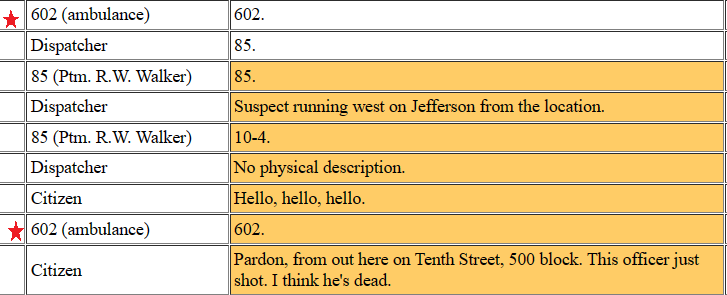


The bottom line is that all the key witnesses report the call being made before the body is removed and the tapes reveal nothing other than your own unsupported interpretation.
These two 602 calls are best explained by the ambulance driver, Butler. After realising it was a police officer lying in the street, Butler returned to his ambulance and tried to call in that the victim was a police officer but couldn't get through (because Callaway was in the process of making his call).
Butler's explanation can be found in this article:
https://kenrahn.com/JFK/History/WC_Period/Reactions_to_Warren_Report/Support_from_center/The_other_witnesses--Nashes.html

After reading through how you approached the mini-debate I do not expect any amount of evidence to change your mind about this aspect of the case and, to be quite frank, I couldn't care less. What I'd like to know is, what was the point of the mini-debate? Was it just about point-scoring over some trivial detail?

Online Bill Brown

  • Hero Member
  • *****
  • Posts: 2024
Re: T.F. Bowley, A Wind-Up Wristwatch & 1:17
« Reply #25 on: April 05, 2024, 11:00:08 PM »
According to Callaway, Tippit was loaded into the ambulance after he made the call.
According to Benevides, Tippit was loaded into the ambulance after Callaway made the call.
And it would appear that Scoggins testifies to the same thing:

Mr. Scoggins: And then I got out of the cab and run down there; the ambulance had already arrived by the time I got there, and they were in the process of picking the man up, and they had done had him, was putting him on the stretcher when I got there, and they put him in the ambulance and took him away, and there was someone that got on the radio at that time and they told him he was going to report it, so they told him to get off the air, that it had already been reported, and he picks up the officer's pistol that was laying on the ground, apparently fell out of his holster when he fell, and says, "Come on, let's go see if we can find him."

Mr. Belin: Mr. Scoggins, I started to ask you about the revolver of the policeman when you came and saw him. This was in his holster or on the street?
Mr. Scoggins: It was on the street whenever I saw it.
Mr. Belin: Do you know where it was with relation to the policeman's body?
Mr. Scoggins: It was there pretty close to his body, you know, like kind of under his body when they picked him up. It either fell out of his holster or was laying on the ground, one, I don't know which.
Mr. Belin: What did you see him do? This man came up and picked up the policeman's gun. He picked it up and said, "Let's go see if we can find him?"

Although he doesn't know Callaway's name Scoggins testifies to the same sequence - he makes the call, after which he picks up the pistol from where Tippit is still lying.

...the tapes do tell us when the ambulance was leaving the scene en route to Methodist Hospital.  The tapes tell us that the ambulance was leaving the scene as Callaway was making his report on the squad car radio.

This is simply not true. The tapes tell us no such thing. This is something you have completely made up.
Below is a copy of the relevant transcript of the tapes. The ambulance calls (602) are picked out with red stars.
Both calls are just the call numbers of the ambulance - 602
There is nothing else.
You have assigned your own meaning to them.


The bottom line is that all the key witnesses report the call being made before the body is removed and the tapes reveal nothing other than your own unsupported interpretation.
These two 602 calls are best explained by the ambulance driver, Butler. After realising it was a police officer lying in the street, Butler returned to his ambulance and tried to call in that the victim was a police officer but couldn't get through (because Callaway was in the process of making his call).
Butler's explanation can be found in this article:
https://kenrahn.com/JFK/History/WC_Period/Reactions_to_Warren_Report/Support_from_center/The_other_witnesses--Nashes.html

After reading through how you approached the mini-debate I do not expect any amount of evidence to change your mind about this aspect of the case and, to be quite frank, I couldn't care less. What I'd like to know is, what was the point of the mini-debate? Was it just about point-scoring over some trivial detail?


Dan, you're simply incorrect about Scoggins.  Read what he said again.

The police tapes obviously don't mention the body being loaded into the ambulance, but the tapes do tell us when the ambulance was leaving the scene en route to Methodist Hospital.  The tapes tell us that the ambulance was leaving the scene as Callaway was making his report on the squad car radio.

602 (ambulance):   602.       
Dispatcher:   85.       
85 (Ptm. R.W. Walker):   85.       
Dispatcher:   Suspect running west on Jefferson from the location.       
85 (Ptm. R.W. Walker):   10-4.       
Dispatcher:   No physical description.       
Citizen (Callaway):   Hello, hello, hello.       
602 (ambulance):   602.       
Citizen (Callaway):   Pardon, from out here on Tenth Street, 500 block. This officer just shot. I think he's dead.
Dispatcher:   10-4. We have that information. The citizen using the radio: Remain off the radio now.


That "602" was Butler attempting to let dispatch know that they were leaving the scene en route to the hospital.  However, he could not get through because Callaway is on the squad car radio reporting the incident (as the ambulance is speeding off).


After arriving on the scene in the ambulance, Butler and Kinsley rolled Tippit's body over (he was lying on his stomach) in order to place Tippit onto the stretcher..  Callaway noticed Tippit's service revolver lying on the street (it was underneath the body).  Callaway picked up the revolver and placed it on the hood of the patrol car and then helped Bowley, Butler and Kinsley load Tippit's body into the ambulance.

T.F. Bowley stated in his affidavit that once Tippit's body was loaded into the ambulance, he saw the service revolver lying on the hood of the patrol car (having been placed there moments earlier by Callaway).  Bowley picked up the revolver off of the hood and placed on the front seat of the patrol car.

"When the ambulance left, I took the gun and put it inside the squad car." -- T.F. Bowley (12/2/63 affidavit)

After making his report to the police dispatcher on the squad car radio, Callaway grabbed the service revolver from the front seat and proceeded to seek others to help him go off in search for the killer.

More evidence that Callaway helped load the body into the ambulance BEFORE he got on the police radio to report the shooting...

"And then I got out of the cab and run down there; the ambulance had
already arrived by the time I got there, and they were in the process
of picking the man up, and they had done had him, was putting him on
the stretcher when I got there, and they put him in the ambulance and
took him away, and there was someone that got on the radio at that
time and they told him he was going to report it, so they told him to
get off the air, that it had already been reported, and he picks up
the officer's pistol that was laying on the ground, apparently fell
out of his holster when he fell, and says, "Come on, let's go see if
we can find him."
-- WILLIAM SCOGGINS

The "someone that got on the radio" was Callaway and the "at that
time"
was once the ambulance "took him away".

Domingo Benavides said that Callaway got on the patrol car radio to report the shooting and the "officer" at the other end (the dispatcher) told Callaway that they already had that information and to stay off the air.  Benavides then said that Callaway grabbed the service revolver and said to Benavides that they should go chase the killer.  Benavides said he declined and added that Callaway then went over to the cab driver (Scoggins).

Online Dan O'meara

  • Hero Member
  • *****
  • Posts: 3774
Re: T.F. Bowley, A Wind-Up Wristwatch & 1:17
« Reply #26 on: April 05, 2024, 11:45:52 PM »

Dan, you're simply incorrect about Scoggins.  Read what he said again.

The police tapes obviously don't mention the body being loaded into the ambulance, but the tapes do tell us when the ambulance was leaving the scene en route to Methodist Hospital.  The tapes tell us that the ambulance was leaving the scene as Callaway was making his report on the squad car radio.

602 (ambulance):   602.       
Dispatcher:   85.       
85 (Ptm. R.W. Walker):   85.       
Dispatcher:   Suspect running west on Jefferson from the location.       
85 (Ptm. R.W. Walker):   10-4.       
Dispatcher:   No physical description.       
Citizen (Callaway):   Hello, hello, hello.       
602 (ambulance):   602.       
Citizen (Callaway):   Pardon, from out here on Tenth Street, 500 block. This officer just shot. I think he's dead.
Dispatcher:   10-4. We have that information. The citizen using the radio: Remain off the radio now.


That "602" was Butler attempting to let dispatch know that they were leaving the scene en route to the hospital.  However, he could not get through because Callaway is on the squad car radio reporting the incident (as the ambulance is speeding off).


After arriving on the scene in the ambulance, Butler and Kinsley rolled Tippit's body over (he was lying on his stomach) in order to place Tippit onto the stretcher..  Callaway noticed Tippit's service revolver lying on the street (it was underneath the body).  Callaway picked up the revolver and placed it on the hood of the patrol car and then helped Bowley, Butler and Kinsley load Tippit's body into the ambulance.

T.F. Bowley stated in his affidavit that once Tippit's body was loaded into the ambulance, he saw the service revolver lying on the hood of the patrol car (having been placed there moments earlier by Callaway).  Bowley picked up the revolver off of the hood and placed on the front seat of the patrol car.

"When the ambulance left, I took the gun and put it inside the squad car." -- T.F. Bowley (12/2/63 affidavit)

After making his report to the police dispatcher on the squad car radio, Callaway grabbed the service revolver from the front seat and proceeded to seek others to help him go off in search for the killer.

More evidence that Callaway helped load the body into the ambulance BEFORE he got on the police radio to report the shooting...

"And then I got out of the cab and run down there; the ambulance had
already arrived by the time I got there, and they were in the process
of picking the man up, and they had done had him, was putting him on
the stretcher when I got there, and they put him in the ambulance and
took him away, and there was someone that got on the radio at that
time and they told him he was going to report it, so they told him to
get off the air, that it had already been reported, and he picks up
the officer's pistol that was laying on the ground, apparently fell
out of his holster when he fell, and says, "Come on, let's go see if
we can find him."
-- WILLIAM SCOGGINS

The "someone that got on the radio" was Callaway and the "at that
time"
was once the ambulance "took him away".

Domingo Benavides said that Callaway got on the patrol car radio to report the shooting and the "officer" at the other end (the dispatcher) told Callaway that they already had that information and to stay off the air.  Benavides then said that Callaway grabbed the service revolver and said to Benavides that they should go chase the killer.  Benavides said he declined and added that Callaway then went over to the cab driver (Scoggins).

 ;)
As I said Bill, no amount of evidence was ever going to change you're mind.
A couple of things:
What was the point of the debate about Callaway? What difference does it make whether he called in before or after the body was removed?
When you write things like this - "That "602" was Butler attempting to let dispatch know that they were leaving the scene en route to the hospital." - do you know you're just making up what you believe it means? You do realise that you are just plucking this interpretation of what the "602" means out of thin air?

Online Dan O'meara

  • Hero Member
  • *****
  • Posts: 3774
Re: T.F. Bowley, A Wind-Up Wristwatch & 1:17
« Reply #27 on: April 05, 2024, 11:54:18 PM »
Examining the transcripts of the DPD tapes, there's something I find very unusual.
Between 12:54pm and 1:09pm on channel 2 there are hardly any transmissions:
Chism asks for a squad to pick up some blood.
Souter asks for info on JFK and JBC's condition.
And that's basically it.
More or less, for 15 minutes there appears to be radio silence.
I find this almost inconceivable.
Are there transmissions at this time that aren't recorded in the transcripts?

These are the transcripts I'm using:
https://www.jfk-assassination.net/dpdtapes/tapes2.htm

« Last Edit: April 06, 2024, 12:06:45 AM by Dan O'meara »