When Was JBC Hit?

Users Currently Browsing This Topic:
0 Members

Author Topic: When Was JBC Hit?  (Read 140668 times)

Online Charles Collins

  • Hero Member
  • *****
  • Posts: 4402
Re: When Was JBC Hit?
« Reply #126 on: May 02, 2024, 07:42:39 PM »
My point is that there is no evidence that he was not hit in the thigh earlier than the back strike.  There can be no assurance that he would have felt it. Even if you can imagine CE399 deflecting over to the left thigh from the wrist, the characteristics of the wound are not consistent with having been made by the missile that caused the wrist wound:
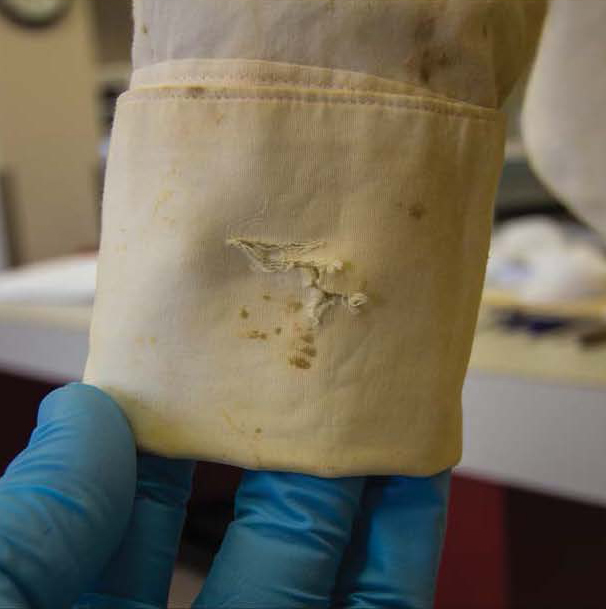
My point is that the damage to CE399 occurred after passing through JFK and was caused by striking the femur butt first. It is the SBT proponents who fantasize about a bullet striking JBC's rib in the back, butt-first, with enough force to break the rib near the spine, demolish 10 cm of rib, fracture the radius, deposit flakes of lead in the wrist, create an irregular tear in the sleeve and have only one impact point.
Right.  I didn't realize that JBC was a eunuch.


My point is that the damage to CE399 occurred after passing through JFK and was caused by striking the femur butt first.

If you think that the wound penetrated deep enough to strike the femur bone, then your idea is completely at odds with what the doctors who attended to JBC testified to.


Senator COOPER. I am just trying to remember whether we asked you, Doctor, if you probed the wound in the thigh to see how deep it was.
Dr. GREGORY. I did not, Senator. Dr. Tom Shires at our institution attended that wound, and I have his description to go on, what he found, what he had written, and his description is that it did not penetrate the thigh very deeply, just to the muscle, but not beyond that.


Online Andrew Mason

  • Hero Member
  • *****
  • Posts: 1650
    • SPMLaw
Re: When Was JBC Hit?
« Reply #127 on: May 02, 2024, 09:38:47 PM »

My point is that the damage to CE399 occurred after passing through JFK and was caused by striking the femur butt first.

If you think that the wound penetrated deep enough to strike the femur bone, then your idea is completely at odds with what the doctors who attended to JBC testified to.

Senator COOPER. I am just trying to remember whether we asked you, Doctor, if you probed the wound in the thigh to see how deep it was.
Dr. GREGORY. I did not, Senator. Dr. Tom Shires at our institution attended that wound, and I have his description to go on, what he found, what he had written, and his description is that it did not penetrate the thigh very deeply, just to the muscle, but not beyond that.
That was Dr. Gregory's understanding of Dr. Shires' understanding.  But Dr. Shires actually said what he understood and he said this:
    6H106:
    • Dr. SHIRES. The wound on the thigh was a peculiar one. There was a 1 cm.
      punctate missile wound over the junction of the middle and lower third of the leg
      and the medial aspect of the thigh. The peculiarity came in that the X-rays of
      the left leg showed only a very small 1 mm. bullet fragment embedded in the
      femur of the left leg. Upon exploration of this wound, the other peculiarity
      was that there was very little soft tissue damage, less than one would expect
      from an entrance wound of a centimeter in diameter, which was seen on the
      skin. So, it appeared, therefore, that the skin wound was either a tangential
      wound or that a larger fragment had penetrated or stopped in the skin and had
      subsequently fallen out of the entrance wound.
      Mr. SPECTER What size fragment was there in the Governor’s leg at that
      time?
      Dr. SHIRES. We recovered none. The small one that was seen was on X-my
      and it was still in the femur and being that small, with no tissue damage after
      the debridement, it was thought inadvisable to remove this small fragment.
      Mr. SPECTER. Is that fragment in the bone itself at the present time?
      Dr. SHIRES. Yes.
      Mr. SPECTER. What would your best estimate be as to the size of that fragment?
      Dr. SHIRES. One millimeter in diameter--one to two.

    He wrote in his medical report, CE392, 17H20, that the missile was seen to course through the subcutaneous fat and into the vestus medialis (the inner upper thigh muscle) leaving a fragment embedded in the femur:


    And here is the account of what he said 14 years later to the HSCA 7 HSCA 445:
    • He was open-minded about the
      possibility that the fragment could have been just under
      the skin, but preferred to reiterate his initial impressions
      that the fragment was in the thigh bone
      . Dr. Shires said
      that while they explored the entire track of the missile,
      they were not " . . .exploring it as a track . . ." ; rather they
      were " . . .exploring the wound looking for a big missile
      injury ." Dr . Shires said he found little hemorrhage, so
      he felt it was likely that a high velocity missile did not
      pass through the skin causing the wound".

    Online Charles Collins

    • Hero Member
    • *****
    • Posts: 4402
    Re: When Was JBC Hit?
    « Reply #128 on: May 02, 2024, 09:53:48 PM »
    That was Dr. Gregory's understanding of Dr. Shires' understanding.  But Dr. Shires actually said what he understood and he said this:
      6H106:
      • Dr. SHIRES. The wound on the thigh was a peculiar one. There was a 1 cm.
        punctate missile wound over the junction of the middle and lower third of the leg
        and the medial aspect of the thigh. The peculiarity came in that the X-rays of
        the left leg showed only a very small 1 mm. bullet fragment embedded in the
        femur of the left leg. Upon exploration of this wound, the other peculiarity
        was that there was very little soft tissue damage, less than one would expect
        from an entrance wound of a centimeter in diameter, which was seen on the
        skin. So, it appeared, therefore, that the skin wound was either a tangential
        wound or that a larger fragment had penetrated or stopped in the skin and had
        subsequently fallen out of the entrance wound.
        Mr. SPECTER What size fragment was there in the Governor’s leg at that
        time?
        Dr. SHIRES. We recovered none. The small one that was seen was on X-my
        and it was still in the femur and being that small, with no tissue damage after
        the debridement, it was thought inadvisable to remove this small fragment.
        Mr. SPECTER. Is that fragment in the bone itself at the present time?
        Dr. SHIRES. Yes.
        Mr. SPECTER. What would your best estimate be as to the size of that fragment?
        Dr. SHIRES. One millimeter in diameter--one to two.

      He wrote in his medical report, CE392, 17H20, that the missile was seen to course through the subcutaneous fat and into the vestus medialis (the inner upper thigh muscle) leaving a fragment embedded in the femur:


      And here is the account of what he said 14 years later to the HSCA 7 HSCA 445:
      • He was open-minded about the
        possibility that the fragment could have been just under
        the skin, but preferred to reiterate his initial impressions
        that the fragment was in the thigh bone
        . Dr. Shires said
        that while they explored the entire track of the missile,
        they were not " . . .exploring it as a track . . ." ; rather they
        were " . . .exploring the wound looking for a big missile
        injury ." Dr . Shires said he found little hemorrhage, so
        he felt it was likely that a high velocity missile did not
        pass through the skin causing the wound".


      It appears quite clear that, if there actually was anything in the femur, then it was only a very small fragment. No where does he indicate that anything the size of CE 399 penetrated deeper than what Dr. Gregory indicated.

      You indicated that the damage to CE 399 was caused by it striking the femur. How it that possible? It didn’t even come close to striking the femur. This is what I am saying.[/list]

      Online Andrew Mason

      • Hero Member
      • *****
      • Posts: 1650
        • SPMLaw
      Re: When Was JBC Hit?
      « Reply #129 on: May 02, 2024, 10:03:00 PM »
      So use a slope of 21 degrees relative to the car rail? OK. Can I also move Connally so he matches where he's at in the Zapruder film (ie:the Z193 I use in the graphic posted earlier).
      No. You can't use their positions at z223 either.  My point is to show that based on the first shot being between z190 and z200, and taking into account the range of uncertainty over relative positions of the two men, that there was a plausible clear straight line path from JFK's throat exit to JBC's left thigh.  So to demonstrate that I am batsh_t crazy, as you suggest, you have to show that for any position and posture of the men that is consistent with the photographic evidence at around z190-195 (I use z193 because it is the clearest) and within the range of uncertainty of the positions and posture of the two men, the trajectory from JFK's exit wound to JBC's left thigh cannot be direct ie. unobstructed by JBC's body parts that were clearly not struck.

      Online Andrew Mason

      • Hero Member
      • *****
      • Posts: 1650
        • SPMLaw
      Re: When Was JBC Hit?
      « Reply #130 on: May 02, 2024, 10:09:25 PM »

        It appears quite clear that, if there actually was anything in the femur, then it was only a very small fragment. No where does he indicate that anything the size of CE 399 penetrated deeper than what Dr. Gregory indicated.

        You indicated that the damage to CE 399 was caused by it striking the femur. How it that possible? It didn’t even come close to striking the femur. This is what I am saying.[/list]
        The only means by which a metal fragment could have been embedded in the femur, as Dr. Shires always maintained, would be from being deposited there by the butt end of CE399.  Dr. Gregory did not operate on the thigh wound.  He simply viewed it and thought it looked like it was made by the butt end of an intact missile e.g. the butt end of CE399.  Dr. Shires maintained that the bullet penetrated much deeper than you suggest ie. through the skin, fat layer and into the muscle and deposited a fragment in the femur.  It was also a tangential wound on an oblique strike in the direction of the femur toward the knee.  Pretty hard to fit that with a bullet coming from the right wrist.

        Online Charles Collins

        • Hero Member
        • *****
        • Posts: 4402
        Re: When Was JBC Hit?
        « Reply #131 on: May 02, 2024, 10:23:47 PM »
          The only means by which a metal fragment could have been embedded in the femur, as Dr. Shires always maintained, would be from being deposited there by the butt end of CE399.  Dr. Gregory did not operate on the thigh wound.  He simply viewed it and thought it looked like it was made by the butt end of an intact missile e.g. the butt end of CE399.  Dr. Shires maintained that the bullet penetrated much deeper than you suggest ie. through the skin, fat layer and into the muscle and deposited a fragment in the femur.  It was also a tangential wound on an oblique strike in the direction of the femur toward the knee.  Pretty hard to fit that with a bullet coming from the right wrist.

        The only means by which a metal fragment could have been embedded in the femur, as Dr. Shires always maintained, would be from being deposited there by the butt end of CE399.

        If a small fragment broke off due to impact with the thigh, that small fragment could possibly (in my opinion) penetrate through the muscle to the area of the bone. However, nothing either Doctor said indicates that CE 399 (or anything that large) penetrated to the bone. If fact they both said only to the muscle, no further. Again, your idea of the damage to CE 399 being caused by the femur bone is not supported by the evidence.[/list]

        Online Andrew Mason

        • Hero Member
        • *****
        • Posts: 1650
          • SPMLaw
        Re: When Was JBC Hit?
        « Reply #132 on: May 02, 2024, 11:39:07 PM »


        I use Z193 also, because it's the clearest frame in the area. I moved Connally as far to the right as he could go (in defiance of where he is actually seen in Z193 but where you think he is), twisted his torso as much as humanly possible and nothing about your Theory remotely works.

        Maybe you think there's some kind of Yoga gyrations and strange body contortions occurring out of sight. You think Connally's movements as he emerges from behind the sign and turns his body to face the side of the car are natural and merely out of concern for the President.

        You keep asking for things, without addressing why Connally doesn't match his position in Z193, if he's supposedly over against the side of the car, per your Theory. There is little I can do for you until you address the problems with your Theory demonstrated in my graphic. Have you considered a life-size reconstruction of the limousine interior and posing live models?
        You know I think very highly of your graphics skills, Jerry.  But your measurements are not quite accurate.  The key factor is the distance between the two men and that requires an accurate limo and placement of the seats.   I put the distance between JFK's exit wound and JBC's spine about 6-8 inches longer than you have it (30-32 inches).  I also have him a bit lower and a bit smaller head and possibly shoulders (40 cm between armpits) than you have shown.   Your model has JBC too far back.  He is behind the side window when in z193 his face is partly seen through the window.  You also still have the downward angle wrong and his thigh too low.