Oswald took 10.2 seconds to fire all three shots.

Users Currently Browsing This Topic:
0 Members

Author Topic: Oswald took 10.2 seconds to fire all three shots.  (Read 165369 times)

Online Charles Collins

  • Hero Member
  • *****
  • Posts: 4402
Re: Oswald took 10.2 seconds to fire all three shots.
« Reply #357 on: February 07, 2025, 06:09:51 PM »

Andrew, why are you quoting what Dale Myers wrote about a different portion (Houston Street) of the animation!!??   ???


First of all Dale Myers DOES provide some figures and does NOT essentially dismiss error. The following is part of what he indicates regarding potential error in the rotational positioning of the figures as they are seen in the Zapruder film on Elm Street. It seems to me that the distance inboard of JBC versus JFK would be subject to similar margins of error, or perhaps even smaller ones.


The ability to accurately position both men is directly related to the clarity of the original film. At the earliest portion of the Zapruder film, the limousine is at its farthest point from Zapruder's lens. The images of both JFK and JBC are very small in the frame and consequently distorted by film grain. As the limousine draws closer to the camera, they grow larger within the frame and therefore are distorted less by film grain.


From about Zapruder frame 240 through 360, the effect of film grain on the ability to position the occupants in the car accurately is negligible. At their farthest point from Zapruder's camera, it was possible to rotate both JFK and JBC up to 6-degrees in any direction without a perceivable mismatch with the original film. This amount of error dropped to about 4-degrees by Zapruder frame 190 and within 3-degrees by Zapruder frame 223. Therefore, the estimated margin of error lies between 3 and 6-degrees, depending on which point in the film is under discussion. The larger figure was used to calculate potential errors in plotting trajectories.

The clearest frames of the Zapruder film were sought for positioning JFK and JBC in order to minimize any errors. Key frame positions were generally placed at half-second intervals throughout the recreation, although tighter keying patterns (1-5 frame intervals) were employed during Zapruder frames 220-238, and 312-330.

The resulting animation was spot checked against the original Zapruder film to insure an accurate representation. Where "drifting" was detected, additional key frames were used to nail down the action.

It took six weeks to complete the key frame process, after which a test render was produced. The resulting animation was a computer generated "hand-held" version of the Zapruder film. In essence, the key frame process had created a motion file of Zapruder's camera in 3D space. Stepping through each frame of the animation revealed how Zapruder held his camera while trying to follow the limousine as it moved down Elm Street.


Dale Myers follows up regarding potential errors later on in his descriptions of the animation. Here are some of the figures that he describes:

There are a number of potential sources for error in plotting a trajectory using the method described above. The creation of the objects, positioning of those objects, and locating the wounds are all possible sources of statistical error. Despite the rigorous checks that were performed to minimize these errors, it is important to understand that statistical errors are inevitable. It is equally important to note that these errors are minimal and within margins anticipated with this type of recreation.

For instance, blueprints from the 1978 restoration project were used to construction the model of the Texas School Book Depository. Upon completion, the dimensions of the sixth floor sniper's nest window were checked against the actual window dimensions provided by officials from The Sixth Floor Museum at Dealey Plaza. The model was found to be within one inch of the actual dimensions. This shows the overall model to have a better than 99.9% accuracy level - well within tolerances for this project.

Because the construction of Dealey Plaza was based on survey maps, a high degree of accuracy was obtained, particularly in the creation of Elm Street - a crucial feature in establishing any assassination trajectory. The slope of the road, and its relationship to the Book Depository were among the many details available in the 1978 Drommer & Associates survey map. The Elm Street portion of the Dealey Plaza model shows a better than 99.4% accuracy level.

The positioning of the limousine is another potential source of error, although much less so than other sources. By matching the speed of the limousine model to the actual limousine seen in the Zapruder film, these potential errors are further reduced. The film's multiple frame count provides a "sample rate" that assures a close alignment. At any given frame, the limousine model is calculated to be within 4 inches of its real world counterpart. The error associated with this figure would be negligible on any trajectory analysis.

The greatest source of potential error lies in positioning the occupants in the limousine since their positions will determine the relationship of the entrance and exits wounds to the environment of Dealey Plaza, and hence, any plotted trajectory. Potential errors in establishing the correct relationship between the wounds and the environment can be depicted through the use of trajectory cones.


Several graphic illustrations and further descriptions of the trajectory cone can be found on this webpage.

https://www.jfkfiles.com/jfk/html/concl2b.htm


Online Andrew Mason

  • Hero Member
  • *****
  • Posts: 1650
    • SPMLaw
Re: Oswald took 10.2 seconds to fire all three shots.
« Reply #358 on: February 07, 2025, 10:21:25 PM »

Andrew, why are you quoting what Dale Myers wrote about a different portion (Houston Street) of the animation!!??   ???
Because that was the only place I could find where he commented on the relative horizontal positions of the two men.


Quote
First of all Dale Myers DOES provide some figures and does NOT essentially dismiss error. The following is part of what he indicates regarding potential error in the rotational positioning of the figures as they are seen in the Zapruder film on Elm Street. It seems to me that the distance inboard of JBC versus JFK would be subject to similar margins of error, or perhaps even smaller ones.
He is not talking about the error in the inboard distance between the two men. He is talking about the angle of rotation of each of the two men in their seats.  This is really inconsequential.   The difference in horizontal position of JBC's right armpit between facing car forward and facing 10 degrees to the right is negligible:  If the armpit wound is 20 cm from the spine (6 HSCA 48) a turn of 10 degrees to the right moves the wound left by 20(1-cos(10))=.3 cm or 3 mm.  A turn of 3 degrees moves it .02 cm or .2 mm.  That cannot be the error in the horizontal placement of JBC relative to JFK.

Myers does not give us the relative vertical or horizontal distances between the neck exit wound on JFK and the right armpit entrance wound on JBC.  We are just supposed to accept his animation as accurate without being able to check it.  If  I have missed it somewhere, please point it out to me.

[Note: Myers cannot be talking about the range of the angle that the two men could occupy relative to Zapruder while still fitting the positions seen in the Zapruder frames from z190 to z223.  If that was the case, the distance would be huge: a 3 degree angle represents 1/120th of the circumference of a circle of radius equal to the distance from JBC to Zapruder at z190. That distance is about 120 feet.  So a 3 degree angle subtends an arc of 2pi(120)/120=6.28 feet!!!]


Online Charles Collins

  • Hero Member
  • *****
  • Posts: 4402
Re: Oswald took 10.2 seconds to fire all three shots.
« Reply #359 on: February 08, 2025, 12:14:08 AM »
Because that was the only place I could find where he commented on the relative horizontal positions of the two men.

He is not talking about the error in the inboard distance between the two men. He is talking about the angle of rotation of each of the two men in their seats.  This is really inconsequential.   The difference in horizontal position of JBC's right armpit between facing car forward and facing 10 degrees to the right is negligible:  If the armpit wound is 20 cm from the spine (6 HSCA 48) a turn of 10 degrees to the right moves the wound left by 20(1-cos(10))=.3 cm or 3 mm.  A turn of 3 degrees moves it .02 cm or .2 mm.  That cannot be the error in the horizontal placement of JBC relative to JFK.

Myers does not give us the relative vertical or horizontal distances between the neck exit wound on JFK and the right armpit entrance wound on JBC.  We are just supposed to accept his animation as accurate without being able to check it.  If  I have missed it somewhere, please point it out to me.

[Note: Myers cannot be talking about the range of the angle that the two men could occupy relative to Zapruder while still fitting the positions seen in the Zapruder frames from z190 to z223.  If that was the case, the distance would be huge: a 3 degree angle represents 1/120th of the circumference of a circle of radius equal to the distance from JBC to Zapruder at z190. That distance is about 120 feet.  So a 3 degree angle subtends an arc of 2pi(120)/120=6.28 feet!!!]


Because that was the only place I could find where he commented on the relative horizontal positions of the two men.

So, if I understand you correctly, you believe that Dale Myers is commenting on the relative horizontal positions of the two men in the following passage.

The large, and often overlapping, still and motion picture record of the motorcade between Main and Houston Streets and the point at which Zapruder began filming, provided an accurate and definitive record of the positions of JFK and JBC during this pre-shooting portion of the recreation.


However, you do not believe that Dale Myers is commenting on the relative horizontal positions of the two men in the following passage in the Key Framing section.

The film is returned to the first frame showing the president and the same process used to match the limousine to the film is used to position President Kennedy (JFK) and Governor John B. Connally (JBC).

https://www.jfkfiles.com/jfk/html/kframe.htm#errors

Am I understanding your opinion correctly?

Online Andrew Mason

  • Hero Member
  • *****
  • Posts: 1650
    • SPMLaw
Re: Oswald took 10.2 seconds to fire all three shots.
« Reply #360 on: February 08, 2025, 04:07:32 AM »
Plus-or-minus two frames, in which Zapruder frame, be it hypothetical (i.e., before Z-133) or actual (i.e., Z-133-on) do you think the first shot was fired?
I can only tell you what the evidence says. The evidence is that JFK reacted visibly to the first shot by moving left and/or clutching at his upper chest, and/or slumping, and /or assuming a blank look..

According to Phil Willis was an instant before he took his photo which was at z202.  According to Croft it was after his z161 photo. Croft said he has m d enough time to wind his camera and click the shutter again at the moment of the smfirst shot. According to Hugh Betzner it was just after he took his z186 photo. According to the occupants of the VP car I they had just completed the turn onto Elm. It is still turning when last seen at z181. According to Mary Woodward it was just after the President passed by where she was standing (3 feet past the lamppost near the Thornton Freeway sign).

So, if one puts that altogether, and it is all consistent, the first shot was somewhere between z186 and z202.  It may be around z193 based on the change in JFK that appears to begin there.

Online Tom Graves

  • Hero Member
  • *****
  • Posts: 3495
Re: Oswald took 10.2 seconds to fire all three shots.
« Reply #361 on: February 08, 2025, 06:47:54 AM »
I can only tell you what the evidence says. The evidence is that JFK reacted visibly to the first shot by moving left and/or clutching at his upper chest, and/or slumping, and /or assuming a blank look..

According to Phil Willis, [there] was an instant before he took his photo which was at z202.  According to Croft it was after his z161 photo. Croft said he has m d enough time to wind his camera and click the shutter again at the moment of the smfirst shot. According to Hugh Betzner it was just after he took his z186 photo. According to the occupants of the VP car I they had just completed the turn onto Elm. It is still turning when last seen at z181. According to Mary Woodward it was just after the President passed by where she was standing (3 feet past the lamppost near the Thornton Freeway sign).

So, if one puts that altogether, and it is all consistent, the first shot was somewhere between z186 and z202.  It may be around z193 based on the change in JFK that appears to begin there.

In my humble opinion you're full of high-fructose beans.

Question: How many shots do you think were fired altogether, and how many (if any) were fired from the sixth floor Sniper's Nest?
« Last Edit: February 08, 2025, 08:10:11 AM by Tom Mahon »

Online Charles Collins

  • Hero Member
  • *****
  • Posts: 4402
Re: Oswald took 10.2 seconds to fire all three shots.
« Reply #362 on: February 08, 2025, 10:55:29 AM »
Because that was the only place I could find where he commented on the relative horizontal positions of the two men.

He is not talking about the error in the inboard distance between the two men. He is talking about the angle of rotation of each of the two men in their seats.  This is really inconsequential.   The difference in horizontal position of JBC's right armpit between facing car forward and facing 10 degrees to the right is negligible:  If the armpit wound is 20 cm from the spine (6 HSCA 48) a turn of 10 degrees to the right moves the wound left by 20(1-cos(10))=.3 cm or 3 mm.  A turn of 3 degrees moves it .02 cm or .2 mm.  That cannot be the error in the horizontal placement of JBC relative to JFK.

Myers does not give us the relative vertical or horizontal distances between the neck exit wound on JFK and the right armpit entrance wound on JBC.  We are just supposed to accept his animation as accurate without being able to check it.  If  I have missed it somewhere, please point it out to me.

[Note: Myers cannot be talking about the range of the angle that the two men could occupy relative to Zapruder while still fitting the positions seen in the Zapruder frames from z190 to z223.  If that was the case, the distance would be huge: a 3 degree angle represents 1/120th of the circumference of a circle of radius equal to the distance from JBC to Zapruder at z190. That distance is about 120 feet.  So a 3 degree angle subtends an arc of 2pi(120)/120=6.28 feet!!!]


We are just supposed to accept his animation as accurate without being able to check it.  If  I have missed it somewhere, please point it out to me.


Andrew, Dale Myers gives us detailed descriptions of how he created his animation. It seems to me that the best way to check his work would be to follow in his footsteps and create your own computer model and animation.


Online Andrew Mason

  • Hero Member
  • *****
  • Posts: 1650
    • SPMLaw
Re: Oswald took 10.2 seconds to fire all three shots.
« Reply #363 on: February 08, 2025, 06:38:36 PM »
In my humble opinion you're full of high-fructose beans.
All I have done is point out the evidence.

Quote
Question: How many shots do you think were fired altogether, and how many (if any) were fired from the sixth floor Sniper's Nest?
Again, I can only refer you to the evidence. Here is the distribution of witness recollections as to the number of shots:
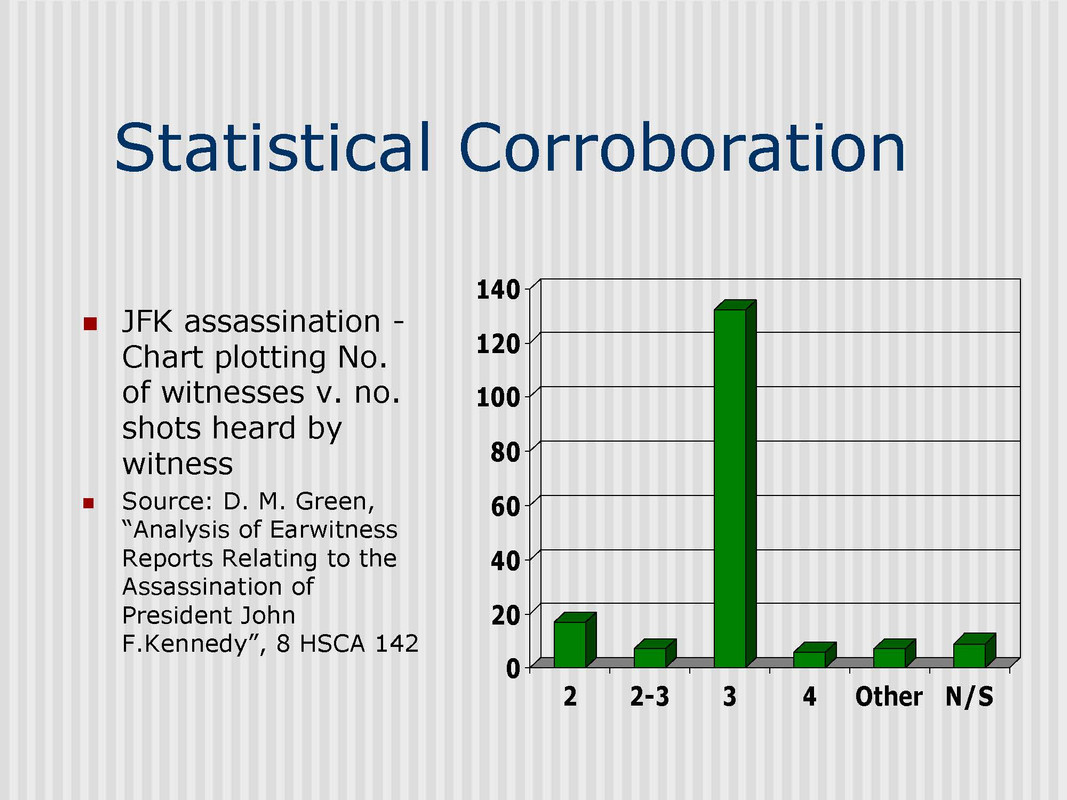

The possibility that the sample mean (3 shots) differs from the actual number is practically zero. This is further corroborated by the physical evidence of shells found (three).

To determine where the shots originated one has to look at all the evidence. When one does that, there is convergence on all shots coming from the same location.

The location is identified by direct observation by witnesses who saw the rifle in the window, by the three witnesses on the fifth floor who heard the shots coming from directly above them, and by the physical evidence found on the sixth floor.