Oswald took 10.2 seconds to fire all three shots.

Users Currently Browsing This Topic:
0 Members

Author Topic: Oswald took 10.2 seconds to fire all three shots.  (Read 165368 times)

Online Charles Collins

  • Hero Member
  • *****
  • Posts: 4402
Re: Oswald took 10.2 seconds to fire all three shots.
« Reply #350 on: February 06, 2025, 12:29:18 PM »
The margin of error comes in when Myers purports to make ridiculously accurate measurements such as this (on page 171 of his PDF version of "Epipolar Geometric Analysis of Amateur Films Related to Acoustics Evidence in the John F. Kennedy Assassination"):

  • "The true position of Camera Car 1 was determined by using computer models to align a model
    of the 17.5 foot long 1964 Chevrolet Impala with Hughes’ field-of-view. The result shows the
    right rear bumper of Camera Car 1 is 2.95 feet north of, and 0.66 feet west of the line-of-sight
    drawn between the Hughes’ camera and the northwest corner of the Records Building; not
    on the line of sight as Thomas reported."

First of all, there is some margin of error in the placement of Hughes' camera in the middle of the intersection (*1) and the exact line of sight to the corner of the building. Then there is the error in the model of Dealey Plaza and the car model that he used.  Then there is the inaccuracy in plotting an exact position of everything in the grainy Hughes film. There has to be some uncertainty in "2.95 feet north and .66 feet east".  Myers admits of none.

Myers then concludes (p. 171):
  • "When correctly scaled computer models of Camera Car 1 are aligned to Hughes frame H633
    and Zapruder frame Z220, the distance between those two exposures was determined to be
    59.8 feet; not 73 feet as reported by Thomas."

Keep in mind that he is trying to compare the difference in position of Camera Car #1 around this Hughes frame:
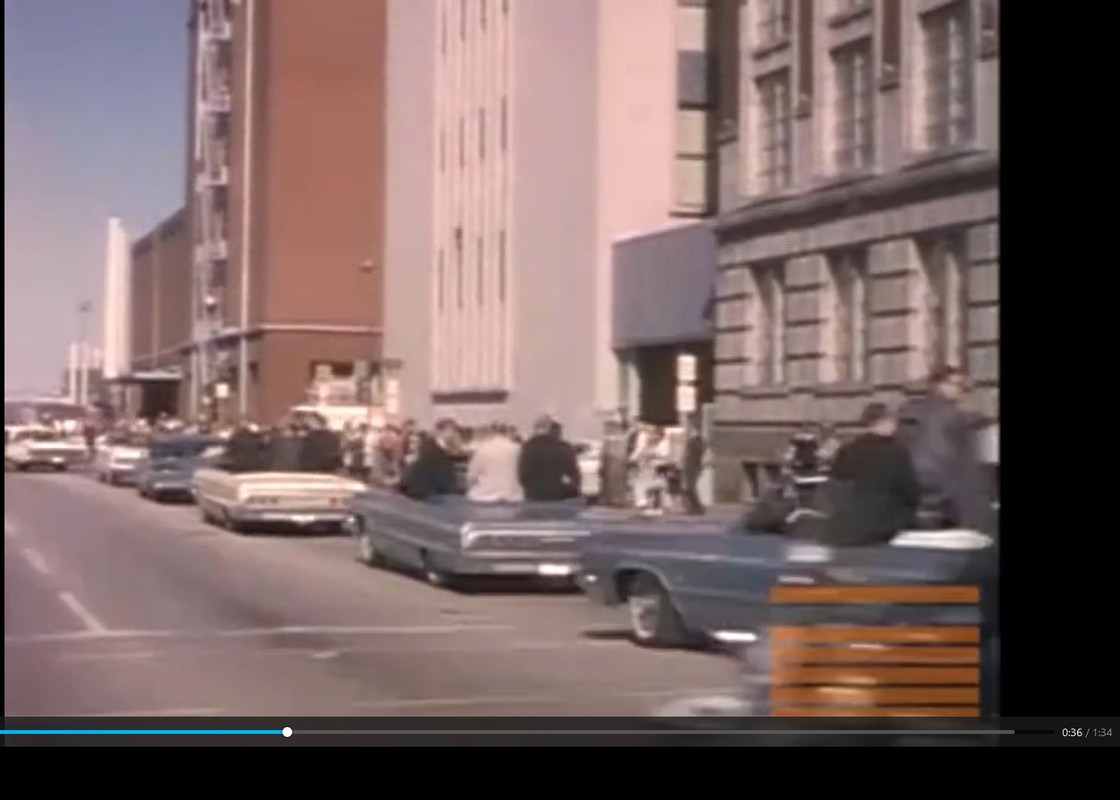

to its position in Z220:
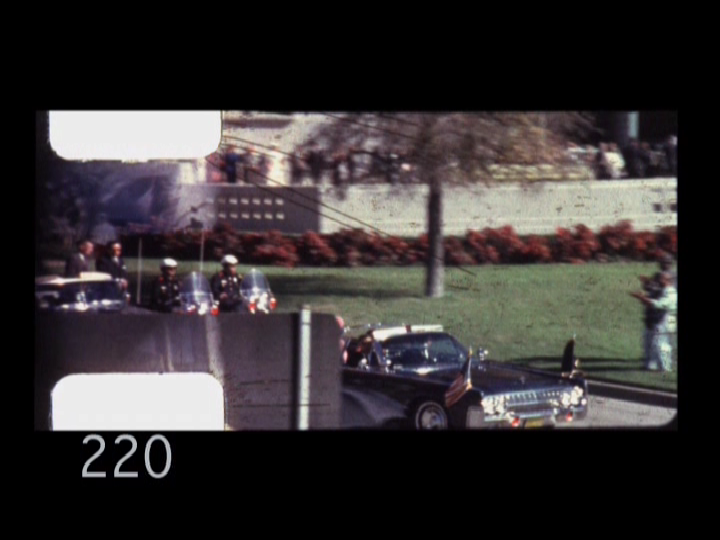

and this is his conclusion:
"Considering that the known speed prior to Hughes frame H633 was 11.83 ft/sec (8.1 mph) and
the known speed at Zapruder frame Z220 was 13.89 feet/sec (9.5 mph), it was determined that
Camera Car 1 was traveling at an average speed of 12.86 feet/sec (8.8 mph) and therefore
traversed the 59.8 foot distance between Hughes frame H633 and Zapruder frame Z220 in
4.65 seconds; not the 6.2 to 8.3 second guesstimate ventured by Thomas".

To suggest that it is 4.65 seconds and could not be 4.5 or 5.0 seconds he needs to give us a reasonable estimate of the total possible error in all the measurements he uses to reach that conclusion.  He admits of none.

*1 Here is what Myers wrote in footnote 198 page 171:
  • 198. Thomas reported that Robert Hughes’ precise location at the time that he filmed the motorcade is “not known” and that his best
    estimate based on examining his film and a photograph taken by Charles Bronson is that Hughes was standing 8 feet south of the center
    line of Main Street and 14 feet west of the center line of Houston Street. Thomas’s positioning of the Hughes camera is essentially correct.
    Using computers to align the Hughes’ camera field of view with computer models of Dealey Plaza, I pinpointed Hughes’ location as 8.83
    feet south of the center line of Main Street and 15.5 feet west of the center line of Houston Street.


Dale Myers gives us a lot of information that is generated by a computer and based on his model of Dealey Plaza. As we learned back in 1968 from the movie “2001: A Space Odyssey” computers don’t make errors….  ;)

Dale Myers tells us some information about how he made his computer model of Dealey Plaza. Professional surveys, professional building construction plans, lots of personal measurements & photos, lots of trips to Dealey Plaza, lots of photos from 1963, several years of work, etc. I have a cheap laser distance meter. It has a specified range of 60-meters and a specified accuracy of +/- 1.5-millimeters. Given the time frame that Dale Myers worked on the model, and the fact that laser distance meters became available about 1993, I would assume that he probably utilized one for many of his measurements.

Dale Myers tells us that his purpose for this film synchronization project is to refute the HSCA’s acoustical study’s conclusions. He tells us that an error margin of +/- one frame is his goal and is considered (for this project) to be in sync. He verifies most of his findings with alternates. For example, here is a portion of his table of contents:

APPENDIX I: FIVE ADDITIONAL REFERENCE POINTS COMMON TO THE
ZAPRUDER AND HUGHES FILMS CONFIRM THE VALIDITY OF SYNCHRONIZING
HUGHES FRAME H648 TO ZAPRUDER FRAME Z150

(SEC-1) The trajectory and speed of the presidential limousine as depicted in the Tina
Towner film is consistent with Hughes frame H648 synchronizing to Zapruder frame

(SEC-2) The trajectory and speed of the Camera Car 1 (the tenth car in the motorcade) as
depicted in the Robert Hughes film is consistent with Hughes frame H648 synchronizing
to Zapruder frame Z150.

(SEC-3) The trajectory and speed of the Camera Car 2 (the eleventh car in the
motorcade) as depicted in the Robert Hughes film is consistent with Hughes frame
H648 synchronizing to Zapruder frame Z150.

(SEC-4) The trajectory and speed of the Dallas police officer Marion L. Baker’s
motorcycle as depicted in the Robert Hughes and Abraham Zapruder films is
consistent with Hughes frame H648 synchronizing to Zapruder frame Z150.
Secrets of a Homicide: The JFK Assassination - Epipolar Geometric Analysis of Amateur Films Related to
Acoustics Evidence in the John F. Kennedy Assassination by Dale K. Myers / © 2007 Dale K. Myers / REPORT
5

(SEC-5) The trajectory and speed of eyewitness Rosemary Willis as depicted in the
Elsie Dorman, Mark Bell, John Martin, and Abraham Zapruder films is consistent with
Hughes frame H648 synchronizing to Zapruder frame Z150.


Go to each section to read all the details.

Personally it appears to me that Dale Myers has done an outstanding job. You entered this discussion with the notion that Dale Myers had the beginning of the Wiegman film out of sync with the others. I think we have seen that the issue is a matter of Dale Myers using the original film versus a more commonly available edited copy. Not an error by Dale Myers, but actually a more accurate depiction of what actually happened (due to Dale Myers’ thoroughness). That bodes well for my confidence level in his works. 

You are entitled to your own opinions of course. But your argument reminds me of Iacoletti’s refusal to believe that there has ever been any evidence of anything…. 


Offline John Iacoletti

  • Hero Member
  • *****
  • Posts: 11351
Re: Oswald took 10.2 seconds to fire all three shots.
« Reply #351 on: February 06, 2025, 09:13:19 PM »
You are entitled to your own opinions of course. But your argument reminds me of Iacoletti’s refusal to believe that there has ever been any evidence of anything….

Nice strawman, Charles.  Next?

Myers further displays his ridiculous grasp of significant digits by claiming that Tippit was shot at precisely 1:14:30 pm.  I'm surprised he didn't say how many milliseconds.

Online Tom Graves

  • Hero Member
  • *****
  • Posts: 3495
Re: Oswald took 10.2 seconds to fire all three shots.
« Reply #352 on: February 06, 2025, 10:02:07 PM »
Myers further displays his ridiculous grasp of significant digits by claiming that Tippit was shot at precisely 1:14:30 pm.  I'm surprised he didn't say how many milliseconds.

Yet you would have criticized him if he'd had the gosh-darned gall to say "between 1:14 and 1:15."

LOL!
« Last Edit: February 07, 2025, 04:18:41 AM by Tom Mahon »

Online Charles Collins

  • Hero Member
  • *****
  • Posts: 4402
Re: Oswald took 10.2 seconds to fire all three shots.
« Reply #353 on: February 06, 2025, 11:29:08 PM »
Nice strawman, Charles.  Next?

Myers further displays his ridiculous grasp of significant digits by claiming that Tippit was shot at precisely 1:14:30 pm.  I'm surprised he didn't say how many milliseconds.


Myers does explain in detail how he arrived at the figures (similar to as he does in the film synchronization documentation). Andrew Mason thought he had found a significant error with the Wiegman film sync. But as we have seen the difference was due to Myers’ thoroughness.

Online Andrew Mason

  • Hero Member
  • *****
  • Posts: 1650
    • SPMLaw
Re: Oswald took 10.2 seconds to fire all three shots.
« Reply #354 on: February 07, 2025, 04:01:39 AM »
.

Personally it appears to me that Dale Myers has done an outstanding job. You entered this discussion with the notion that Dale Myers had the beginning of the Wiegman film out of sync with the others. I think we have seen that the issue is a matter of Dale Myers using the original film versus a more commonly available edited copy. Not an error by Dale Myers, but actually a more accurate depiction of what actually happened (due to Dale Myers’ thoroughness). That bodes well for my confidence level in his works. 

You are entitled to your own opinions of course. But your argument reminds me of Iacoletti’s refusal to believe that there has ever been any evidence of anything….
Myers has done a creditable job and is very skilled at animation techniques.  I am just saying that he is overstating the accuracy of his conclusions and does not provide details that are needed in order to check his results. 

My main concern with Myers is with his portrayal of the SBT which involves the accuracy of his placements of the two men in the car as it passed down Elm St. He is using the same zfilm frames to do this that Itek used for their HSCA analysis.  But Itek was careful to provide an error range. Itek concluded that Connally was between 4.5 and 7.5 inches inboard of JFK. (6” ± 1.5”).  Myers doesn’t provide a figure and essentially dismisses error. He says that he lined them up based on the zfilm and the implication is that the error was negligible:
  • “The large, and often overlapping, still and motion picture record of the motorcade between Main and Houston Streets and the point at which Zapruder began filming, provided an accurate and definitive record of the positions of JFK and JBC during this pre-shooting portion of the recreation.”
« Last Edit: February 07, 2025, 04:06:55 AM by Andrew Mason »

Online Tom Graves

  • Hero Member
  • *****
  • Posts: 3495
Re: Oswald took 10.2 seconds to fire all three shots.
« Reply #355 on: February 07, 2025, 04:16:14 AM »
Myers has done a creditable job and is very skilled at animation techniques.  I am just saying that he is overstating the accuracy of his conclusions and does not provide details that are needed in order to check his results. 

My main concern with Myers is with his portrayal of the SBT which involves the accuracy of his placements of the two men in the car as it passed down Elm St. He is using the same zfilm frames to do this that Itek used for their HSCA analysis.  But Itek was careful to provide an error range. Itek concluded that Connally was between 4.5 and 7.5 inches inboard of JFK. (6” ± 1.5”).  Myers doesn’t provide a figure and essentially dismisses error. He says that he lined them up based on the zfilm and the implication is that the error was negligible:
  • “The large, and often overlapping, still and motion picture record of the motorcade between Main and Houston Streets and the point at which Zapruder began filming, provided an accurate and definitive record of the positions of JFK and JBC during this pre-shooting portion of the recreation.”

Plus-or-minus two frames, in which Zapruder frame, be it hypothetical (i.e., before Z-133) or actual (i.e., Z-133-on) do you think the first shot was fired?
« Last Edit: February 07, 2025, 07:37:11 PM by Tom Mahon »

Online Charles Collins

  • Hero Member
  • *****
  • Posts: 4402
Re: Oswald took 10.2 seconds to fire all three shots.
« Reply #356 on: February 07, 2025, 01:18:12 PM »
Myers has done a creditable job and is very skilled at animation techniques.  I am just saying that he is overstating the accuracy of his conclusions and does not provide details that are needed in order to check his results. 

My main concern with Myers is with his portrayal of the SBT which involves the accuracy of his placements of the two men in the car as it passed down Elm St. He is using the same zfilm frames to do this that Itek used for their HSCA analysis.  But Itek was careful to provide an error range. Itek concluded that Connally was between 4.5 and 7.5 inches inboard of JFK. (6” ± 1.5”).  Myers doesn’t provide a figure and essentially dismisses error. He says that he lined them up based on the zfilm and the implication is that the error was negligible:
  • “The large, and often overlapping, still and motion picture record of the motorcade between Main and Houston Streets and the point at which Zapruder began filming, provided an accurate and definitive record of the positions of JFK and JBC during this pre-shooting portion of the recreation.”


Andrew, why are you quoting what Dale Myers wrote about a different portion (Houston Street) of the animation!!??   ???


First of all Dale Myers DOES provide some figures and does NOT essentially dismiss error. The following is part of what he indicates regarding potential error in the rotational positioning of the figures as they are seen in the Zapruder film on Elm Street. It seems to me that the distance inboard of JBC versus JFK would be subject to similar margins of error, or perhaps even smaller ones.


The ability to accurately position both men is directly related to the clarity of the original film. At the earliest portion of the Zapruder film, the limousine is at its farthest point from Zapruder's lens. The images of both JFK and JBC are very small in the frame and consequently distorted by film grain. As the limousine draws closer to the camera, they grow larger within the frame and therefore are distorted less by film grain.


From about Zapruder frame 240 through 360, the effect of film grain on the ability to position the occupants in the car accurately is negligible. At their farthest point from Zapruder's camera, it was possible to rotate both JFK and JBC up to 6-degrees in any direction without a perceivable mismatch with the original film. This amount of error dropped to about 4-degrees by Zapruder frame 190 and within 3-degrees by Zapruder frame 223. Therefore, the estimated margin of error lies between 3 and 6-degrees, depending on which point in the film is under discussion. The larger figure was used to calculate potential errors in plotting trajectories.

The clearest frames of the Zapruder film were sought for positioning JFK and JBC in order to minimize any errors. Key frame positions were generally placed at half-second intervals throughout the recreation, although tighter keying patterns (1-5 frame intervals) were employed during Zapruder frames 220-238, and 312-330.

The resulting animation was spot checked against the original Zapruder film to insure an accurate representation. Where "drifting" was detected, additional key frames were used to nail down the action.

It took six weeks to complete the key frame process, after which a test render was produced. The resulting animation was a computer generated "hand-held" version of the Zapruder film. In essence, the key frame process had created a motion file of Zapruder's camera in 3D space. Stepping through each frame of the animation revealed how Zapruder held his camera while trying to follow the limousine as it moved down Elm Street.
« Last Edit: February 07, 2025, 01:31:17 PM by Charles Collins »