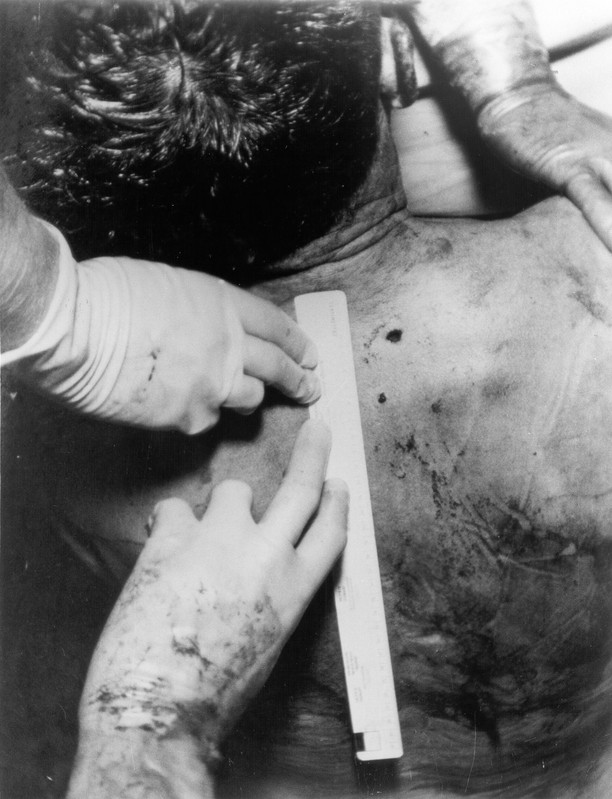
Commander HUMES - The wound in the low neck of which I had previously begun to speak is now posteriorly--is now depicted in 385, in 386 and in 388.
....
Commander HUMES - You will note that the wound in the posterior portion of the occiput on Exhibit 388 is somewhat longer than the other missile wound which we have not yet discussed in the low neck.
.....
Commander HUMES - I--our previously submitted report, which is Commission No. 387, identified a wound in the low posterior neck of the President.
.....
Commander HUMES - In attempting to relate findings within the President's body to this wound which we had observed low in his neck, we then opened his chest cavity, and we very carefully examined the lining of his chest cavity and both of his lungs.
.....
Commander HUMES - The angle which we observed in measuring, in comparing the point of entrance, our point of entrance labeled "C" on 385 and "D" point of exit is one that the point of exit is below the point of entrance compared with the vertical.
.....
Commander HUMES - The report which we have submitted, sir, represents our thinking within the 24-48 hours of the death of the President, all facts taken into account of the situation.
The wound in the anterior portion of the lower neck is physically lower than the point of entrance posteriorly, sir.
==============
Mr. SPECTER - Have you been present here today during the entire course of Doctor Humes testimony?
Commander BOSWELL - I have, sir; yes.
Mr. SPECTER - Do you have anything that you would like to add by way of elaboration or modification to that which Doctor Humes has testified?
Commander BOSWELL - None, I believe. Doctor Humes has stated essentially what is the culmination of our examination and our subsequent conference, and everything is exactly as we had determined our conclusions.
Mr. SPECTER - And are you one of the three coauthors of the autopsy report which has been previously identified as a Commission Exhibit?
Commander BOSWELL - Yes; I am.
Mr. SPECTER - All the facts set forth therein are correct in accordance with your analysis and evaluation of the situation?
Commander BOSWELL - Yes.
Mr. SPECTER - And specifically, as to the points of entry and points of exit which have been testified to by Doctor Humes, do his views express yours as well?
Commander BOSWELL - They do, yes.
==============
Mr. SPECTER - Were you present here today and did you hear the entire testimony of Doctor Humes?
Colonel FINCK - Yes; I did.
Mr. SPECTER - And do you concur in Dr. Humes' statements and opinions regarding the point of entry C, point of exit D, and general angle on the flight of the missile?
Colonel FINCK - I certainly do.
==========
"This wound is located approximately at the point where the bullet would be expected to exit, given the nature of the entrance wound in the upper right back and the damage to the transverse process of the lower cervical and first thoracic vertebras, which are situated on a line between the entrance and exit points."- HSCA Volume VII, page 175
That may be why they said this:
"the entrance perforation is medial to the scapula and superior to the ribs." - HSCA Volume VII, page 87
T1 being the uppermost vertebra for the ribs.
And there's this from the HSCA photographic analysis panel:
168. "the evidence indicates that the bullet passed near, but did not strike, the right lateral processes of the seventh cervical and first thoracic vertebrae (nor any other bony matter) (59)"- HSCA Volume VI, page 56
(59) sources paragraphs 272-289 of the FPP report.
================
The midpoint is estimated to be 13.5 centimeters below the right mastoid process, with the head and neck, as positioned within the photograph, 6 cm below the most prominent neck crease and 5 cm below the upper shoulder margin. - HSCA Volume VII, page 85
------
"There is an elliptical penetrating wound of the skin of the back located approximately 15 cm. medial to the right acromial process, 5 cm. lateral to the mid-dorsal line and 14 cm. below the right mastoid process. This wound lies approximately 5.5 cm. below a transverse fold in the skin of the neck."- Clark Panel
===========
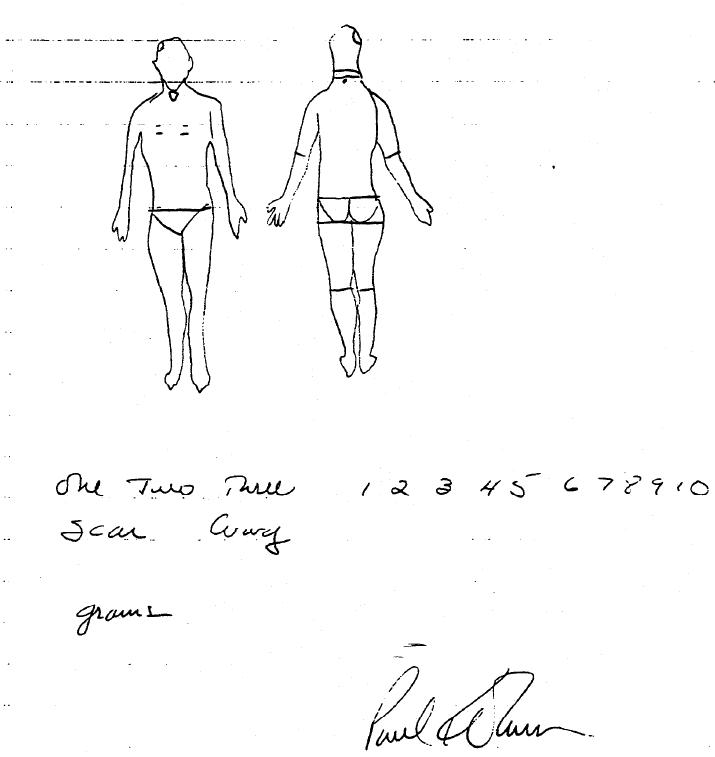
"back in the neck...just above C7". - Paul O'Connor, HSCA interview
Sorry, but the words of Hume and his drawings do not match the autopsy photo. Just no way that hole seen in the autopsy photo is above the shoulder line and as close to the folds of the neck as depicted in the drawing. I don’t give this guy much credibility if he burned his notes. He was selected over other more qualified and experienced people and that in itself is suspicious.

