As most JFK researchers know, the “Walker Bullet,” or CE 573, was purportedly extracted from the home of General Edwin Walker on April 10, 1963, and was contemporaneously described in official Dallas Police Department (DPD) reports as “steel jacketed.”
Someone had taken a potshot at Walker that night, through the window on the rear side of his house, in front of which the General was seated. Or so Walker had related to the DPD that night.
Not one, but rather two, DPD detectives, by the names of Ira Van Cleave and Don E. McElroy, put their signatures on a General Offense Report, and authored and signed a Supplementary Offense Report on April 10.
In the Supplementary Offense Report, both detectives observed “a bullet of unknown caliber,
steel jacket, had been shot through the window” at Walker’s home, as the General sat his desk.[1]
Two DPD patrolmen, B.G. Norvell and J.P. Tucker authored the General Offense Report, which also identified the Walker Bullet as a “steel jacketed bullet.” DPD officers had held the Walker Bullet that night in their hands, and inscribed initials into it, as did a Lt. Day of the DPD a day later, according to official reports.
Months later, the Warren Commission (WC) would conclude it was Lee Harvey Oswald (LHO) who shot at and attempted to murder Walker that night. The WC reached that conclusion after the FBI said the Walker Bullet, or CE 573, was in fact the same type of Western-brand ammo that LHO used in his Mannlicher-Carcano rifle.
Of course, the problem is the Walker Bullet in the possession of the Warren Commission, CE 573, is
copper jacketed, and obviously so.
CE 573, whatever its true origins, is a severely mangled bullet; so much so that its copper-jacketing has been torn asunder. Thus any observer, even a layman, can easily see the copper jacket is in fact copper through-and-through, and not a relatively uncommon steel-jacketed bullet with copper-gilding. It would not be surprising if a photo of CE 573 is used in police-cadet training courses somewhere as a classic example of a copper-jacketed bullet.
Moreover, there are initials carved into CE 573, though of mysterious origin. Anyone carving initials into a copper-jacketed bullet would immediately know it was copper-jacketed, and not steel-jacketed, as copper is softer than steel.
In addition, anyone carving initials into a copper-gilded steel jacketed bullet would notice the steel color and hardness emerging from under the microscopically thin copper gilding. It is inexplicable that even one big-city police detective would describe CE 573 as “steel-jacketed.”
But two DPD detectives and two DPD patrolman authored and signed brief one-page reports prominently describing the Walker Bullet as exactly that, “steel jacketed”—after having handled the slug and marking it with their initials.
---30---
Here is a photo of the CE-573, the bullet that the WC says that the FBI says is the bullet that was retrieved from Walker's residence April 10 1963. Remember, the WC had to rely on the FBI for investigative work, and much else.
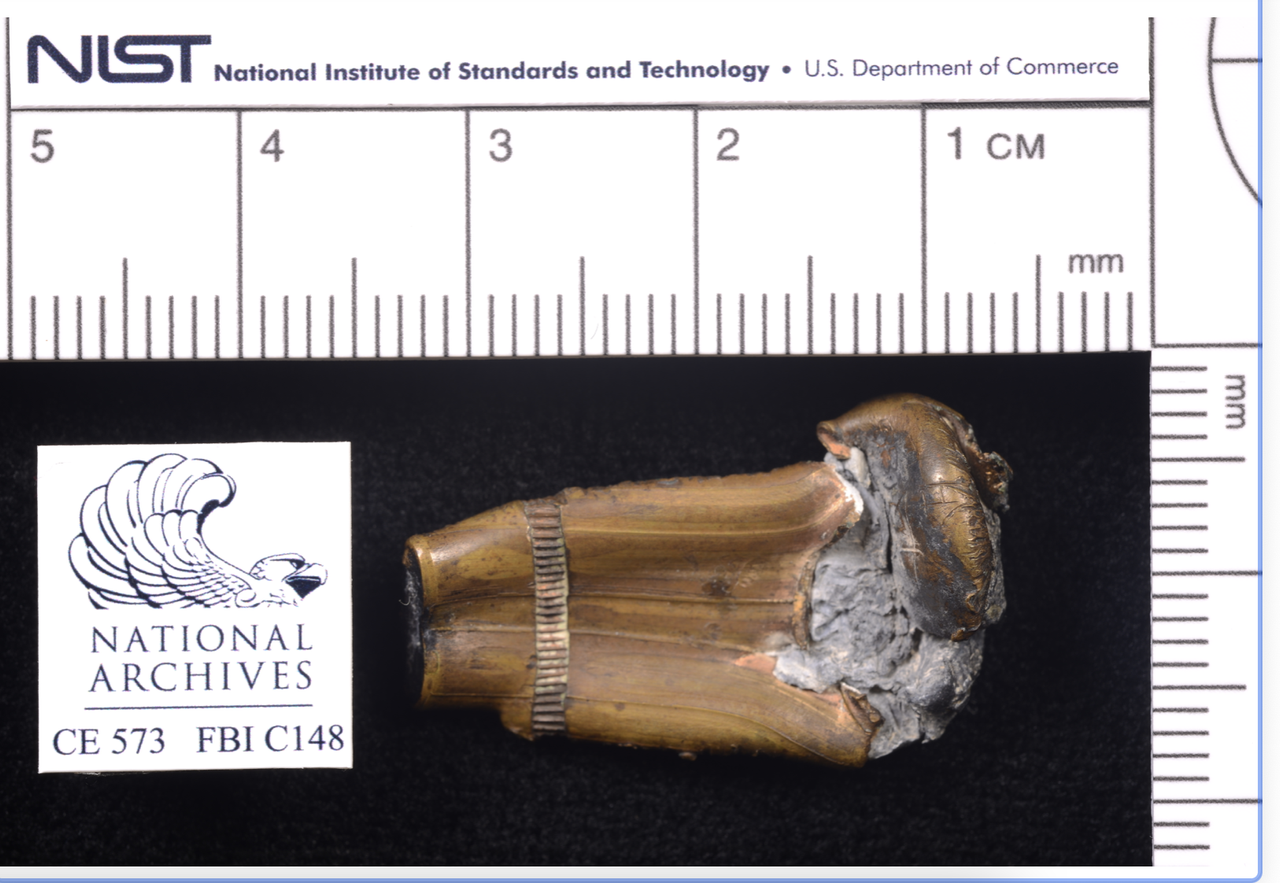
I doubt even a novice weekend plinker would identify CE-573 as a "steel-jacketed" bullet.
So why is this important?
Sadly, it indicates that FBI was willing to manipulate evidence. It is inconceivable that two DPD detectives, and also two DPD patrolmen, all identified the CE-573 as a steel-jacketed bullet, in official reports, in what was the most important attempted murder case in Texas history, up to that point, in April of 1963.
Walker was then a major public figure. The would-be assassin's slug found in the Walker house was key evidence.
The reasonable deduction from the above, that someone switched out the true Walker bullet for a copper-jacketed version, does not exonerate LHO in the JFKA, or necessarily suggest a wide-ranging Deep State plot to assassinate JFK.
It does make uncomfortable placing 100% faith in the FBI's investigation of the JFKA. And remember, it was the FBI that did legwork for the WC---a commission that was leaning heavily to the LNT before it was even formed.
Caveat emptor, and draw your own conclusions.
 Topic: The Walker Bullet, CE-573, Sure Looks Funny (Read 2408 times)