Anyone but Tom understand what the "KGB stuff" is all about?

Users Currently Browsing This Topic:
Tom Graves

Author Topic: Anyone but Tom understand what the "KGB stuff" is all about?  (Read 779 times)

Offline Lance Payette

  • Hero Member
  • *****
  • Posts: 1066
Re: Anyone but Tom understand what the "KGB stuff" is all about?
« Reply #32 on: January 23, 2026, 07:05:46 PM »
I would be far out over my skis if I purported to speak knowledgeably about the Bagley stuff with which TG is obsessed, so I don't want to give that impression. I did, however, read a number of reviews of Bagley's Spy Wars, which apparently serves as TG's bible. One noted that Bagley "rather conveniently" relies heavily on information provided to him by supposed - but unnamed - KGB sources. More than one noted Bagley's bitterness at his downfall with the CIA, a motivation that I believe simply must be taken into consideration in regard to all of Bagley's latter-day revelations.

Set forth below is the review from the London Sunday Times. The reviewer, Christoper Andrew, had met with Nosenko and is the co-author, with defector Vasili Mitrokhin, of several books on the famed 300,000 document Mitrokhin Archive. As you can read, he was distinctly unimpressed with Spy Wars.. The review itself appears at: https://www.thetimes.com/world/us-world/article/spy-wars-moles-mysteries-and-deadly-games-n7j9f67n78p.

I'm going to have to get at least one of the Mitrokhin Archives books, which all seem to be available at Amazon:


Anyway, here's the review of Spy Wars:

Spy Wars is the story of one of the biggest bungles in the history of the CIA. The bungle began in January 1964, two months after President Kennedy was assassinated, with the defection of Yuri Nosenko, a KGB officer, to America. Recruited as a CIA agent 18 months earlier, Nosenko brought with him a number of leads from KGB files, including information that, while staying in the Soviet Union, Lee Harvey Oswald, Kennedy's assassin, had been assessed by the KGB as too mentally unstable to use as an agent.

Nosenko's CIA interrogators, however, found apparent gaps in his story and quickly became suspicious. The intelligence that seemed to exonerate the KGB of involvement with Oswald was, they concluded, Soviet disinformation. Their suspicions were strengthened by a previous KGB defector, Anatoly Golitsyn, an unreliable conspiracy theorist who warned that bogus defectors would be dispatched by the KGB to discredit him. He claimed that Nosenko was one of them.

In April 1964, Nosenko was imprisoned by the CIA, and deprived of ordinary human contact and reading material, while his interrogators tried to make him admit that he was a plant. Nosenko refused. Four years later, he was exonerated by the CIA leadership, given financial compensation and hired as a consultant. Later agency investigations also concluded Nosenko was genuine. Thirty years after his incarceration, he was invited to give a lecture at the CIA and was given a standing ovation.

Tennent "Pete" Bagley was one of Nosenko's main CIA interrogators. Remarkably, in Spy Wars he sticks to his 40-year-old conclusion that Nosenko was a "provocateur" sent by the KGB to deceive the CIA. His book is deeply unconvincing. As Bagley himself admits, although there had been numerous bogus Soviet refugees, "never in the KGB's 45 years . . . had they sent one directly out of their own halls".

Bagley is still angry with his agency colleagues who cleared Nosenko. He dismisses the first report to do so, by Bruce Solie, as "nonsense" and Solie himself as deeply ignorant of the "real Soviet and KGB world". CIA senior management thought differently and gave Solie an award. For Nosenko, Bagley still feels evident contempt. Nosenko, he claims, was clearly ignorant of "things any KGB officer would know about his own workplace". Why the KGB would choose such an ignorant officer for a mission to deceive the CIA is a question that, surprisingly, does not seem to occur to Bagley.

Twenty years ago, I spent an enjoyable day with Nosenko at the Washington home of Cleve Cram, a CIA historian. Nosenko's explanation for his ordeal at the hands of the CIA was far more convincing than that of Spy Wars. He believed he was one of a series of innocent victims of the culture of conspiracy theory that had developed in the CIA's counter-intelligence staff while it was headed by James Jesus Angleton, an able intelligence officer who, partly under the influence of Golitsyn, had developed paranoid tendencies. Angleton even took seriously Golitsyn's claim that the bitter Sino-Soviet split was a charade devised by Moscow and Beijing to deceive the West.

My final encounter with the Nosenko case came in the late 1990s when I was writing a book with another defector, Vasili Mitrokhin, who had smuggled out of KGB archives an unprecedented volume of top-secret material (highly rated by both the CIA and FBI) on operations in America and elsewhere. This material confirmed that Nosenko was a genuine defector. It also revealed that the KGB (unaware that Nosenko had been imprisoned by the CIA) was making plans in the mid1960s to track him down and assassinate him.

JFK Assassination Forum

Re: Anyone but Tom understand what the "KGB stuff" is all about?
« Reply #32 on: January 23, 2026, 07:05:46 PM »


Online Steve M. Galbraith

  • Hero Member
  • *****
  • Posts: 1854
Re: Anyone but Tom understand what the "KGB stuff" is all about?
« Reply #33 on: January 23, 2026, 09:07:28 PM »
I would be far out over my skis if I purported to speak knowledgeably about the Bagley stuff with which TG is obsessed, so I don't want to give that impression. I did, however, read a number of reviews of Bagley's Spy Wars, which apparently serves as TG's bible. One noted that Bagley "rather conveniently" relies heavily on information provided to him by supposed - but unnamed - KGB sources. More than one noted Bagley's bitterness at his downfall with the CIA, a motivation that I believe simply must be taken into consideration in regard to all of Bagley's latter-day revelations.

Set forth below is the review from the London Sunday Times. The reviewer, Christoper Andrew, had met with Nosenko and is the co-author, with defector Vasili Mitrokhin, of several books on the famed 300,000 document Mitrokhin Archive. As you can read, he was distinctly unimpressed with Spy Wars.. The review itself appears at: https://www.thetimes.com/world/us-world/article/spy-wars-moles-mysteries-and-deadly-games-n7j9f67n78p.

I'm going to have to get at least one of the Mitrokhin Archives books, which all seem to be available at Amazon:


Mitrokhin Archive can be read online here: https://archive.org/details/mitrokhinarchive0000andr

The KGB went through great efforts to try and locate Nosenko. The plan was to try and isolate him and kill him. Kalugin book also goes over the plans the KGB had to try and either kidnap or kill Nosenko. Kalugin, who was head of counter intelligence for the KGB (sort of a Soviet equivalent of James Angleton), said Nosenko caused a lot of damage to the KGB including forcing him to return to the USSR. I used to believe that Nosenko was a false defector - the evidence was strong; but a great deal of new evidence that came out, particularly after the fall of the Soviet Union, indicates he was legitimate. Yes, he told lies, made up stories, puffed up his credentials; but so did Golitsyn, e.g., the Sino-Soviet split was a ruse.

Nut graf from Mitrokhin:
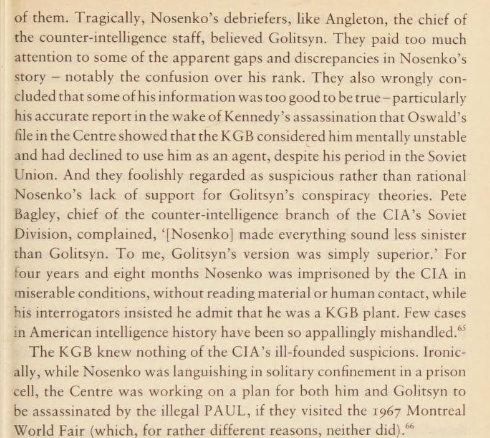
 

« Last Edit: January 23, 2026, 09:19:58 PM by Steve M. Galbraith »

Offline Lance Payette

  • Hero Member
  • *****
  • Posts: 1066
Re: Anyone but Tom understand what the "KGB stuff" is all about?
« Reply #34 on: January 23, 2026, 10:41:59 PM »
Thanks much, Steve!

Given what I now know, it's hard for me to understand the enthusiasm for Bagley - except that what he said fits nicely with the narrative some people would prefer to believe. Him sitting down with Malcolm Blunt strikes me as bizarre at best.

I guess I've always been predisposed to believe Nosenko because it's literally impossible for me to believe the KGB (or the CIA, for that matter) would have had any interest in Lee Harvey Oswald.

Online Benjamin Cole

  • Sr. Member
  • ****
  • Posts: 381
Re: Anyone but Tom understand what the "KGB stuff" is all about?
« Reply #35 on: Yesterday at 12:46:26 AM »
LP--

John Newman is a pretty serious researcher, and he seems to give credence to Bagley, and does Malcolm Blunt.

Newman goes even further, positing that Bruce Solie was a KGB mole.

Nosenko's narrative about the KGB having no stake in LHO is a bit glib. And the timing was perfect.

Gus Russo seems to have his head screwed on tight.

I keep an open mind on this one.

As for threatening to murder JFK, down in MC LHO seemed prone to outbursts, and was ardently seeking passage to Cuba. In a moment of anger, perhaps LHO uttered threats.


Online Steve M. Galbraith

  • Hero Member
  • *****
  • Posts: 1854
Re: Anyone but Tom understand what the "KGB stuff" is all about?
« Reply #36 on: Yesterday at 01:10:52 AM »
Nosenko's father was a relatively important and honored official in the Soviet Government, Ivan Nosenko. He was awarded three Orders of Lenin, the highest civilian award the Soviets gave out and after his death his funeral was attended by top Soviet officials including Khrushchev. In fact, Khrushchev was one of the honor guards at the funeral.

Question: Why would the KGB send the son of this relatively famous (for the Soviets) person to the US? That's incredibly embarrassing for them. Kalugin said the KGB didn't use fake defectors because it made the Soviet Union look bad and because they would lose control of the person after he left. Send a nobody not the son of a war hero.

Doesn't mean it didn't happen but it's something to add to the evidence that Nosenko was legitimate.

« Last Edit: Yesterday at 02:34:06 PM by Steve M. Galbraith »

JFK Assassination Forum

Re: Anyone but Tom understand what the "KGB stuff" is all about?
« Reply #36 on: Yesterday at 01:10:52 AM »


Online Tom Graves

  • Hero Member
  • *****
  • Posts: 2974
Re: Anyone but Tom understand what the "KGB stuff" is all about?
« Reply #37 on: Yesterday at 04:08:44 AM »
Mitrokhin Archive can be read online here: https://archive.org/details/mitrokhinarchive0000andr

The KGB went through great efforts to try and locate Nosenko. The plan was to try and isolate him and kill him. Kalugin book also goes over the plans the KGB had to try and either kidnap or kill Nosenko. Kalugin, who was head of counter intelligence for the KGB (sort of a Soviet equivalent of James Angleton), said Nosenko caused a lot of damage to the KGB including forcing him to return to the USSR. I used to believe that Nosenko was a false defector - the evidence was strong; but a great deal of new evidence that came out, particularly after the fall of the Soviet Union, indicates he was legitimate. Yes, he told lies, made up stories, puffed up his credentials; but so did Golitsyn, e.g., the Sino-Soviet split was a ruse.

Nut graf from Mitrokhin:


. . . . . . .

Dear Steve M.,

Here's a post I made back on 12 June 2025 on my thread titled "KGB disinfo re: Clay Shaw & the CIA, and the effect on The Jolly Green Giant," which was read 1183 times, but you didn't reply to.

Perhaps you missed it?

Major Vasily Mitrokhin, the KGB’s official archivist who was given the task of organizing its operations files and moving them to a new building, was supposedly so distraught by Khruschev’s 1956 anti-Stalin speech and the 1968 USSR / Warsaw Pact invasion of Czechoslovakia that he hand-copied 25,000 KGB documents between 1972 and 1985, retyped them, hid them under the floorboards of his dacha, and smuggled them to the West after the fall of The Iron Curtain — and no one noticed him doing it.

Really?

The putative KGB documents that MI5’s official historian, Christopher Andrew, wrote about in his books The Sword and the Shield: The Mitrokhin Archive and the Secret History of the KGB and The Mitrokhin Archive: The KGB in Europe and the West, either repeat what CIA already knew or strongly suspected (e.g., Lee Harvey Oswald’s “Dear Mr. Hunt” letter was a KGB forgery, and Mark Lane was financially supported by the CPUSA) or, if new, add little to our overall understanding of The Cold War. What’s more interesting to me is what they do not mention, e.g., that Yuri Nosenko was a false-defector-in-place in Geneva in June 1962 and that MI5’s Roger Hollis was a Soviet spy. In fact, they lend “documentary support” to what KGB-influenced espionage writers like Tom Mangold and David Wise have written about those cases.

One can only wonder why.

(sarcasm)

It’s interesting to note, however, that one of Mitrokhin’s documents says a 1967 KGB “active measures” operation involved "placing an article in a NYC newspaper.”

Hmm.

Okay, but it would have been nice if Andrew and Mitrokhin had admitted that the article (see below) was placed in the "National Guardian," a left-wing NYC independent weekly newspaper on 18 March 1967, and that the article referenced another article — one which the KGB had published in a Communist-owned Italian newspaper, "Paese Sera," on 4 March 1967.

Bertrand Russell’s London secretary, Ralph Schoenman, gave Garrison the translated-into-English "Paese Sera" article, and Garrison's assistant from LIFE magazine, Richard Billings, wrote in his journal on 16 March 1967, "Garrison now interested in possible connections between Shaw and the CIA [...] Two leads re: CIA tie: article in March issue of Humanite [sic; L'Humanité]."

These articles motivated the overly ambitious, scandal-plagued and revengeful Garrison to change his reason for having arrested Clay Shaw, a highly successful and closeted gay New Orleans businessman, from suspecting he had masterminded a homosexual "thrill-kill" assassination to fervidly believing he had organized it for the evil, evil CIA.

How did that work out, you ask?

Well, the jury returned a “not guilty” verdict in less than an hour, Garrison wrote a specious book, On the Trail of the Assassins, about the case in 1988, the book’s far-left publisher, Ellen Ray, gave a copy of it to Vietnam War-traumatized Oliver Stone at a Havana film festival, and in 1991 Stone partly based his self-described mythological (“to counter the myth of the Warren Report”) pseudo-documentary, “JFK,” on it.

Which film helped to make our body politic cynical, paranoiac, and apathetic to the point that “former” KGB officer Vladimir Putin, with help from his professional St. Petersburg trolls, et al., was able to install “useful idiot” (or worse) Donald J. Trump as our president in 2017 and 2025.

Here, for your reading pleasure, is the first part of the longish National Guardian article. The bit about "Paese Sera" is in bold text.

By Robert L. Allen on 18 March 1967:

The complicated skein of events involved in the assassination of President John F. Kennedy became even more tangled with the arrest March 1 of Clay L. Shaw, described in the press as "a prominent New Orleans businessman." New Orleans District Attorney Jim Garrison, who made the arrest, contended in a search warrant that at secret meetings in September 1963, "there was an agreement and combination among Clay Shaw (alias Clay Bertrand), Lee Harvey Oswald, and David W. Ferrie and others to kill John F. Kennedy." . . . The Guardian has received reports from Rome linking Shaw with various right-wing organizations and individuals, and possibly with the CIA. The Guardian's Rome correspondent, Phyllis Rosner, quoting the Rome daily PAESE SERA, reported that from 1961 till 1965 Shaw was on the board of directors of the Centro Mondiale Commerciale, which the paper said was engaged in obscure dealings in Rome . . .

. . . . . . .

My comments:

1) To counter the misconceptions and misstatements in the above "National Guardian" article, I highly suggest that you read Patricia Lambert’s 1998 book, False Witness, about Dean Andrews, Jack "Suggs" Martin, Perry Russo, and overly ambitious, scandal-plagued, and revengeful Jim Garrison, et al. ad nauseam. To read it for free, google “false witness” and “archive” simultaneously.

2) In his 1988 memoir, Garrison said he wasn’t aware of the Paese Serra, L'Humanité, and National Guardian articles until after the 1969 trial, but Ralph Schoenman’s ex-wife, JFKA conspiracy theorist Joan Mellen, told researcher Max Holland, after conferring with Schoenman, that he had given the Paese Serra article to Garrison in 1967.

3) It’s interesting to note that on 25 April 1967, the New Orleans-States Item newspaper referenced or summarized claims from the Paese Sera articles, particularly the CIA-PERMINDEX angle involving Shaw's Italian connections, and that one of the newspaper’s former editors told investigator Max Holland that the newspaper got said information from Jim Garrison.

4) The fact that Andrew and Mitrokhin included this partial nugget in The Sword and the Shield but said nothing about the likes of Igor Kochnov, Yuri Guk, "Alexander Kislov," Oleg Gribanov, Aleksey Kulak, Dmitry Polyakov, Boris Orekhov, and Roger Hollis, et al. ad nauseam, lends support to James Angleton's statement, "A good double agent will tell you 98% truth and 2% lies and really mess you up, boy."

Or words to that effect.


-- Tom
« Last Edit: Today at 07:33:08 AM by Tom Graves »

Offline Lance Payette

  • Hero Member
  • *****
  • Posts: 1066
Re: Anyone but Tom understand what the "KGB stuff" is all about?
« Reply #38 on: Yesterday at 01:28:36 PM »
LP--

John Newman is a pretty serious researcher, and he seems to give credence to Bagley, and does Malcolm Blunt.

Newman goes even further, positing that Bruce Solie was a KGB mole.

I am catty about Newman to the point of sounding like I have an axe to grind, but the term "serious researcher" as applied to someone in the JFKA community is scarcely the same as "serious researcher" as applied in academia or the professions. (In my Amazon review of a recent gossip-level book on JFK, I noted that Jim Di was referred to as an "acclaimed historian." BWAHAHA.  :D :D :D)

I once went through this little exercise:

1. Newman's first book, on JFK and Vietnam, was published in 1992 by Grand Central Publishing, then an arm of Warner Books. Warner pulled the book, which created a legal brouhaha that ended with the copyright being returned to Newman. It is now self-published on Amazon's self-publishing platform.

2. His book on Oswald and the CIA was published in 1995 by Carroll & Graf, a reputable publisher that ceased operation in 2007. It was reissued by Skyhorse Publishing, a reputable publisher, in 2008.

3. His Jesus book and all four of his JFKA books were self-published on Amazon's self-publishing platform.

This is not the publishing record of anyone whose books are selling or whom reputable publishers believe have a chance of selling.

Worse yet:

1. The first book on JFK and Vietnam received some attention in the press, but none that I could find in academia.

2. Despite being pretty plugged into the theology scene myself, I could not find one mention of the book on Jesus.

3. I could find literally no attention paid to the four JFKA books outside of the JFKA community.

This is not the record of a researcher who is being taken seriously by academia or professional historians. This seems especially odd since Newman actually does have academic connections via his association with the University of Maryland and James Madison University.

Okay, I'm going full-catty here. This is the one-star Amazon review - NOT BY ME - of Newman's book on Jesus. It does capture pretty much exactly his thought processes in relation to the JFKA as well:

1.0 out of 5 stars Christian Conspiracy Theories
Reviewed in the United States on January 27, 2017
Format: PaperbackVerified Purchase

Books like this seem to come out of groups of academics who view themselves as biblical scholars. These people share a contempt for and disillusionment with mainstream Christianity. They also have a mistrust for the historical processes and individuals who gave us the New Testament.

The steps that occur to produce a book like this are something like:

1. Somebody digs up some old manuscript written by God knows who which seems to be some sort of gospel but it doesn't exactly match the four gospels which were included in the biblical canon of the New Testament.

2. They start comparing these rejected, non canonical gospels with what's in the New Testament. When they see differences they conclude that this obscure gospel they found is correct and the gospels in the bible are all wrong. They conclude that the evil Church fathers conspired to keep the other gospel out of the bible for some nefarious reason.

3. They need to identify some sort of controversial finding which they say has been concealed from the entire world for 2,000 years. This finding may be something which shows the New Testament is wrong or it may be something which is just not in the New Testament. The implication is these so called scholars can see the hidden meanings in their newly found gospel.

4. They start writing books to reveal what they think are profound revelations that will shake the entire Christian world to its very foundations.

This book by John Newman follows the above steps pretty well. His new gospel is called the gospel of Thomas. And in fact he agrees that deliberate alterations were made to the gospels which were eventually included in the bible. He says the objective of these diabolical alterations was to misrepresent what Christ said to make the bible conform to the Church's evil agenda for future expansion.

But Mr. Newman adds another layer of confusion. He says the earth shattering discovery he has made is that Christ was some sort of yoga master and He somehow encoded secret teachings about mystical yoga techniques into His teachings. So the kingdom of God is really within all of us which is probably true. But then Mr. Newman adds that his discovery completely invalidates the idea that Christ was the Messiah that will return someday and judge the world. So basically Mr. Newman's theories invalidate the entire New Testament as it is understood by mainstream Christianity today.

Whether Jesus Christ practiced yoga in some form I don't know. But we can discern from the canonical gospels that revealing mystical knowledge in hidden ways was not something Christ was trying to do. Christ is viewed by many people today as the greatest philosopher of all time specifically for His ability to explain spiritual truths in a way that everyone can easily understand.

Mr. Newman feels he is part of a revolution which is going to allow the entire world to finally understand Christ's teachings for the first time. But to me this book is just part of a fad in popular culture similar to the Da Vinci Code. Like all fads which are built on a foundation of quicksand these trends will eventually die out. At that point these academics will move on and start writing books about whatever new anti Catholic, anti Christianity trend has emerged in society.

...

This book by John Newman is one of the worst, most convoluted and misleading books about Christianity I have ever read in my life. The criticisms against fundamental Christian doctrines contained in this book are egregious and severe.

That being said, it may be worth reading to understand the logic and thought processes used to perform the steps I listed above for writing a book like this.


Online Tom Graves

  • Hero Member
  • *****
  • Posts: 2974
Re: Anyone but Tom understand what the "KGB stuff" is all about?
« Reply #39 on: Yesterday at 01:43:43 PM »
[...]

Dear FPR,

It's too bad you can't point out for us the shortcomings in Newman's Oswald and the CIA, other, perhaps, than his since-admitted error of accusing in the 2008 edition that James Angleton was the JFKA mastermind.

Hopefully you'll be able to do that after you've thoroughly read The Sword and the Shield by a guy who's either a monumental fool or a KGB* agent -- Christopher Andrew -- and a definite KGB* agent, Vasili Mitrokhin (RIP).

*Today's SVR and FSB

-- Tom
« Last Edit: Yesterday at 01:49:01 PM by Tom Graves »

JFK Assassination Forum

Re: Anyone but Tom understand what the "KGB stuff" is all about?
« Reply #39 on: Yesterday at 01:43:43 PM »