Rowland specifically describes it as being open at the collar with a t-shirt underneath so I think we'll have to agree to disagree on that.
You are entitled to whatever opinion you want. However, Rowland (the only one of the witnesses you cite, who gave that description) said he saw this person on the west end of the building about 15-minutes before the shooting. I think it is entirely reasonable that the assassin could have still been wearing his shirt over the t-shirt at that point in time, shedding the outer shirt later, only after he got hot due to sitting in the sun shining in through the sniper’s nest window. If I remember correctly, Rowland gave that description months after the assassination (as he was embellishing some other aspects of what he said he saw). Jackie Kennedy described the sun as being very hot (and she was in a moving convertible with the resulting wind helping to cool her off).
"You are entitled to whatever opinion you want."As are you Charles.
You accept Rowland's observation of a man with with a scoped rifle on the 6th floor and that the man had a shirt on over a t-shirt, but you don't accept the colour of the shirt he gives - "a very light-colored shirt, white or a light blue"
The opinion I have allows me to take witness statements at face value rather than assume 'what they really meant to say'.
And the garment is consistently described as a 'shirt' as opposed to a 't-shirt' by all four witnesses so we'll have to disagree on that too as I believe people know the difference between the two.
Semantics are not going to change the fact that a t-shirt actually is an open neck shirt (versus a buttoned up collar on a collared shirt).
It's not about semantics.
Different garments have different names - trousers are called trousers, jackets are called jackets etc.
Different types of shirt have different names.
You, yourself have demonstrated this in your last few posts:
"In 1963, shirt and ties (often with coats) were more commonly worn than they are these days. Especially among office workers, sales people, etc. Therefore I believe most of these witnesses are most likely describing his t-shirt."Here you specifically delineate the difference between a shirt and Oswald's t-shirt.
A white t-shirt is an iconic garment and instantly recognisable (think James Dean). Everyone knows what a t-shirt is and when trying to give an accurate description it would be stated as such.
There can be absolutely no doubt that these witnesses are not describing a t-shirt.
They are doing what you have naturally done - recognised the difference between a shirt and a t-shirt.
Also, Oswald's t-shirt was brilliant white whereas the open necked shirt worn by the shooter was consistently described as not quite white, more like a really light colour rather than pure white.
No LHO’s shirt was a dingy white. There are numerous photos that confirm this fact.
Really?
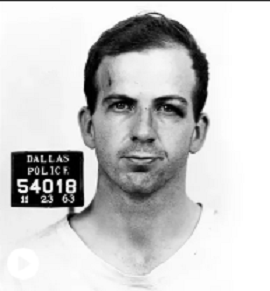
Feel free to post your own copy of his mugshot and see if yours is any less brilliant white.
I find your interpretation really strained and based on your well-founded conviction that Oswald was the shooter therefore the witnesses
must be describing his t-shirt because the shooter was Oswald and he was wearing a white t-shirt therefore they must be describing Oswald's white t-shirt because Oswald was the shooter and he was wearing...etc.
The circumstantial evidence suggests that LHO was in the sniper’s nest at the time of the assassination. This includes fingerprints, numerous witness descriptions of the shooter, no alibi, LHO’s rifle and ammo, LHO last reported seen on the sixth floor, no one saw LHO elsewhere, no strangers reported seen in the TSBD any any of the people who worked there (even after each one being asked that specific questions by the FBI) etc, etc.
If there is any credible evidence of someone else in the sniper’s nest at the time of the assassination, I am unaware of it.
"The circumstantial evidence suggests that LHO was in the sniper’s nest at the time of the assassination."This is completely wrong.
Every single piece of credible circumstantial evidence available regarding who was on the 6th floor just before, during and after the assassination points away from Oswald.
We are in the midst of a discussion wherein four eye-witnesses are describing clothing Oswald wasn't wearing and didn't own. This is really strong circumstantial evidence that the shooter was not Oswald. Just because you are trying to wish it away is meaningless.
"The circumstantial evidence suggests that LHO was in the sniper’s nest at the time of the assassination. This includes fingerprints, numerous witness descriptions of the shooter, no alibi, LHO’s rifle and ammo, LHO last reported seen on the sixth floor, no one saw LHO elsewhere, no strangers reported seen in the TSBD any any of the people who worked there (even after each one being asked that specific questions by the FBI) etc, etc."There is so much wrong in this paragraph I refuse to get involved. All that needs to be said is that there not a single point you've made here that puts Oswald in the SN at the time of the assassination. Not one. Not even close.
That you think you have provided evidence placing him there at the time of the shooting is your issue, not mine.
It smacks of the LNers belief that it is a proven fact Oswald took the shots, when it is just another theory.
"If there is any credible evidence of someone else in the sniper’s nest at the time of the assassination, I am unaware of it."Just as you are unaware of any credible evidence placing Oswald in the SN at the time of the assassination.
A fair interpretation, the face value interpretation, is that the man on the 6th floor was wearing a very light coloured shirt open at the collar.
From this interpretation, and the knowledge that Oswald wasn't wearing such clothing, one has to conclude that this evidence points away from Oswald being the shooter.
As I say, all credible evidence regarding who was on the 6th floor just before, during and after the assassination points away from Oswald. This is just one example.
Sorry, but I believe strongly that an unbiased jury would have to conclude otherwise.
But that's a biased opinion.
 Topic: The Assassination was Sloppy and Amateurish (Read 69009 times)