I’m glad you discussed this, as it will be something for me keep my eye on for possible future use. But at this time I don’t agree enough with your statements to make large changes in the modeling. Here are some of the "statements" I disagree with and reasons why I disagree:
Clearly you've put a lot of time into this aspect of the case but there are key issues I have to disagree with, in particular the notion of neck paralysis at the moment of impact and the so-called jet effect.
Understanding the mechanics of the headshot is of immense importance as, in my opinion, the "back and to the left" motion is the cornerstone of the majority of "multiple shooters" conspiracy thinking. Watching the Z-film in real time it is very difficult to get away from the intuitive perception that the "back and to the left" motion can be caused by anything other than a shot from the right front but a close analysis of the headshot reveals this motion was caused by a shot hitting JFK's head from behind.
“there is zero evidence neck paralysis occurred”
All I can do is to mention the basis I used for the assessment that there was significant neck stiffness (in addition to shoulder, arms, hands and fingers).
1) It is called spasticity or spastic paralysis due to damage to the lower cervical part of the spine and the brachial plexus. In this case via a bullet transit that occurred circa z222.
https://sites.google.com/view/spastic-paralysis/home
2) Some Neurological opinions. From the Study Slide 54 or video time 2:07:00
Comments from Dr. Robert Artwohl explaining why we saw the arms stiffening upward.
“JFK’s reaction to the neck wound was, for all intents and purposes, instantaneous to the hit at Z-223/224. As the bullet passed through his neck, the pressure cavity caused an immediate and wide spread stimulation of all the nerves in the immediate vicinity, that is of the brachial plexus, the large group of nerves that emerge from C5-T1. These are the nerves that supply motor function to the arms.”
Comments from neurologist Dr. Strully in a letter sent by Dr. Strully to Dr. Robert Artwohl, dated April 9, 1994 as to an even greater possible extent of the muscle contractions.
"Before all else, it is necessary to remember that this assassination reveals a sequence of neural responses initiated in the neck by the shock wave and cavitation induced by the bullet in its traverse of the neck. This traumatized all structures in a 6 inch radius in all directions from the path of passage through the neck. This spread of forces occurred in a fraction of a second, traumatizing all neural structures in the immediate vicinity within a fraction of a second as determined by the speed of the missile according to ballistic studies.
As a result, contraction of the muscles innervated by nerves closest to the bullet's path took place first; -- right deltoid, left deltoid, right biceps followed by the left biceps and sequential contraction of all muscles in the forearms, hands, chest, abdominal walls and paraspinal muscle groups, with muscles in the lower extremities, farthest from the shock wave, responding last. All neural structures in the neck were stimulated at the same moment…”
3) Some assessments of the Presidents condition from extended film inspections. From the Study Slide 5 video time 0:08:19
My assessment of the film from z226-z254 and z262-z312 was simply that “JFK looked like a statue locked in place”.
ITEK Corporation’s assessment in their report was that “He appeared to remain in a frozen position”.
4) From voluntary neck stiffening seen in sports at stressful times. From the Study Slide 40 or video time 1:35:50
Besides involuntary stiffening that are likely related to a stretch reflex, there can be in some stressful situations some voluntarily stiffening of necks taken like in the sports of soccer and boxing.
I am in total agreement that the shot through JFK's neck causes an almost instantaneous reflex reaction due to the bullet damaging the nerves of the Brachial Plexus. Elsewhere I have posted the following:
The bullet passed between the C7 and T1 vertebrae, close to the spinal column.
This is confirmed by a fracture found in JFK's spine:
“There is an undisplaced fracture of the proximal portion of the right transverse process of T1 (or the region of the costovertebral junction)”
Quote from the report of the HSCA consulting radiologist, G.M. McDonnel, MD, in: HSCA vol.7: 219.
[see https://www.history-matters.com/archive/jfk/hsca/reportvols/vol7/html/HSCA_Vol7_0115a.htm]
An "undisplaced" fracture is one in which the bones remain aligned indicating a glancing blow by the bullet. This may have affected the trajectory of the bullet through JFK but that is not being considered at this moment. The fracture is of the right transverse process, in accordance with the entry of the bullet slightly to the right of the spine. Looking at this diagram again (obviously the diagram is of the left side of the body but the arguments apply due to the symmetry of the body):
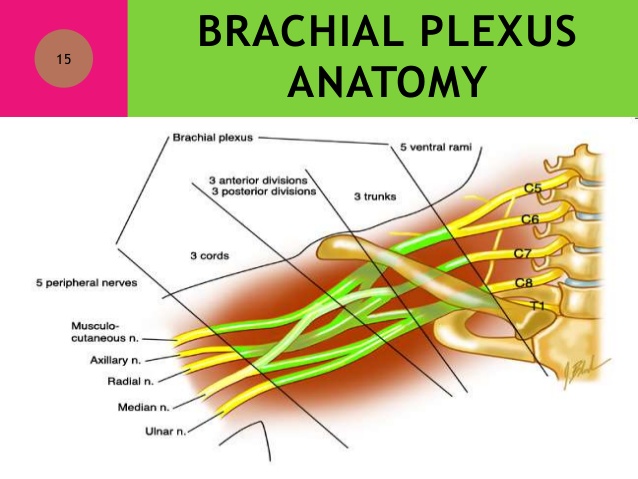
A bullet passing between the C7 and T1 vertebrae, glancing off the transverse process of T1, would almost inevitably sever, or at least severely damage, the nerve marked T1 in the diagram, affecting in particular the Ulnar nerve which has its roots in the "T1" (and C8) nerve. The Ulnar nerve runs the length of the arm, entering the hand where it "flexes the ring and little fingers at the distal interphalangeal joint".
A bullet severing the Ulnar nerve may cause the hand to rapidly contract, however the Ulnar nerve only controls the flexion of the ring and little fingers.
I wish I could find a clearer image than the one below but there is a very strange aspect of JFK's hands in reaction to being shot. One might expect someone to 'clutch' at their throat if they were shot there but JFK doesn't do this. Instead he appears to clench his hands into fists and thrusts them under the area of his chin.
But even this is not quite correct. A clear image (I've seen one but can't find it at the moment) reveals that JFK appears to be 'pointing' at his throat:
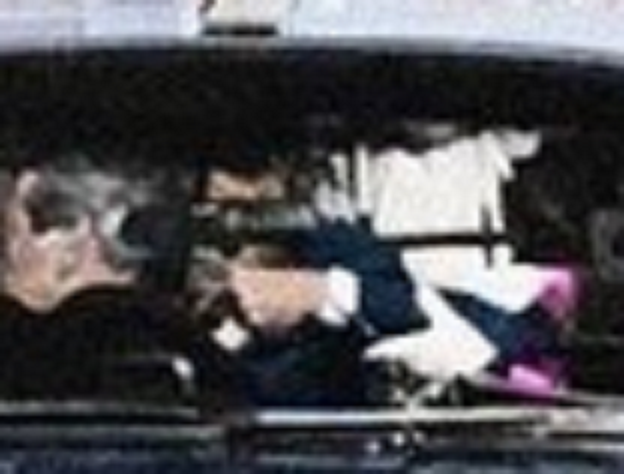
I believe this indicates the bullet has severed his Ulnar nerve, causing some of his fingers (ring and little) to instantly clench shut but leaving his index finger unaffected and in a 'pointing' position.What I did not take into account was the profound effect of "cavitation" as pointed out by Dr Strully:
"This traumatized all structures in a 6 inch radius in all directions from the path of passage through the neck." The full effect of cavitation is demonstrated in this short video:
It is important to note a secondary explosion, referred to as "dieseling", that occurs within the cavitation. I believe this plays an important role in the headshot itself.
So, while I agree that momentary "neck paralysis" appears to have occurred as a result of the shot through the neck, I completely disagree that this paralysis was present at the moment of the headshot. In the clip below we can clearly see that after the initial reaction, during which JFK's elbows extend fully and his body appears to stiffen, his body then relaxes as he slumps to one side and his head drops forward:
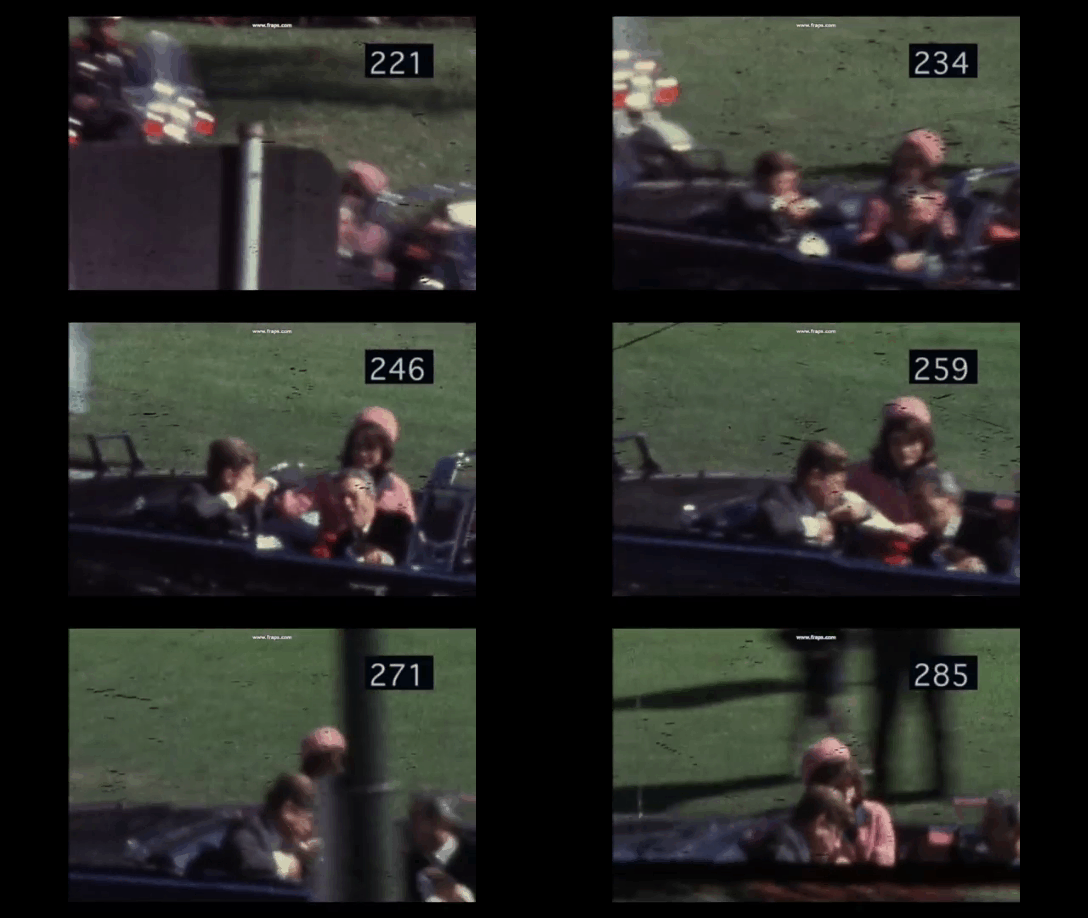
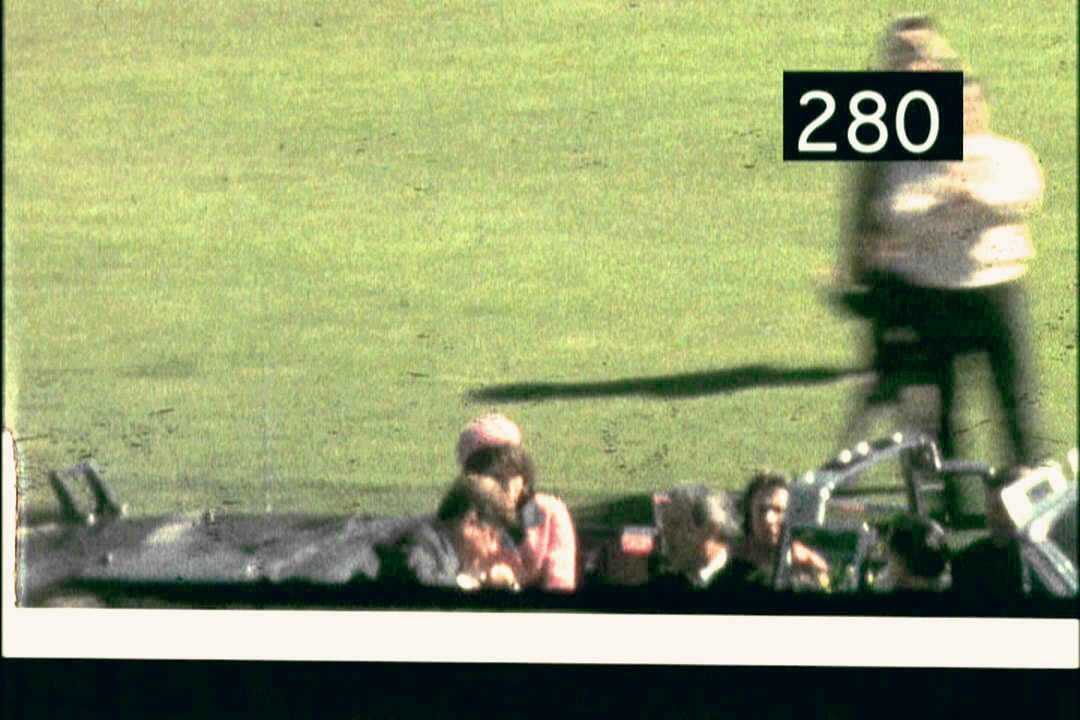
By the moment of the headshot JFK's arms have come down and his head has slumped forward, if anything this is indicative that his neck has totally relaxed by the time of the headshot. A frame from just before the headshot shows this relaxed posture more clearly:
There is "very strong evidence against any kind of jet effect"
All I can do is to mention the basis I used for the assessment that there was some jet effect.
1) The modeling overall did a good job of predicting position of the head and upper torso, but there was one place it didn’t respond well and that was between z312 and z313. The model wanted to say that the head position at z313 should have gone even further ahead and taken longer to come back than it did. I struggled with why the heck this was happening, and finally realized that the model did not include any slowing of the head by another force at that time, i.e. some jet effect. Accounting for this corrected that issue.
2) Simply put, typically when you see a noticeable jet, you get some jet effect. There was noticeable jet fan going forward at z313 that I saw, while its net direction may have been a little forward and to the right. A good experiment would be going out in the yard and take a garden hose with a sprayer on the end. With the hose full of water, open the sprayer to provide a noticeable fan and see if you feel zero force pushing back or is there some detectable force pushing back against your hand.
3) Nick Nalli made the most in-depth calculations I have seen on the head shot and concluded there was some jet effect and further estimated some ranges for its effect on the head. I checked and within those ranges there would be enough to correct my model as described in 1) just above.
4) We see a jet in the Z-film but experiments to show head reversal by jet effect are tricky to set up exactly right, and don’t always work, but typically the ones that fail are ones that don’t show much of a jet. This is described some in the examples of the Study on Slide 7 or video time 0:13:39.
"At the moment of impact JFK's chin is resting on his chest (the sternum is a non-issue) JFK's head can be clearly seen being driven into his chest, there is nowhere for it to go so it rebounds.
That this movement is JFK's head being driven into his chest"
When I hold my head at like a 45 degree angle, it is not resting on my chest, but I cannot see his chest directly relative to his chin extent, so can’t comment on this.
"The initial movement at impact is forward"
I agree and both his head and upper torso have initial forward movement.
"The massive crater in the top of JFK's head after impact"
Yes, It looks like the jet exited the top opening going forward.
"The jet effect might work through a small exit hole out of which matter is ejected but it is totally negated by such a massive head wound."
In experiments small exit holes are good for directionally which is important, but they suffer in that they present a much larger pressure drop to overcome to discharge the mass or fast volumetric mass flow out that orifice which is important to the momentum exchange. In fact I think small holes are overall more limiting in this regard as I think it is easier to get directionality out of generous sized hole than large mass flow rates out of a small hole. You commonly see a melon shot with a small exit hole and with a focused but a limited discharge jet and not much movement at all. This is also discussed briefly in the Study on Slide 7 in the video at time 0:13:39.
Like I said originally, I would expect there would have been some observation of a mark on chin or chest if such a violent collision happened. Because no one saw a mark does not mean it didn’t happen, but it boils down to just a lack of confirmatory evidence at this point that would prevent me in trying to redefine the whole model base on something I can’t really see, or confirm at this point.
There is an even more counter-intuitive aspect to the headshot than the "back and to the left" movement caused by a shot from behind and that is the nature of the injury to JFK's head. In chapter 16 on his website, Pat Speer explains in detail the nature of this injury, concluding it is what is referred to as a "gutter" or "trench" wound. The bullet enters the head quite high up on the skull and exits just above the hairline. At some point the bullet fragments, either entering or exiting the skull, and some of these fragments pepper the inside of the front of the limo. This would seem to indicate the main injury would be sustained towards the front of the skull (other than a small entrance wound at the rear).
In fact, what happens is that almost the entire top portion of the right side of JFK's head is blown directly upwards, perpendicular to the direction of the bullet transit.
That the top of JFK's head is blown off is evidenced in a number of ways. In the clip below pay particular attention to the shape of JFK's head before the headshot and then to the massive crater that appears in the top of his head immediately after:
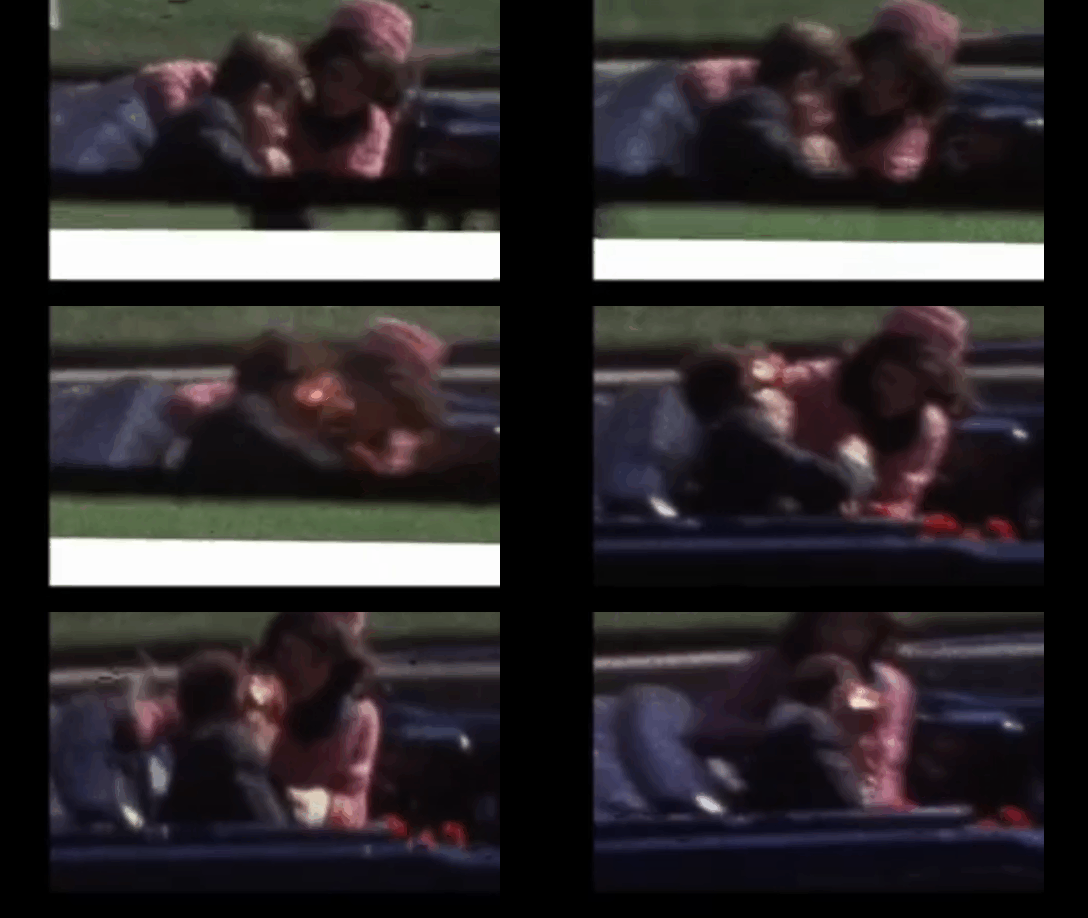
The injury is clearly to the top of his head:

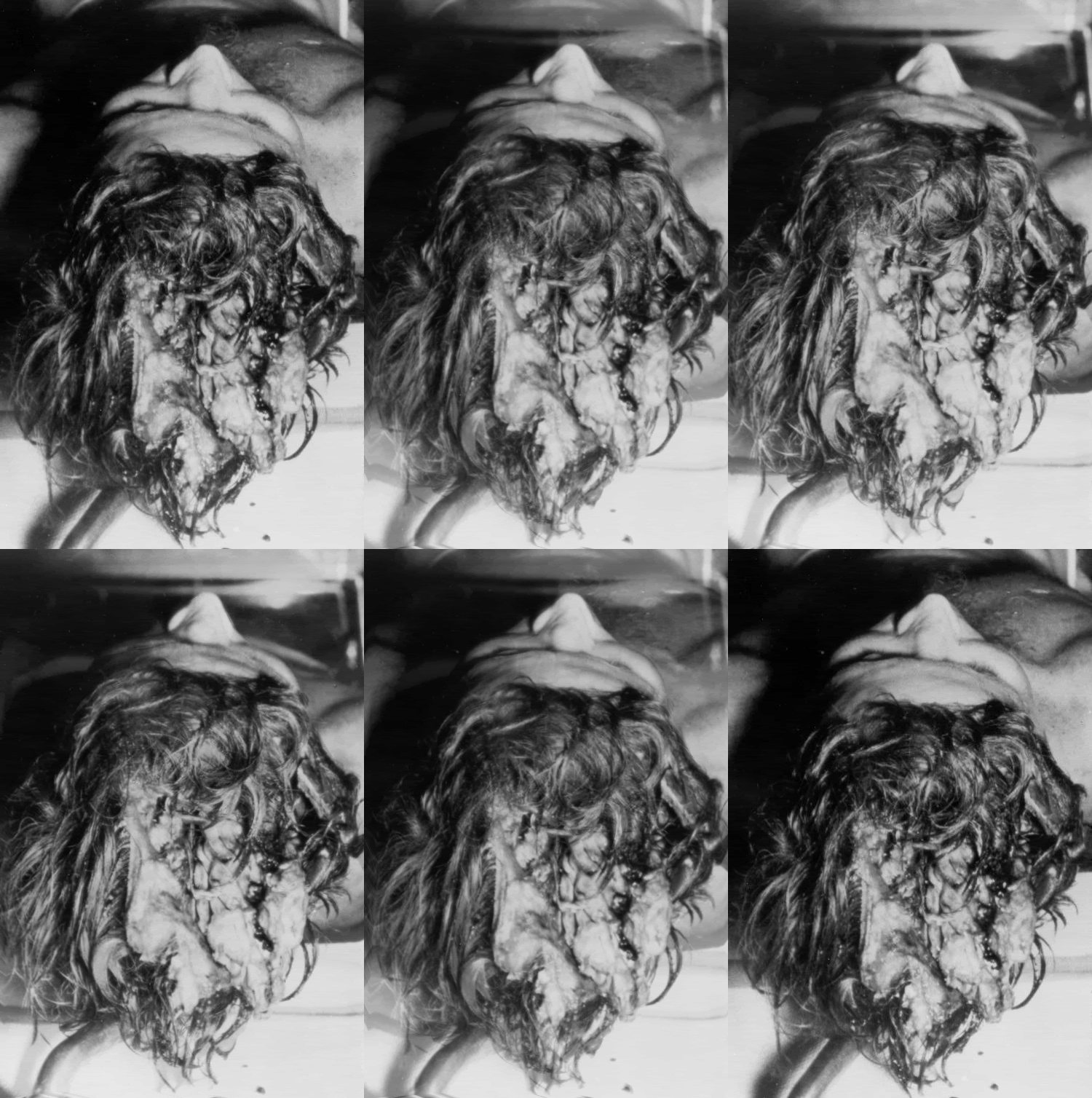
The gif below was created by John Mytton and clearly shows the massive injury to the top of JFK's head:
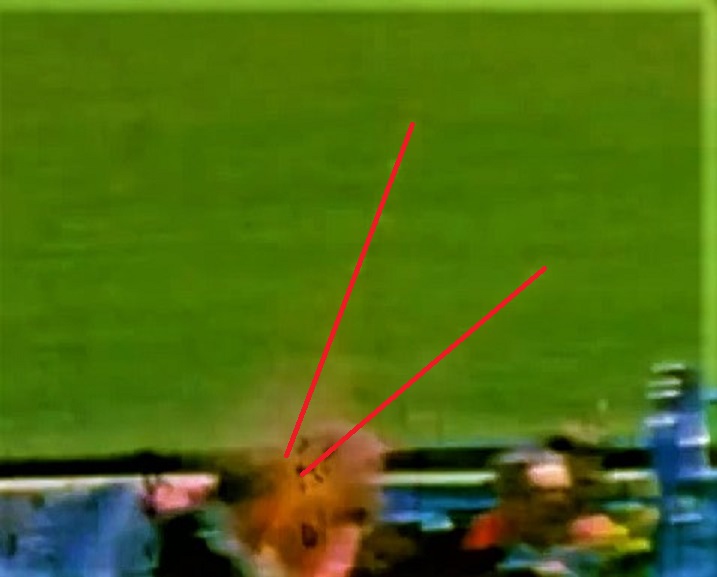
And finally, z313 shows two "jets" exiting the top of JFK's head. The more pronounced "jet" is picked out by the red arrow, the lesser one by the yellow arrow.

If there was any jet effect it would be related to these lines of ejected material being blown from the top of JFK's head. The direction of any jet effect can be seen to have no component that would drive JFK's head backwards:
Referring back to this clip. At the moment of the headshot there appears to be a fan or spray of material moving forwards:
The cause of this requires a deeper understanding of the mechanics of the head injury.
As the bullet enters and exits the head it tears through the scalp at the back and the front creating weak spots in the integrity of the scalp. It also shatters the skull into numerous small pieces, completely destroying the structural integrity of the skull. As the pieces of skull explode upwards they lacerate the scalp between the two weak spots creating a tear along the top of the head. In the Mytton gif we can see some scalp folded over to the left (as we look at it) but there is no scalp covering the right side of the exposed brain.
This part of the scalp is blown to the right side of the head and is the large, pendulous mass of flesh seen hanging down the side of JFK's head. As this large mass of scalp/skull is blown away it creates the fan of material seen moving forward.
But what is the cause of the upwards explosion of skull and brain matter that lacerates the scalp?
The answer is "cavitation". Take one more look at this video posted above demonstrating cavitation caused by a bullet. It is this force acting on the compromised skull that, quite literally, blows the top of the head off.
After the neck shot JFK has a almost instantaneous reflex reaction causing his body to stiffen as his elbows shoot up to their full extent.
His body then relaxes and his head slumps forward. When the shot hits the back of his head it drives it forward and downward. Having nowhere else to go, his head rebounds upwards and backwards in the characteristic "back and to the left" motion.

