JFK's Head Snap and the Implausible Jet-Effect and Neurospasm Theories

Users Currently Browsing This Topic:
0 Members

Author Topic: JFK's Head Snap and the Implausible Jet-Effect and Neurospasm Theories  (Read 131693 times)

Offline Tim Nickerson

  • Hero Member
  • *****
  • Posts: 2109
Re: JFK's Head Snap and the Implausible Jet-Effect and Neurospasm Theories
« Reply #245 on: August 10, 2020, 07:38:21 PM »

I notice you ignored the FPP’s observation that the bullet entered at a “slightly upward” angle.

That was not a finding of the FPP.

Quote
But that is exactly what the diagram shows. We both know you can see this. It is obvious. This is literally a repeat of the story of the emperor’s new clothes. You won’t admit that you see what we both know you can plainly see.

It is also obvious that the back wound is put well above the throat wound and that the trajectory is clearly downward, contrary to the FPP’s diagram.


Worse still, at least for your case, if you take the FPP diagram and tilt Kennedy backward to an upright position, the comical absurdity of the trajectory becomes even more obvious because the bullet would be exiting at an upward angle in relation to the horizontal plane.


That is a poor diagram, to be sure. As you noted , it wrongly has Kennedy in a fully upright position. When in reality, he was slouched forward from between 11 and 18 degrees. Also, it has the vertical angle of trajectory at about 20 degrees. It does not account for the 3 degree slope of the street. They have the position of the entry wound about right but the exit wound is way too low.

Online John Mytton

  • Hero Member
  • *****
  • Posts: 5120
Re: JFK's Head Snap and the Implausible Jet-Effect and Neurospasm Theories
« Reply #246 on: August 11, 2020, 12:15:14 AM »
You know this is comical nonsense. You know that critics say that the same backgrounds were used but that they were very slightly keystoned to produce the appearance of differences between background-object distances, as Malcolm Thompson noted.

OMG, why the deception? The keystone theory has been thoroughly refuted and when I demonstrated the massive amount of parallax changes in the backyard photos you endorsed my evidence(see below), now you're back to square one and peddling your original BS?

Yes, of course, the camera changed positions for each picture.


Every nutty theory that you have posted that I bothered to read follows a similar pattern of nonsensical conclusions, you are obviously spreading yourself over too many subjects being a Jack of all trades, master of none.

JohnM

Offline Michael T. Griffith

  • Hero Member
  • *****
  • Posts: 1529
    • JFK Assassination Website
Re: JFK's Head Snap and the Implausible Jet-Effect and Neurospasm Theories
« Reply #247 on: August 12, 2020, 05:53:12 PM »
OMG, why the deception? The keystone theory has been thoroughly refuted and when I demonstrated the massive amount of parallax changes in the backyard photos you endorsed my evidence(see below), now you're back to square one and peddling your original BS?

What?! LOL! You either cannot read or you are hoping no one will go back and review our dialogue. I have addressed this silly GIF of yours several times. Your GIF shows that you simply do not grasp the basic issue here. 

Folks, go back to my dialogues with Mr. Mytton. You'll see that I repeatedly explained to him that his supposed evidence of "massive" changes in the distances between background objects in the backyard photos was spurious, that his "evidence" showed that he fundamentally does not understand the issue.

"Massive" parallax changes?! What a joke. The changes had to be measured in millimeters. Let us take a look, again, at the parallax measurements that the HSCA PEP published:

The PEP did parallax horizontal and vertical measurements on selected objects in the backgrounds. The horizontal parallax measurements were done on points on the fence at three levels on 133-A and 133-B. There was an “a” measurement and a “b” measurement, each done at three levels. The differences had to be expressed in millimeters:

a-lower: 0.8 mm
a-middle: 0.1 millimeter
a-upper: 1.1 millimeter


b-lower: 0.5 mm
b-middle: 0.7 mm
b-upper: 0.1 mm


The largest difference was 1.1 mm, which equals 0.043 inches. 0.043 inches as a fraction is 11/256ths of an inch. By comparison, 1/16th of inch is 1.59 mm. So 1.1 mm is 30% smaller than 1/16th of an inch. And, again, that was the largest difference.

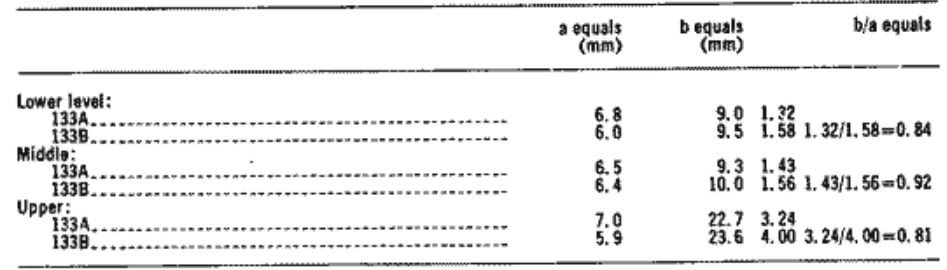
The vertical parallax measurements revealed equally tiny differences. These measurements were done on two objects on the fence. To account for differences in magnification, the measurements were related to the distance from the left edge of one picket to the left edge of the next, and the scaling distance was measured on the two center pickets of the four pickets on the fence. The differences--which, here too, had to be expressed in millimeters:
Gate bolt to screen: 1.7 mm
Scaling distance: 0.3 mm
Gate bolt to screen adjusted for scaling distance: 0.15 mm (1.96 mm in 133-A vs. 2.11 mm in 133-B)

Here are the measurements as written in the PEP report:

133A: gate bolt to screen =30.4 mm. scaling; dist.=15.5 mm
30.4/15.5=1.96
133B: gate bolt to screen=32.1 mm, scaling dist.=15 .2 mm
32.1/15.2=2.11


Again, these are millimeters.

Every nutty theory that you have posted that I bothered to read follows a similar pattern of nonsensical conclusions, you are obviously spreading yourself over too many subjects being a Jack of all trades, master of none.

This is goofball posturing. You really should avoid such posturing when you simultaneously show yourself to be comically ignorant of the facts.

On what planet is 1.1 mm, the largest variation in the horizontal parallax measurements, a "massive" change? Are you kidding? Are you some high schooler using your parent's computer in the basement? 1.1 mm, just FYI, is markedly smaller than 1/16th of an inch, and that was the largest horizontal change! Do you know what a millimeter is?

In the vertical parallax measurements, the gate-bolt-to-screen distance, adjusted for scaling distance, was found to be 0.15 mm (1.96 mm in 133-A vs. 2.11 mm in 133-B). Do you know how tiny a change 0.15 mm is? 0.15 mm equals 0.005905512 inches. Do you know basic math well enough to understand just how incredibly tiny that difference is? This might help you out: 1/16th of an inch is 0.0625 inches. So we're talking about a difference (0.15 mm/0.0059 inches) that is 11 times smaller than 1/16th of an inch.

If you just cannot grasp the basic math here, go ask your parents to explain to you why 0.15 mm is an extremely tiny, tiny, tiny difference.

I hate to be so harsh, but you get on here and spew all this rhetoric while at the same time you make it obvious for all to see that you are clueless about even the basic facts. Maybe on your planet a 1.1 mm horizontal change and a 0.15 mm vertical change are "massive changes," but not down here on Earth.

The only "nutty theory" here is your absurd theory that a top-view handheld camera with a lever instead of a button, and handed back and forth between exposures, could produce photos that contain differences between their background objects that are so tiny that they had to be measured photogrammetrically and that were found to range from only 0.1 mm to 1.1 mm.

Finally, regarding Jerry Organ's labored denial that the rear entry wound in the skull was 6.0 mm, I will just note that even the WC did not stoop to this level of denial and dishonesty. The WC admitted that the skull wound was 6.0 mm, since the autopsy report makes this clear to everyone except a tiny band of WC apologists, and the commission theorized that the skull hole "recoiled" to 6.0 mm after being 6.5 mm or larger when made:

"The dimension of 6 millimeters, somewhat smaller than the diameter of a 6.5-millimeter bullet, was caused by
the elastic recoil of the skull which shrinks the size of an opening after a missile passes through it." (WCR, p. 86)

And notice that the commission said that this recoil "shrinks" the hole. The past tense of "shrinks" is "shrunk." I mention this because Jerry Organ strongly protested my use of the verb "shrunk" in reference to the alleged recoil of the skull.


« Last Edit: August 12, 2020, 08:10:54 PM by Michael T. Griffith »

Offline Bill Chapman

  • Hero Member
  • *****
  • Posts: 6506
Re: JFK's Head Snap and the Implausible Jet-Effect and Neurospasm Theories
« Reply #248 on: August 12, 2020, 08:53:31 PM »
Note the ad-Homs liberally sprinkled on yet another MTG word salad.

Offline Michael T. Griffith

  • Hero Member
  • *****
  • Posts: 1529
    • JFK Assassination Website
Re: JFK's Head Snap and the Implausible Jet-Effect and Neurospasm Theories
« Reply #249 on: August 12, 2020, 09:14:06 PM »

    You really think the pickets in these three photographs should have spread apart by centimeters between exposes? That the photographer's feet shifted two-or-three feet laterally between poses?

    Do you just not understand the basic science here? Do you not grasp the problem? Or are you just throwing mud into the air and hoping some of it will seem credible? You and Mytton either simply do not grasp the problem or you are pretending the problem does not exist and making arguments that have nothing to do with the problem.

    All the ducking and dodging in the world will not explain how a top-view handheld camera that had a lever instead of a button, and that was supposedly passed back and forth between exposures, could have produced three photos with backgrounds so similar that the differences between the objects in the backgrounds are so small that they had to be measured photogrammetrically and were found to be so incredibly tiny as to range between 0.1 mm and 1.1 mm. You keep dancing around this point.


    And you don't mention how the changes are consistent with how each photo was taken.
    • In all cases, more of the background is shown to the right and less to the left on CE 133-B as compared to CE 133-A. Since the shadow analysis indicated that CE 133-B was taken before CE 133-A, the parallax indicates that the camera was moved slightly to the left between these two exposures.

    LOL! This is what happens when you quote stuff without understanding the science behind it (or when you are unwilling to address the problem). The whole point is that the camera would have moved far, far, far more than "slightly to the left" if the photos had been taken in the manner alleged.

    The parallax measurements show that the camera barely moved to the left at all between those two exposures, so little, so slightly, in fact, that the largest variation was only 1.1 mm in one of the horizontal parallax measurements. Nope, not on this planet.

    • Since less background appeared above the gate bolt. on 133A than on 133B, the camera was moved slightly downward between these two exposures.

    More comedy. Again, the point is that the camera should have moved far, far, far more than the parallax measurements indicate it did, assuming, of course, that the photos were taken as alleged.

    The camera was moved so slightly downward that the gate-bolt-to-screen distance, adjusted for scaling distance, was found to be only 0.15 mm. 0.15 mm equals 0.005905512 inches. To grasp how tiny a change this is, consider that 1/16th of an inch is 0.0625 inches. So we're talking about a difference that is 11 times smaller than 1/16th of an inch. Not on this planet.

     
    Between the first and second pickets from the left gate, just below the bottom edge of the upper horizontal member, a small black rectangle appears. It appears more elongated in the vertical direction on CE 133-A, as one would expect if the camera were moved down between exposures, exposing more of the dark area in the background.

    This is your same bumbling, bogus argument, only this time regarding the vertical movement. Yes, the camera was moved downward, and the downward movement was impossibly slight. The camera was moved downward so slightly that the gate-bolt-to-screen distance, adjusted for scaling distance, was found to be only 0.15 mm. Not on this planet.

    As I have suggested before, why don't you WC apologists pool your money and perform a simple, inexpensive reenactment with the same model Imperial Reflex camera, or with a reasonably similar camera, and prove that someone taking three photos with such a camera and handing it back and forth between exposures could take photos that would contain such impossibly tiny differences in the distances between their background objects?


    So now we'll be hearing that the "forgers" took all that into account.

    LOL! You have no clue what you are talking about. What "all that"? All you have done is repeat facts that prove the very point I've been making.

    The forgers would not have needed to take "all that" into account because the "all that" was the result of using the same background and only slightly keystoning it to try to make it less obvious that they used the same background! The "all that" simply reinforces the fact that the parallax measurements prove that the camera moved impossibly tiny amounts between exposures. If you have an explanation for these impossibly small variations, let's see it.


    The Commission was evidently referring to the head when they used the word "skull". Because their own footnote references Humes testimony about the scalp wound measurements.

    Uh, no, the commission said "the skull," not "the scalp." I'm pretty sure they knew the difference. Yes, the footnote references Humes' testimony, in which, at one point, Humes said the same thing:

    "So, we could see that it was the measurement which I gave before, I believe 15 by 6 millimeters. When one reflected the scalp away from the skull in this region, there was a corresponding defect through both tables of the skull in this area." (2 H 352)

    What do you not understand about this plain English? Oh, that's right: You still won't admit that in medical terms "corresponding" means "match," "fit," "agree with." When you acknowledge this definition, Humes was plainly saying that when they reflected the scalp, they could see that the wound in the skull matched the wound in the scalp, which was 6 mm wide.

    So, "apparently," the author of this section of the report chose to rely on the autopsy report and on Humes's statement quoted above, and not on Humes's attempt to create wiggle room about the size of the wound in the skull. It is revealing that you, instead, choose to ignore the autopsy report and to ignore Humes's 2 H 352 statement, and instead rely solely on his waffling attempt to create wiggle room for the size of the skull wound.


    Little Donald Trump won't let nothing go and has to have the largest font size in the room. The difference is that the Commission provided the context of elastic recoil (and for skin if we go by their footnote). Which means a temporary enlargement that settles naturally to a slightly-smaller size. Compare with your scoffing tweet:

        "The WC comically said that the skull bone shrunk."

    But that is exactly what the WC said--the report even used the verb "shrinks." Shall we read it yet again?:

    "The dimension of 6 millimeters, somewhat smaller than the diameter of a 6.5-millimeter bullet, was caused by the elastic recoil of the skull which shrinks the size of an opening after a missile passes through it." (WCR, p. 86)

    So the WC said that when a bullet strikes skull bone, the supposed "elastic recoil" of the skull "SHRINKS" the hole after the bullet goes through it so that the hole is smaller than the diameter of the bullet.

    You do realize that "shrunk" is the past tense of "shrink," right?

    Why don't you look up the verb "to shrink" while you're looking up the verbs "infer" and "imply," because you seem to have a problem with those verbs too. Or, maybe find some question or statement in the WC records uttered by "Mr. SPECTOR" that supports your twisting of language because you don't like what the language says.
    [/list]
    « Last Edit: August 12, 2020, 09:20:24 PM by Michael T. Griffith »

    Online John Mytton

    • Hero Member
    • *****
    • Posts: 5120
    Re: JFK's Head Snap and the Implausible Jet-Effect and Neurospasm Theories
    « Reply #250 on: August 13, 2020, 12:57:12 AM »
    What?! LOL! You either cannot read or you are hoping no one will go back and review our dialogue. I have addressed this silly GIF of yours several times. Your GIF shows that you simply do not grasp the basic issue here. 

    Folks, go back to my dialogues with Mr. Mytton. You'll see that I repeatedly explained to him that his supposed evidence of "massive" changes in the distances between background objects in the backyard photos was spurious, that his "evidence" showed that he fundamentally does not understand the issue.

    "Massive" parallax changes?! What a joke. The changes had to be measured in millimeters. Let us take a look, again, at the parallax measurements that the HSCA PEP published:

    The PEP did parallax horizontal and vertical measurements on selected objects in the backgrounds. The horizontal parallax measurements were done on points on the fence at three levels on 133-A and 133-B. There was an “a” measurement and a “b” measurement, each done at three levels. The differences had to be expressed in millimeters:

    a-lower: 0.8 mm
    a-middle: 0.1 millimeter
    a-upper: 1.1 millimeter


    b-lower: 0.5 mm
    b-middle: 0.7 mm
    b-upper: 0.1 mm


    The largest difference was 1.1 mm, which equals 0.043 inches. 0.043 inches as a fraction is 11/256ths of an inch. By comparison, 1/16th of inch is 1.59 mm. So 1.1 mm is 30% smaller than 1/16th of an inch. And, again, that was the largest difference.

    The vertical parallax measurements revealed equally tiny differences. These measurements were done on two objects on the fence. To account for differences in magnification, the measurements were related to the distance from the left edge of one picket to the left edge of the next, and the scaling distance was measured on the two center pickets of the four pickets on the fence. The differences--which, here too, had to be expressed in millimeters:


    For a start I said there was a massive amount of parallax changes, i.e. the distances between each and every object in the backyard photos show a parallax change hence my usage of "massive amount of parallax changes" and for the record shows that these multiple parallax changes are definitely not a simple keystone adjustment, so STOP saying there was.

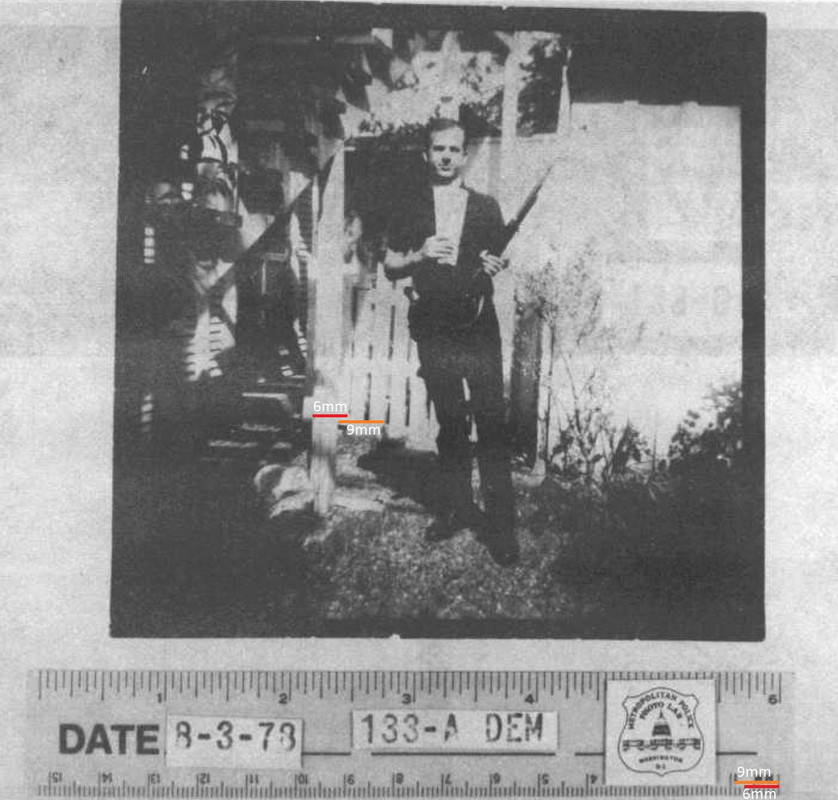
    Secondly, you're either being really dishonest or absolutely clueless, I asked you before what these millimeter changes are relative to, are we talking about a postage stamp size photo, a newspaper size photo, an actual size from the location photo or a billboard size photo? A close look at the actual HSCA document shows that the size of the post to the lower picket that the HSCA measured was only 6.8mm(0.27 inch), a measurement that you conveniently keep leaving out of your posts because without context the quoted measurements that you mindlessly keep repeating are meaningless.


    The recovered de Mohrenschildt photo appears to be about the size of the photo that correlates to the millimeter measurements used by the HSCA and as we can see the overall width of the photo is less than 5.5 inches which is proportionally many times less than the actual size of the real world location. Doh!


    JohnM


    « Last Edit: August 13, 2020, 01:01:34 AM by John Mytton »

    Online John Mytton

    • Hero Member
    • *****
    • Posts: 5120
    Re: JFK's Head Snap and the Implausible Jet-Effect and Neurospasm Theories
    « Reply #251 on: August 13, 2020, 03:13:29 AM »
    You realize the HSCA were not talking about the parallax differences in terms of life-scale?

         "such impossibly tiny differences in the distances between their background objects"

    Yep. It appears you don't.


    Quote
    Yep. It appears you don't.

     :D

    JohnM