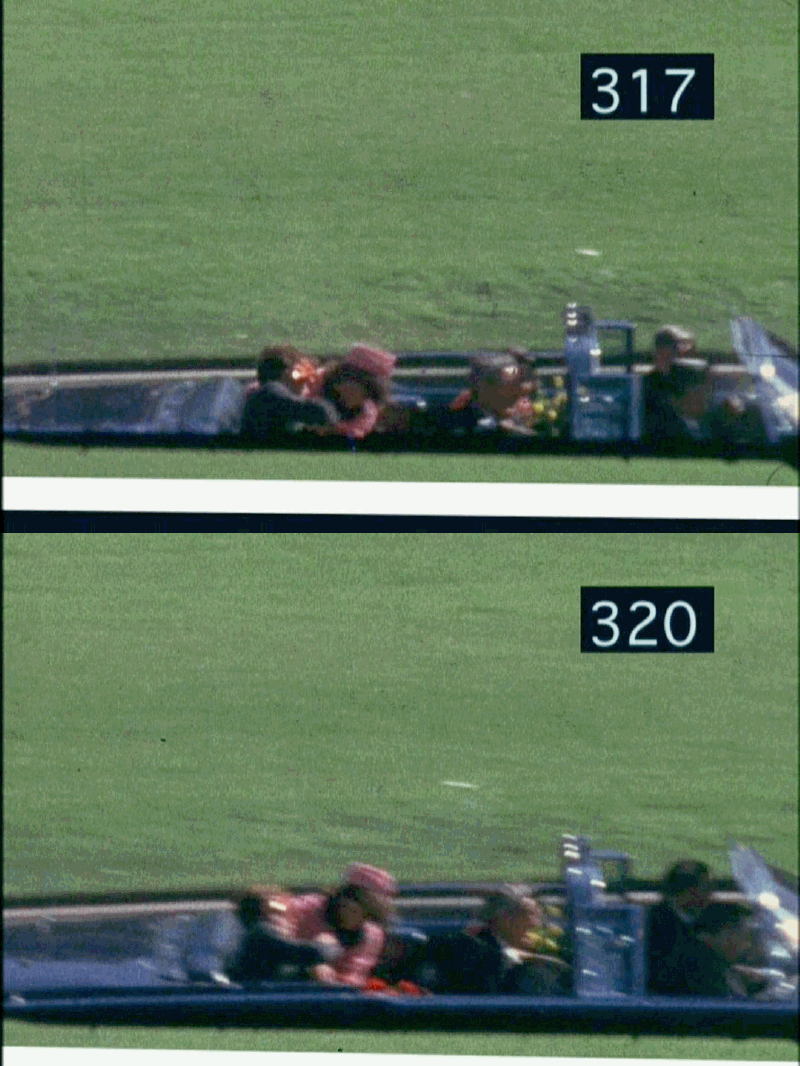
How long does it take to alter hundreds of frames of film?

Users Currently Browsing This Topic:
0 Members

Author Topic: How long does it take to alter hundreds of frames of film?  (Read 96754 times)

Offline John Mytton

  • Hero Member
  • *****
  • Posts: 5118
Re: How long does it take to alter hundreds of frames of film?
« Reply #21 on: January 10, 2018, 07:09:13 AM »
What are my objectives on this forum, Mytton?

What are your objectives on this forum? What makes you try so hard? What are you trying to accomplish?

"If you're not part of the solution, you're part of the coverup."

Are YOU part of the coverup?


Quote
What are my objectives on this forum, Mytton?

To obfuscate as much as possible and make CTs appear to be Paranoid Kooks!

Quote
What are your objectives on this forum?

To learn about a time period that is interesting and I like the photo side where you work with a lump of clay and try to create a masterpiece.

Quote
What makes you try so hard?

I'm a perfectionist.

Quote
What are you trying to accomplish?

To make the World a better Place, and wipe out World War and World Hunger!


JohnM


Offline Jack Trojan

  • Hero Member
  • *****
  • Posts: 864
Re: How long does it take to alter hundreds of frames of film?
« Reply #22 on: January 10, 2018, 11:32:11 PM »
This was explained to you in the other thread, as soon as images are combined in an optical printer you have a degraded image with additional layers of grain. The special effects in movies at the time were locked off matte shots or blue screen work and not suitable for Zapruder type alterations.

It's just too easy. You are in no position to comment since it has been shown time and again that you don't have a clue about film. An optical printer adds no more grain to film than it does when it makes a copy. Who the hell said anything about overlays and matting? Give your head a shake and get in the game at least. How the hell can you analyse the grain on a copy of the original and tell me an optical printer wasn't used to create it? Duh.

Quote
The Zapruder frames reveal no build up of Film grain and thus the film was exposed in Zapruder's camera.

Super BS.

Quote
As soon as even one frame is removed you introduce an obvious stutter but throughout the Zapruder film is silky smooth. In the following gif only one frame was removed and the resulting lack of fluidity is plain to see.

You mean like this? ;)


This is why only a few alternating frames can be removed to speed up the limo without a perceptible herky jerkiness. And I never claimed the limo was sped up, only that I have concerns and that it could have been done, easy peasy. But why did it slow down in the first place smart guy? I won't hold my breath for your obfuscation.

Quote
You do realize that blackening one frame requires the exact correct pigment of black to match the surrounding level of black and then  when you start a series of frames then you have to consider how your black is affected by the movement and constantly changing lightsource that have a direct effect on your black, so in other words without advanced computer cycles to calculate the various intensities of black you're not going to provide anything close to photorealistic.

Are you serial? Hahaha!

Quote
Or maybe because an 8mm camera only takes a limited amount of film and Zapruder had already used some of the film so was simply saving film for Kennedy.

Not according to Zapruder, but what would he know?

Offline Jack Trojan

  • Hero Member
  • *****
  • Posts: 864
Re: How long does it take to alter hundreds of frames of film?
« Reply #23 on: January 10, 2018, 11:50:08 PM »


Yeah I thought it was hilarious too, now he's physicist who is also a photogrammetrist on the side.
Too bad all the old posts got scrapped because the list of what professions Trojan magically morphed into to support any number of his arguments was staggering.
He claimed to be a photo something or other expert but didn't know the about the difference in size between 35mm still and motion picture film then he put the sprockets on the wrong side, he tries to bluff his way through but keeps getting busted.


JohnM

Geo-physics->Geomatics->Photogrammetry

There are lots of us out there in the GIS world, dufus. Just ask Google Earth. You should try taking a course sometime instead of spending countless hours spouting LNer obfuscation on a JFK forum.

Offline John Mytton

  • Hero Member
  • *****
  • Posts: 5118
Re: How long does it take to alter hundreds of frames of film?
« Reply #24 on: January 11, 2018, 12:36:19 AM »
It's just too easy. You are in no position to comment since it has been shown time and again that you don't have a clue about film. An optical printer adds no more grain to film than it does when it makes a copy. Who the hell said anything about overlays and matting? Give your head a shake and get in the game at least. How the hell can you analyse the grain on a copy of the original and tell me an optical printer wasn't used to create it? Duh.

Super BS.

You mean like this? ;)


This is why only a few alternating frames can be removed to speed up the limo without a perceptible herky jerkiness. And I never claimed the limo was sped up, only that I have concerns and that it could have been done, easy peasy. But why did it slow down in the first place smart guy? I won't hold my breath for your obfuscation.

Are you serial? Hahaha!

Not according to Zapruder, but what would he know?


Quote
You are in no position to comment since it has been shown time and again that you don't have a clue about film.

Aren't you the "film expert" that said any ghost image in the sprocket area was impossible with Zapruder's Bell and Howell, and also thought the size of 35mm photographic film should allow for the sprockets and for that matter you put the sprockets on the wrong end, WOWOW??? LMFAOYD!

Quote
An optical printer adds no more grain to film than it does when it makes a copy.

The purpose of an Optical Printer is to combine different pieces of film footage into one combined piece of footage, which is useful for locked off shots or combining elements with previously shot blue screen footage, so basically to produce any type of special effect requires multiple passes. You keep espousing the virtues of using an optical printer but have not yet produced any methodology, you claimed something happened but don't say what that was.  But alas some before your have tried and failed, just look at David Healey who is light years ahead of you in technical knowledge and can more or less visualise his ideas instead of speaking from a Wiki search.

David claims that the Limo was cut out, I'm guessing with a very sharp knife and was recomposited over the background and enlarged, why, who the fcuk knows! But anyway first of all this makes hideous outlines and can be instantly spotted because there is no natural bleeding, the new differing position of the lighting will be geometrically incorrect thus instantly spotable and how do you trace around objects which have heavy motion blur.

Here we see the basic concept of compositing various elements with an Optical Printer and the result even with computers shows heavy borders around the occupants and is not close to photorealistic.


David tried using photoshop which has many levels of benefit over a traditional chop and paste with an Optical Printer and what he produced also isn't photorealistic.
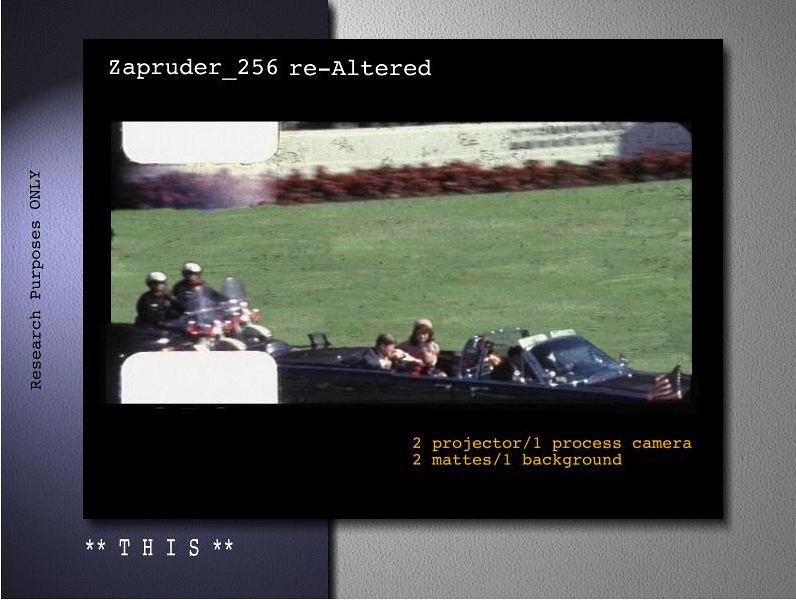


Hahaha, compositing ain't easy.


Btw if an Optical Printer could produce results like the amazing images we see in Zapruder then why does virtually nobody use them any more?


Look here and learn from Zavada.

http://www.jfk-info.com/zavada1.htm


JohnM
« Last Edit: January 11, 2018, 07:26:15 AM by John Mytton »

Offline John Mytton

  • Hero Member
  • *****
  • Posts: 5118
Re: How long does it take to alter hundreds of frames of film?
« Reply #25 on: January 11, 2018, 12:46:50 AM »
Geo-physics->Geomatics->Photogrammetry

There are lots of us out there in the GIS world, dufus. Just ask Google Earth. You should try taking a course sometime instead of spending countless hours spouting LNer obfuscation on a JFK forum.


Geo-physics->Geomatics->Photogrammetry

WOW, and you also lower yourself to the mundane work of Optical Printer Operator, you're an astrophysicist,  and you're an astronaut and your dad's the President!


JohnM

Offline Tim Nickerson

  • Hero Member
  • *****
  • Posts: 2109
Re: How long does it take to alter hundreds of frames of film?
« Reply #26 on: March 26, 2018, 04:58:57 AM »
I'm a physicist.  ;D

Sure you are. And Rob Caprio is the Lucasian Professor of Mathematics.

Offline Steve Thompson

  • Newbie
  • *
  • Posts: 25
Re: How long does it take to alter hundreds of frames of film?
« Reply #27 on: March 26, 2018, 03:05:43 PM »
By my count, there's at least the Zapruder, Nix, Muchmore, Bell, Bronson, Dorman, Hughes, and Towner films that show JFK in Dealy Plaza.

To those of you who believe the Zapruder film has been altered, it might help everyone to understand your position if you could tell the rest of us two things:
*  Which of these films do you believe have been altered ?
*  Which of these films do you believe have not been altered ?

Many thanks...