The First Shot

Users Currently Browsing This Topic:
0 Members

Author Topic: The First Shot  (Read 451459 times)

Offline Dan O'meara

  • Hero Member
  • *****
  • Posts: 3774
Re: The First Shot
« Reply #798 on: March 09, 2022, 11:30:18 PM »
You can see hand movement from z200-207.  That is before you say there was a first shot at z223.   One sees that JFK's hands have moved from the high waving position in z200 to hands in front of his torso at z224.  That could not have occurred between z223 and z224 (55 ms).  So you must be assuming that it occurred prior to the first shot.

When you write - "One sees that JFK's hands have moved from the high waving position" - you are talking about JFK's right hand (not hands). Nowhere in my post have I used JFK's right hand/arm to demonstrate the "instantaneous" reflex reaction caused by the effect of the bullet and accompanying cavitation traumatising the area of the Brachial Plaexus through which the bullet transits. I made this clear when I posted:

"The best way to gauge when JFK begins to react is to focus on his left arm."

LEFT ARM

",,,reaching back into the limo holding his left hand, which appears to rest on his stomach area, his left elbow down by his side. He releases his left hand as he begins to wave with his right. His left hand stays resting on his stomach area, his left elbow down by his side. His left arm/hand stays in this position as he goes behind the sign and is still in this position as he emerges from it:[/b]

If I haven't been clear enough, allow me to clarify.
In the clip below focus on JFK's LEFT ARM/HAND:
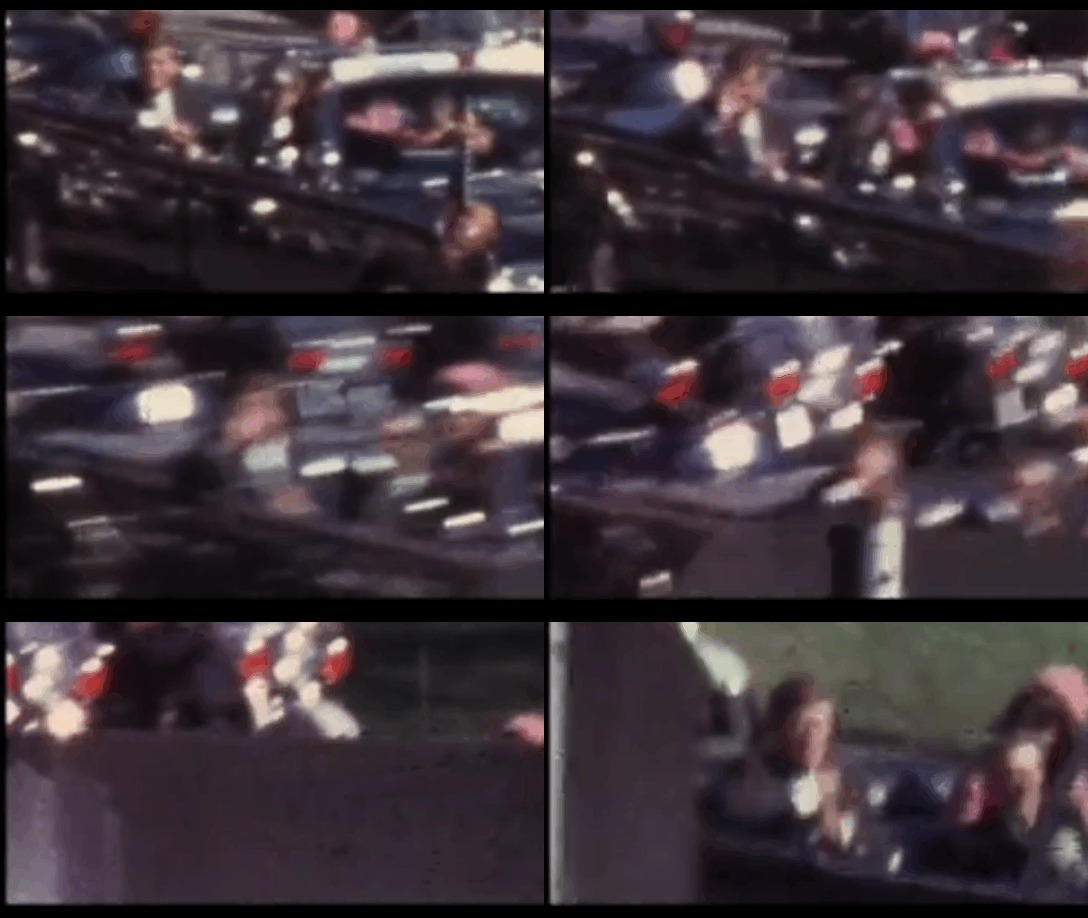


JFK's left arm is down by his side and his left hand is resting on his stomach area. It's a relaxed position and it stays like this as he passes behind the Stemmons sign.

Now here comes the important part -

As JFK emerges from behind the Stemmons sign his left arm is still down by his side and his left hand is still resting on his stomach area.
The reason this important is because it shows there has been no movement of JFK's left arm/hand as he passes behind the Stemmons sign, it is in the same position. There is no sign that the left arm/hand is reacting to anything when we see JFK emerge from behind the Stemmons sign.

The Gif below shows Z-frames 224. 225. and 226.
Still focusing on JFK's LEFT ARM/HAND:

z224 shows the left arm down by the side. The left elbow is hidden below the edge of the door.
z225 shows a slight movement of the left arm but the left elbow is still below the edge of the door.
z226 shows the left arm is definitely beginning to rise as the left elbow comes above the edge of the door.
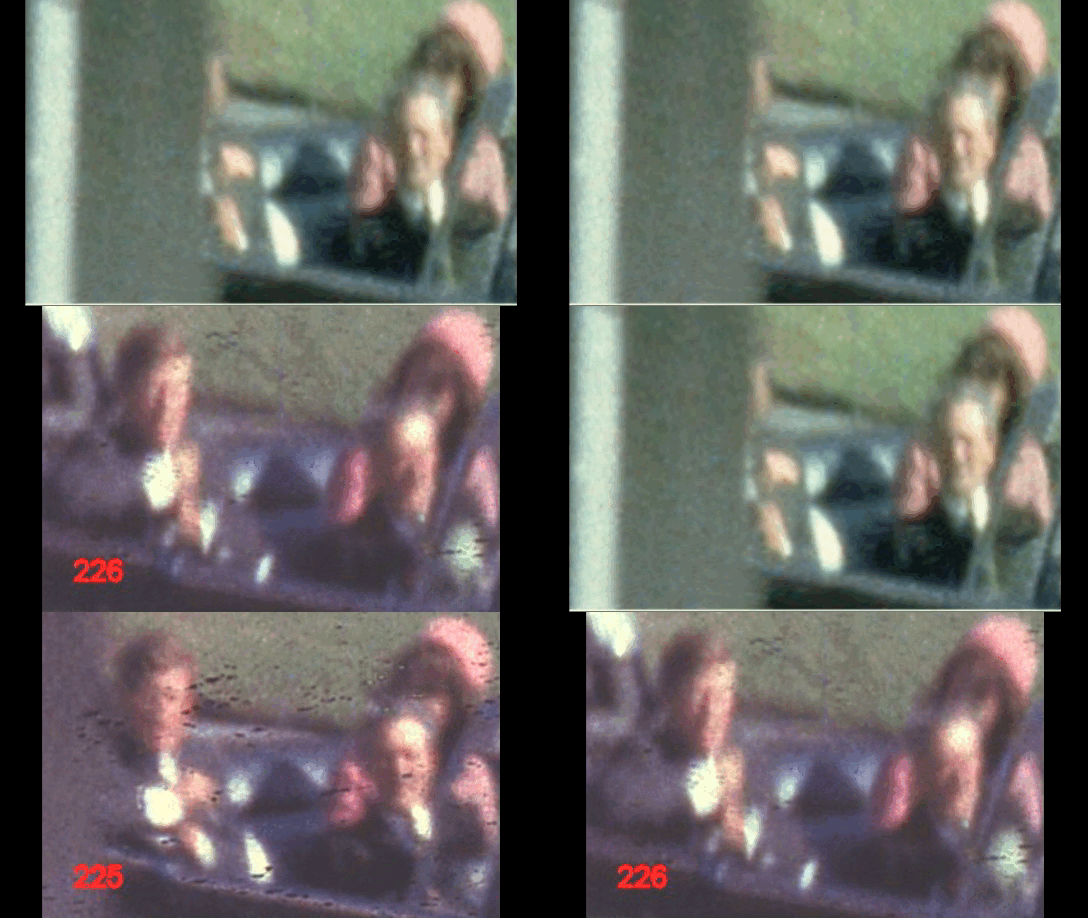


It must be remembered that as the Z-film rolls on from this point we see both JFK's arms flying up to the "elbows fully extended" position within a fraction of a second. JFK's left arm coming up from his side, as shown in the Gif above, is the beginning of his rapid and extreme reaction to the effect of the bullet and cavitation passing through the Brachial Plexus.
This is made clear by the comments of Drs Artwohl and Strully:

“JFK’s reaction to the neck wound was, for all intents and purposes, instantaneous to the hit at Z-223/224. As the bullet passed through his neck, the pressure cavity caused an immediate and wide spread stimulation of all the nerves in the immediate vicinity, that is of the brachial plexus, the large group of nerves that emerge from C5-T1. These are the nerves that supply motor function to the arms.

The nerves of the Brachial Plexus supply the motor functions to the arms.

"Before all else, it is necessary to remember that this assassination reveals a sequence of neural responses initiated in the neck by the shock wave and cavitation induced by the bullet in its traverse of the neck.  This traumatized all structures in a 6 inch radius in all directions from the path of passage through the neck.  This spread of forces occurred in a fraction of a second, traumatizing all neural structures in the immediate vicinity within a fraction of a second as determined by the speed of the missile according to ballistic studies.

The result of cavitation is that the nerves of the Brachial Plexus are traumatised within a fraction of a second. This has an "instantaneous" effect on the nerves that supply the motor functions for the arms. Dr. Strully describes the effect we see happening to JFK in detail:

"As a result, contraction of the muscles innervated by nerves closest to the bullet's path took place first; -- right deltoid, left deltoid, right biceps followed by the left biceps and sequential contraction of all muscles in the forearms, hands, chest, abdominal walls and paraspinal muscle groups, with muscles in the lower extremities, farthest from the shock wave, responding last.  All neural structures in the neck were stimulated at the same moment…

Within a fraction of a second all the muscles described by Dr Strully contract. It is this contraction of these muscles that we see in the Z-film and the analysis of the left arm presented above demonstrates conclusively that this reflex reaction can be visually seen to be taken place by z225/6.
This means the stimulus that caused this radical reaction occurred a fraction of a second before this.
Perfectly in accordance with a strike at z223.

Finally, it can be stated conclusively that such a strike at z195 would have caused JFK's arm's to fly up before he even went behind the Stemmons sign. Any strike earlier than z223 is utterly refuted by the effect of the bullet and accompanying cavitation on the nerves of the Brachial Plexus.

« Last Edit: March 09, 2022, 11:32:23 PM by Dan O'meara »

Online Andrew Mason

  • Hero Member
  • *****
  • Posts: 1655
    • SPMLaw
Re: The First Shot
« Reply #799 on: March 10, 2022, 12:50:58 AM »
When you write - "One sees that JFK's hands have moved from the high waving position" - you are talking about JFK's right hand (not hands). Nowhere in my post have I used JFK's right hand/arm to demonstrate the "instantaneous" reflex reaction caused by the effect of the bullet and accompanying cavitation traumatising the area of the Brachial Plaexus through which the bullet transits. I made this clear when I posted:

"The best way to gauge when JFK begins to react is to focus on his left arm."

LEFT ARM

",,,reaching back into the limo holding his left hand, which appears to rest on his stomach area, his left elbow down by his side. He releases his left hand as he begins to wave with his right. His left hand stays resting on his stomach area, his left elbow down by his side. His left arm/hand stays in this position as he goes behind the sign and is still in this position as he emerges from it:[/b]
So you agree that the movement of the right arm from the high position in z200 to the claw position seen in z225 is just a coincidence. 

There is a small but noticeable change in the orientation of the left hand.  Prior to the sign it appears to be relaxed and directed across his body. In z224 it is in a claw position pointing up and you can see his watch:

Quote
"As a result, contraction of the muscles innervated by nerves closest to the bullet's path took place first; -- right deltoid, left deltoid, right biceps followed by the left biceps and sequential contraction of all muscles in the forearms, hands, chest, abdominal walls and paraspinal muscle groups, with muscles in the lower extremities, farthest from the shock wave, responding last.  All neural structures in the neck were stimulated at the same moment…

Within a fraction of a second all the muscles described by Dr Strully contract. It is this contraction of these muscles that we see in the Z-film and the analysis of the left arm presented above demonstrates conclusively that this reflex reaction can be visually seen to be taken place by z225/6.
This means the stimulus that caused this radical reaction occurred a fraction of a second before this.
Perfectly in accordance with a strike at z223.

Finally, it can be stated conclusively that such a strike at z195 would have caused JFK's arm's to fly up before he even went behind the Stemmons sign. Any strike earlier than z223 is utterly refuted by the effect of the bullet and accompanying cavitation on the nerves of the Brachial Plexus.

I doubt very much that the temporary cavity was much bigger than the bullet diameter.  The bullet went through the strap muscles of the upper back, which are very strong muscles because they control the head and keep it vertical.  One would need some evidence that a bullet through a body at this point will cause reflex movement of the arms.  I don't see any evidence of that. It is just a theory and without testing the theory it really doesn't amount to anything. 
« Last Edit: March 10, 2022, 12:55:38 AM by Andrew Mason »

Offline Dan O'meara

  • Hero Member
  • *****
  • Posts: 3774
Re: The First Shot
« Reply #800 on: March 10, 2022, 01:34:19 AM »
So you agree that the movement of the right arm from the high position in z200 to the claw position seen in z225 is just a coincidence. 

There is a small but noticeable change in the orientation of the left hand.  Prior to the sign it appears to be relaxed and directed across his body. In z224 it is in a claw position pointing up and you can see his watch:
I doubt very much that the temporary cavity was much bigger than the bullet diameter.  The bullet went through the strap muscles of the upper back, which are very strong muscles because they control the head and keep it vertical.  One would need some evidence that a bullet through a body at this point will cause reflex movement of the arms.  I don't see any evidence of that. It is just a theory and without testing the theory it really doesn't amount to anything.

What a piss-poor response. I honestly don't know why you bothered.

"I doubt very much that the temporary cavity was much bigger than the bullet diameter."

 :D :D :D

Is that your expert opinion?

"One would need some evidence that a bullet through a body at this point will cause reflex movement of the arms."

Then one should read my posts.


Online Andrew Mason

  • Hero Member
  • *****
  • Posts: 1655
    • SPMLaw
Re: The First Shot
« Reply #801 on: March 11, 2022, 09:05:05 PM »
What a piss-poor response. I honestly don't know why you bothered.
So, then I don't know why you can't answer it.  You can't see the difference in his hand positions between z200 and z224, including his left hand?

Quote
"I doubt very much that the temporary cavity was much bigger than the bullet diameter."

Is that your expert opinion?
Experts have to persuade non-experts, like judges.  Your model and theory is not persuasive for a number of reasons.  A recognized ballistics expert, Vincent DiMaio's (Gunshot Wounds, Practical Aspects of Firearms, Ballistics and Forensic Techniques, 1999 at Ch. 3) says:

"The size of both the temporary and the permanent cavities is determined not only by the amount of kinetic energy deposited in the tissue but also by the density and elastic cohesiveness of the tissue."

DiMaio shows that the temporary cavity of a jacketed bullet starts being confined to the matter very close to the bullet path and increases with bullet yaw. A non-jacketed bullet that expands on impact transfers more energy on entry than a jacketed bullet.  He provides a profile of the temporary cavities from different bullets:


"A full metal jacketed rifle bullet will produce a cylindrical cavity until it begins to yaw. At this time, the bullet’s cross-sectional area will become larger, and the drag force will be increased. The result is an increase in kinetic energy loss and thus an increase in the diameter of the temporary cavity (Figure 3.2A). "

You want us to believe that your video of a bullet passing through ballistic gel represents the path of a 6.5 mm jacketed bullet would do when passing near JFK's thoracic spine about an inch after entering.  Your video looks nothing like the path of a jacketed rifle bullet in the first profile in DiMaio's drawing Fig. 3.2

Your theory seems to be that the bullet created enormous lateral force between the bullet path and the nerves exiting the spine at T1-T2, which is maybe an inch into the body at that point.  The 6.5 mm round nose bullet is very stable and the entry wound shows no signs of yaw.  You need to show that the lateral force near the bullet entry point would displace the spinal nerves located about an inch away.

Quote
"One would need some evidence that a bullet through a body at this point will cause reflex movement of the arms."

Then one should read my posts.
As I said, this is all good theory.  It just needs some empirical evidence to support it. 

Offline Dan O'meara

  • Hero Member
  • *****
  • Posts: 3774
Re: The First Shot
« Reply #802 on: March 12, 2022, 01:24:20 AM »
So, then I don't know why you can't answer it.  You can't see the difference in his hand positions between z200 and z224, including his left hand?

Answer what?
That JFK's right hand is moving between z200 and z224?
Of course it is, I've never said it's not. I've made it specifically clear I was talking about his left arm but you started going on about his right hand waving because you don't know what else to do.

Quote
Experts have to persuade non-experts, like judges.  Your model and theory is not persuasive for a number of reasons.  A recognized ballistics expert, Vincent DiMaio's (Gunshot Wounds, Practical Aspects of Firearms, Ballistics and Forensic Techniques, 1999 at Ch. 3) says:

"The size of both the temporary and the permanent cavities is determined not only by the amount of kinetic energy deposited in the tissue but also by the density and elastic cohesiveness of the tissue."

DiMaio shows that the temporary cavity of a jacketed bullet starts being confined to the matter very close to the bullet path and increases with bullet yaw. A non-jacketed bullet that expands on impact transfers more energy on entry than a jacketed bullet.  He provides a profile of the temporary cavities from different bullets:


"A full metal jacketed rifle bullet will produce a cylindrical cavity until it begins to yaw. At this time, the bullet’s cross-sectional area will become larger, and the drag force will be increased. The result is an increase in kinetic energy loss and thus an increase in the diameter of the temporary cavity (Figure 3.2A). "

You neglected to mention this paragraph which you must have read as it's just before the ones you've posted:

"The picture is radically different in the case of a high-velocity rifle bullet.
As the bullet enters the body, there is a “tail splash,” or backward hurling of
injured tissue. This material may be ejected from the entrance. The bullet
passes through the target, creating a large temporary cavity whose maximum
diameter is up to 11 to 12.5 times the diameter of the projectile."


Every diagram Di Maio has drawn shows cavitation many times wider than the path of the bullet.
Thank you for providing evidence to support my argument.

Quote
You want us to believe that your video of a bullet passing through ballistic gel represents the path of a 6.5 mm jacketed bullet would do when passing near JFK's thoracic spine about an inch after entering.  Your video looks nothing like the path of a jacketed rifle bullet in the first profile in DiMaio's drawing Fig. 3.2

Your theory seems to be that the bullet created enormous lateral force between the bullet path and the nerves exiting the spine at T1-T2, which is maybe an inch into the body at that point.  The 6.5 mm round nose bullet is very stable and the entry wound shows no signs of yaw.  You need to show that the lateral force near the bullet entry point would displace the spinal nerves located about an inch away.


What nerves exiting the spine between T2 and T2?
Who mentioned nerves exiting the spine between T1 and T2?

"...which is maybe an inch into the body at that point."

What ??

Quote
As I said, this is all good theory.  It just needs some empirical evidence to support it.

Would empirical evidence include the position of the wound on JFK's upper back/lower neck?
Would it include the fact the bullet traversed his body through the Brachial Plexus?
Would it include the fact the nerves of the Brachial Plexus supply the motor functions of the arms/hands?
Would it include the fact that cavitation occurs?
Would it include the extreme and unbelievably rapid of JFK's reactions as captured in the Z-film?

If not, what kind of empirical evidence are you after?


Online Andrew Mason

  • Hero Member
  • *****
  • Posts: 1655
    • SPMLaw
Re: The First Shot
« Reply #803 on: March 12, 2022, 06:50:02 PM »
Answer what?
That JFK's right hand is moving between z200 and z224?
I said that both hands move and change orientation between z200 and z224. So you are attributing that to simple coincidence. You don't seem to want to admit that this is necessarily what you are saying.

Quote
You neglected to mention this paragraph which you must have read as it's just before the ones you've posted:

"The picture is radically different in the case of a high-velocity rifle bullet.
As the bullet enters the body, there is a “tail splash,” or backward hurling of
injured tissue. This material may be ejected from the entrance. The bullet
passes through the target, creating a large temporary cavity whose maximum
diameter is up to 11 to 12.5 times the diameter of the projectile."
Which, he goes on to explain, develops as the bullet yaws. How much did this bullet yaw in passing through the first inch or so of JFK's back/neck? Did it yaw much at all anywhere in his body? The WC ballistics scientists didn't think so.

Quote
Every diagram Di Maio has drawn shows cavitation many times wider than the path of the bullet.
Thank you for providing evidence to support my argument.
Many times? You have to quantify that. Is it twice the diameter? 3 times? Not much more than that initially, judging by the diagram if the maximum is 11-12.5 times.

You are saying that the temporary cavity after travelling about an inch into JFK's back was large enough to jolt the nerves exiting the spine.  That requires a cavity extending at least an inch outward from the bullet. That's a cavity with a diameter of 50 mm or about 8 times the diameter of the bullet. If the maximum is around 11 to 12.5  times when the bullet is going sideways, how do you get that large a cavity?


Quote
What nerves exiting the spine between T2 and T2?
Who mentioned nerves exiting the spine between T1 and T2?

"...which is maybe an inch into the body at that point."

What ??

Would empirical evidence include the position of the wound on JFK's upper back/lower neck?
Would it include the fact the bullet traversed his body through the Brachial Plexus?
Would it include the fact the nerves of the Brachial Plexus supply the motor functions of the arms/hands?
Would it include the fact that cavitation occurs?
Would it include the extreme and unbelievably rapid of JFK's reactions as captured in the Z-film?

If not, what kind of empirical evidence are you after?
First of all, one could measure the pressure around the bullet path of a 6.5 mm bullet passing through similar biological material as a function of distance from the bullet track and distance along the track. One could then measure the pressure required to excite the nerves near the neck. From that one could the see whether it is even possible to stimulate those nerves from a bullet passing near them and, if so, quantify how close it would have to be and how far along the path it would have to be.
« Last Edit: March 12, 2022, 09:29:56 PM by Andrew Mason »

Offline Dan O'meara

  • Hero Member
  • *****
  • Posts: 3774
Re: The First Shot
« Reply #804 on: March 24, 2022, 01:19:58 AM »
I said that both hands move and change orientation between z200 and z224. So you are attributing that to simple coincidence. You don't seem to want to admit that this is necessarily what you are saying.
Which, he goes on to explain, develops as the bullet yaws. How much did this bullet yaw in passing through the first inch or so of JFK's back/neck? Did it yaw much at all anywhere in his body? The WC ballistics scientists didn't think so.
Many times? You have to quantify that. Is it twice the diameter? 3 times? Not much more than that initially, judging by the diagram if the maximum is 11-12.5 times.

You are saying that the temporary cavity after travelling about an inch into JFK's back was large enough to jolt the nerves exiting the spine.  That requires a cavity extending at least an inch outward from the bullet. That's a cavity with a diameter of 50 mm or about 8 times the diameter of the bullet. If the maximum is around 11 to 12.5  times when the bullet is going sideways, how do you get that large a cavity?

First of all, one could measure the pressure around the bullet path of a 6.5 mm bullet passing through similar biological material as a function of distance from the bullet track and distance along the track. One could then measure the pressure required to excite the nerves near the neck. From that one could the see whether it is even possible to stimulate those nerves from a bullet passing near them and, if so, quantify how close it would have to be and how far along the path it would have to be.

The argument I'm putting forward is extremely simple.
It is an explanation for the unbelievably rapid movement of JFK's left arm
In z224 his left arm is down by his side:


Six Z-frames later (z232) his left arm has extended upwards to a very extreme position:


This movement takes place in approximately 0.33 seconds - one third of a second.
In one third of a second JFK's left arm has gone from a resting position down by his side to a position where his left elbow is extended upwards to, what appears to be, it's fullest extent.
The rapidity of this movement is indicative of a reflex reaction to a stimulus of the nerves controlling the function of the arms. These nerves are collectively known as the Brachial Plexus. It is no coincidence that the bullet which passes through JFK, passes through the Brachial Plexus at the approximate position represented in this graphic by the red dot:


Artwohl makes the following point:

“JFK’s reaction to the neck wound was, for all intents and purposes, instantaneous to the hit at Z-223/224. As the bullet passed through his neck, the pressure cavity caused an immediate and wide spread stimulation of all the nerves in the immediate vicinity, that is of the brachial plexus, the large group of nerves that emerge from C5-T1. These are the nerves that supply motor function to the arms.”

The measurable, extremely rapid movement of JFK's left arm is evidence the nerves of the Brachial Plexus were damaged by a bullet that passed through this large group of nerves. This damage may have been caused by the bullet itself, severing  a nerve, and the effect of cavitation, which may have contributed to further stimulation of the nerves.