Welcome, Guest. Please login or register.

Author Topic: Acoustic Evidence  (Read 3126 times)

Online Michael T. Griffith

  • Hero Member
  • *****
  • Posts: 2000
    • JFK Assassination Website
Re: Acoustic Evidence
« Reply #56 on: Today at 02:59:49 PM »
Thompson thinks the two men Bowers saw were "behind" the fence (see excerpt below). They weren't. They were in front.

As Bowers testified:
Mr. BOWERS - "Directly in line, towards the mouth of the underpass, there were two men. One man, middle-aged, or slightly older, fairly heavy-set, in a white shirt, fairly dark trousers. Another younger man, about midtwenties, in either a plaid shirt or plaid coat or jacket."

Note: Plaid shirt/coat/jacket.. The obvious choice of clothing for any sniper.

And:
Mr. BOWERS - They were standing within 10 or 15 feet of each other, and gave no appearance of being together, as far as I knew.

And:
Mr. BOWERS - He [DPD motorcycle officer Haygood] came up into this area where there are some trees, and where I had described the two men were in the general vicinity of this.
Mr. BALL - Were the two men there at the time?
Mr. BOWERS - I--as far as I know, one of them was. The other I could not say. The darker dressed man was too hard to distinguish from the trees. The white shirt, yes; I think he was.

The man in plaid coat/jackert is on the left below. To his right is the older man in the white shirt (most likely Emmett Hudson, the Plaza grounds keeper). These are, based on all of his statements, the two men I think Bowers saw "towards the mouth of the underpass." You can't be "towards the mouth of the underpass" if you are behind the fence.

One, you're forgetting that Bowers made a point of saying he didn't recognize the two men. Bowers had been working there for years and he noticed the two men because he had never seen them before. He would have recognized Hudson.

Two, by only quoting Bowers' WC testimony, you're ignoring the fact that he gave a more detailed description of where the two men were located in his interviews with Lane and Thompson. In his interview with Lane, which Thompson quotes but which you omitted, Bowers said the two men were standing near the wooden fence and that they were standing in the vicinity of where he saw the flash of light or smoke:

These two men were standing back from the street somewhat at the top of the incline and were very near two trees which were in the area. . . . in the vicinity of where the two men I’ve described were . . . something which occurred which caught my eye in this immediate area on the embankment. . . a flash of light or smoke or something which caused me to feel like something out of the ordinary had occurred there" (Thompson, Last Second in Dallas, pp. 126-127).

Three, we have seen that you, Mitch Todd, and John Corbett have no logical, credible explanation for the three cars' obvious recon of the area behind the knoll in the 25 minutes before the shooting. For starters, nobody would have accidentally taken the extension road into the parking lot. That is just silly. And, it would not have taken 3-4 minutes and longer for those cars to look for a parking space or to figure out that the extension road was the only exit from the small parking lot (Bowers himself said the parking lot was small, a fact that you can confirm by period photos of the lot).

Note: Bowers never mentions hearing a shot from the fence. Or seeing anyone with a rifle. These are called clues, clues there wasn't a gunman behind the fence. In JFK conspiracy world they are clues there *was* a gunman. But of course.

You still have not laid a finger on the scientific acoustical evidence that gunfire came from the grassy knoll. Let me remind you, yet again, that the NRC/NAS panel members were only able to reduce the probability of the grassy knoll shot to 77.7%, which is still a high probability, and that they did this by introducing two inexcusable errors into their calculations.

Your chief critic of the acoustical evidence here has proved he has no credibility by repeating the long-debunked amateurish, unscientific nonsense that N-waves are not unique to gunfire, obviously unaware that there is a big difference between gunfire N-waves and crude N-waves produced by random noise, as two of the HSCA's acoustical scientists explained in great detail when Congressman Edgar ignorantly suggested that the dictabelt's N-waves were merely random noise. Heck, if your chief critic had even bothered to Google this, he would have known better. Out of curiosity, I asked Google AI "What is the difference between an N-wave caused by random noise and an N-wave caused by gunfire?" and Google AI replied by saying that random noise "might crudely mimic" a gunfire N-wave but that there are clear differences between the two, just as the HSCA's acoustical scientists noted:

Gunfire: A bullet traveling at supersonic speeds creates a true physical shock cone (Mach cone). When this passes a microphone, it produces a mathematically clean, highly symmetric N-wave. The drop from peak overpressure to the negative under-pressure phase is a direct, smooth linear line.

Random Noise: A sudden loud noise (like a mechanical clatter, wind buffet, or digital glitch) might crudely mimic an N-wave on a graph if it has a sharp onset and decay. However, the line between its positive and negative peaks is usually jagged, asymmetrical, and filled with micro-fluctuations because it isn't governed by a uniform supersonic shock cone. (Google AI results for "What is the difference between an N-wave caused by random noise and an N-wave caused by gunfire?")


The HSCA's acoustical scientists spent many pages explaining the difference between the oscillographic traits of soundwaves created by gunfire vs. the oscillographic traits of soundwaves created by random noise. Again, even the NRC/NAS panel did not claim that the dictabelt's N-waves were merely random noise. How did the panel explain the presence of gunfire N-waves on the dictabelt? They offered no explanation for them. They just ignored them. 

Bowers never publicly mentioned "hearing a shot from the fence," but he repeatedly said he saw an unusual event behind the fence that drew his attention to that spot during the shooting ("a flash of light or smoke or something which caused me to feel that something out of the ordinary had occurred there").

We have plenty of other credible evidence of gunfire from the knoll. For example: 

-- Julia Ann Mercer, the wife of a former U.S. Congressman, told law enforcement officials on the day of the shooting that before the assassination she saw a man carrying a rifle case and heading toward the grassy knoll. She said she was driving on Elm Street when she saw a man exit the back of a truck with an encased rifle in his hand, and that the man headed toward the grassy knoll. All of her accounts contain the same essential elements: there was a parked truck; there were two men in the truck; the man who was not driving took something from the back of the truck; the object that the man took from the back of the truck looked like a rifle encased in some kind of material; the man who exited the truck carrying an encased rifle headed up the grassy knoll.

Perhaps in tacit recognition of the essential consistency in Mercer’s accounts, John McAdams allowed that her initial statements to the Dallas sheriff’s department and the FBI were truthful, and he suggested that Mercer mistook a tool box for a gun case. However, even in her first statement, Mercer specified that the object the man was carrying was 3.5 to 4 feet long and 8 inches wide at its widest point and tapered down to 4 or 5 inches wide at its narrowest point, which obviously rules out a tool box.

-- Five police officers said they were told by witnesses right after the shooting that gunfire had come from the grassy knoll. Anthony Summers discusses one of them:

Another policeman, Patrolman Joe Smith, was holding up traffic across the road from the Book Depository when the motorcade passed by. On hearing the gunfire—and a woman cry out, “They’re shooting the President from the bushes!”—Smith ran to the grassy knoll, the only bushy place in the area. In 1978, he still remembered what he reported shortly after the assassination, that in the parking lot, “around the hedges, there was the smell, the lingering smell of gunpowder.” (Not in Your Lifetime, 2013, pp. 42-43)

In fact, we know that four other police officers were told by witnesses moments after the shooting that gunfire had come from the grassy knoll, as Thompson documented way back in 1967:

This "unusual occurrence—a flash of light or smoke or something" was observed by other witnesses who reported it to law-enforcement officers on the scene. Deputy Sheriffs L. C. Smith, Seymour Weitzman, A. D. McCurley, and J. L. Oxford all later spoke of witnesses who called their attention to the stockade fence. Smith reported that as he ran toward the knoll "I heard a woman unknown to me say the President was shot in the head and the shots came from the fence on the north side of Elm Street" (19 H 516). Weitzman recalled that:

"As he came to the fence at the top of the grassy slope, some bystander mentioned that the firecracker or shot had come from the other side of the fence, and he requested a bystander to bend over and he used the bystander's back as a step and vaulted over the fence" (Archives, CD 5).

McCurley and Oxford independently reported being told by a witness or witnesses that smoke had been seen near the corner of the stockade fence. McCurley recalled:

"I ran over and jumped a fence and a railroad worker stated to me that he believed the smoke from the bullets came from the vicinity of a stockade fence which surrounds the park area" (19 H 514).

Oxford gave a similar account:

"We jumped the picket fence which was along Elm Street and ran over into the railroad yards. When we got there, there was a man who told us that he had seen smoke up in the corner of the fence" (19 H 530). (Six Seconds in Dallas, 1967, pp. 115-121)


-- Jesse Price was watching the motorcade from the roof of the Terminal Annex Building. Immediately after the shots were fired, Price's attention was drawn to the area behind the grassy knoll because he saw a man running across the railyard behind the knoll. He said the man was running toward "the passenger cars on the railroad siding." In a filmed interview in 1966, Price said the man "was running very fast, which gave me the suspicion that he was doing the shooting." This man, Price added, "was carrying something in his right hand," which "could have been a gun."

Here is Thompson in his book. Notice the dismissal of Bower's friends' accounts? "Garbled at best". In fact, if you read the entire section on Bowers you'll see that Thompson is dismissal of him too. He wants to use selected parts of Bowers account to support his more important witness: Sam Holland.
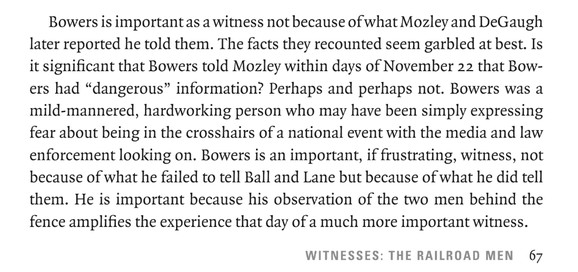

You can read his book online here: https://www.google.com/books/edition/Last_Second_in_Dallas/2MnDEAAAQBAJ?hl=en

The "dismissal" of the two friends' accounts? That's a bit of an overstatement. The curious "garbled at best" description clearly does not apply to Mozley's statement that Bowers told him he had dangerous information about the shooting, since Thompson assumes Bowers said this to Mozley and allows that the statement may be "significant."

And, again, just a few pages earlier, Thompson says DeGaugh's and Mozley's accounts are not like the 1990s accounts from other Bowers friends that are "not to be taken seriously," and that the two men's accounts "suggest that Bowers saw more than he revealed when questioned by Joe Ball and Mark Lane" (Last Second in Dallas, 2021, p. 128). Let's read it again:

Let's read again what Thompson says:

Also not to be taken seriously are reports from people who knew Bowers that he claimed to have seen one of the men he described put a rifle in the trunk of a car. These reports surfaced in the 1990s when various TV producers were in search of a story. The same cannot be said of the reports of two individuals who, like Bowers, worked for the Union Terminal Railroad.

Both suggest that Bowers saw more than he revealed when questioned by Joe Ball and Mark Lane.


The first is Olan DeGaugh. As yardmaster, he was several levels above Bowers in the railroad company hierarchy. In an oral history interview in 2002, he described Bowers as “a good person, a good worker, a good man. . . . . He was. . . .  one of my best friends.” When asked if he had talked to Bowers about the Kennedy assassination, he replied, “Several times. I don’t know how many times. Not a real long conversation.” When asked if Bowers ever varied his story about what happened that day, DeGaugh said, “I don’t think he ever changed it.”

And what did Bowers tell DeGaugh about the assassination?

DeGaugh said, “Well, the day Kennedy was assassinated, he [Bowers] was looking out the window and there was a car parked next to the board fence out here barely where the street ends and he saw someone holding the trunk of a car put something in it and drive off. And it had been assumed that it had been Oswald. It may have been Oswald.” DeGaugh said the car “was a coupe of some kind . . . an old car.” 

The second is Barney Mozley, the switchman who relieved Bowers by taking the “second trick” in the tower that Friday afternoon.  Also in 2002, Mozley gave an oral history interview. After explaining his difficulty in getting through police lines to relieve Bowers, Mozley pointed out that from the tower, “you can’t see the assassination. I mean, when there was actually shooting. You could hear it, but you couldn’t see it. That was the way it was.” He did talk to Bowers about the assassination within days of November 22.

QUESTION: Did he ever talk to you about the assassination at all ever?

ANSWER: Yeah, he did, but he didn’t want it to be repeated. And I never did say anything about him, but I can say something about him now. He was a . . . yeah, he would do that and tell you, “Now, don’t go around talking about it because,” he said, “It’s dangerous.” But he never said dangerous from whom.

QUESTION: How long after the assassination did he tell you that?

ANSWER: Oh, it was just a few days. (Last Second in Dallas, pp. 128-129)


There is really nothing "garbled" about Mozley's and DeGaugh's accounts if we consider that they were given in interviews and thus were spoken from memory and extemporaneously. Mozley was quite specific that it was only a few days after the shooting when Bowers said he didn't want Mozley to repeat what he had told him and that the information was "dangerous," and Mozley specified that Bowers did not say from whom the danger was posed. This has the ring of truth and credibility, which is probably why Thompson assumes that Bowers did in fact say this to Mozley and why he allows that Mozley's statement may be significant. 

And DeGaugh's recollection about Bowers seeing a man put something into the trunk of a car near the fence and drive off mirrors what Bowers' friend James Sterling told New Orleans DA investigator Gary Sanders in a 1967 witness statement: Sterling informed Sanders that Bowers told him that after the shots were fired, he saw two men running from behind the fence, that they ran up to a car, threw something in the trunk, jumped in the car, and drove off. I seriously doubt that DeGaugh was aware of Sterling's 1967 statement to Sanders, yet the essential similarity between the two accounts is obvious.

What we have here with Thompson's treatment of Mozley and DeGaugh is an example of the fact that Thompson occasionally goes too far in questioning valid evidence after introducing it as credible. He'll introduce evidence with statements that endorse its credibility, but then he'll partially walk back the evidence with excessive/unjustified qualifications. Fellow researchers have criticized him for this. However, I guess Thompson's excessive caution is a good thing in a way, since it makes it all the more important when he endorses evidence without any qualification, as he does with the acoustical evidence.

And, again, notice that Thompson, even while qualifying his endorsement of the Mozley and DeGaugh accounts, assumes that Bowers did in fact tell Mozley he had dangerous information and allows that Mozley's statement may be significant.

Finally, I would again point out that Bowers' widow told Penn Jones that Bowers had been told not to talk. Of course, Mitch Todd says Jones was unreliable, but people who knew Jones considered him to be a down-to-Earth, honest, sincere person. Jones, who bravely defended civil rights in a very anti-civil rights state, was a WWII vet and the owner and chief editor of the Midlothian Mirror newspaper. I don't think Jones would have fabricated the widow's statement.
 
« Last Edit: Today at 03:26:54 PM by Michael T. Griffith »

Online John Corbett

  • Hero Member
  • *****
  • Posts: 2625
Re: Acoustic Evidence
« Reply #57 on: Today at 04:56:23 PM »
One, you're forgetting that Bowers made a point of saying he didn't recognize the two men. Bowers had been working there for years and he noticed the two men because he had never seen them before. He would have recognized Hudson.

Imagine that. Two guys who Bowers had never seen before showed up at the time and place a presidential motorcade was passing by. That's a real head scratcher.
Quote

Two, by only quoting Bowers' WC testimony, you're ignoring the fact that he gave a more detailed description of where the two men were located in his interviews with Lane and Thompson. In his interview with Lane, which Thompson quotes but which you omitted, Bowers said the two men were standing near the wooden fence and that they were standing in the vicinity of where he saw the flash of light or smoke:

The flash of light could easily be caused by the sun reflecting off the chrome or glass of a moving vehicle.
Quote

These two men were standing back from the street somewhat at the top of the incline and were very near two trees which were in the area. . . . in the vicinity of where the two men I’ve described were . . . something which occurred which caught my eye in this immediate area on the embankment. . . a flash of light or smoke or something which caused me to feel like something out of the ordinary had occurred there" (Thompson, Last Second in Dallas, pp. 126-127).

Yeah, a POTUS getting shot would qualify as something out of the ordinary.
Quote

Three, we have seen that you, Mitch Todd, and John Corbett have no logical, credible explanation for the three cars' obvious recon of the area behind the knoll in the 25 minutes before the shooting. For starters, nobody would have accidentally taken the extension road into the parking lot. That is just silly. And, it would not have taken 3-4 minutes and longer for those cars to look for a parking space or to figure out that the extension road was the only exit from the small parking lot (Bowers himself said the parking lot was small, a fact that you can confirm by period photos of the lot).

You are a very poor judge of what is logical or credible. You were given two possible but mundane reasons why three cars might have entered that parking lot and then left. You have given us no reason to believe those cars had anything to do with a plot to assassinate JFK. As is your custom, you simply assume what you cannot prove.
Quote

You still have not laid a finger on the scientific acoustical evidence that gunfire came from the grassy knoll. Let me remind you, yet again, that the NRC/NAS panel members were only able to reduce the probability of the grassy knoll shot to 77.7%, which is still a high probability, and that they did this by introducing two inexcusable errors into their calculations.

Keep clinging to your discredited acoustics evidence that flies in the face of the entire body of evidence. It's all you have going for you 62+ years after the fact.
Quote


Your chief critic of the acoustical evidence here has proved he has no credibility by repeating the long-debunked amateurish, unscientific nonsense that N-waves are not unique to gunfire, obviously unaware that there is a big difference between gunfire N-waves and crude N-waves produced by random noise, as two of the HSCA's acoustical scientists explained in great detail when Congressman Edgar ignorantly suggested that the dictabelt's N-waves were merely random noise. Heck, if your chief critic had even bothered to Google this, he would have known better. Out of curiosity, I asked Google AI "What is the difference between an N-wave caused by random noise and an N-wave caused by gunfire?" and Google AI replied by saying that random noise "might crudely mimic" a gunfire N-wave but that there are clear differences between the two, just as the HSCA's acoustical scientists noted:

Where would you be without "long-debunked amateurish, unscientific nonsense"?
Quote

Gunfire: A bullet traveling at supersonic speeds creates a true physical shock cone (Mach cone). When this passes a microphone, it produces a mathematically clean, highly symmetric N-wave. The drop from peak overpressure to the negative under-pressure phase is a direct, smooth linear line.

Random Noise: A sudden loud noise (like a mechanical clatter, wind buffet, or digital glitch) might crudely mimic an N-wave on a graph if it has a sharp onset and decay. However, the line between its positive and negative peaks is usually jagged, asymmetrical, and filled with micro-fluctuations because it isn't governed by a uniform supersonic shock cone. (Google AI results for "What is the difference between an N-wave caused by random noise and an N-wave caused by gunfire?")


The HSCA's acoustical scientists spent many pages explaining the difference between the oscillographic traits of soundwaves created by gunfire vs. the oscillographic traits of soundwaves created by random noise. Again, even the NRC/NAS panel did not claim that the dictabelt's N-waves were merely random noise. How did the panel explain the presence of gunfire N-waves on the dictabelt? They offered no explanation for them. They just ignored them. 

Bowers never publicly mentioned "hearing a shot from the fence," but he repeatedly said he saw an unusual event behind the fence that drew his attention to that spot during the shooting ("a flash of light or smoke or something which caused me to feel that something out of the ordinary had occurred there").

But no shooter.
Quote

We have plenty of other credible evidence of gunfire from the knoll. For example: 

-- Julia Ann Mercer, the wife of a former U.S. Congressman, told law enforcement officials on the day of the shooting that before the assassination she saw a man carrying a rifle case and heading toward the grassy knoll. She said she was driving on Elm Street when she saw a man exit the back of a truck with an encased rifle in his hand, and that the man headed toward the grassy knoll. All of her accounts contain the same essential elements: there was a parked truck; there were two men in the truck; the man who was not driving took something from the back of the truck; the object that the man took from the back of the truck looked like a rifle encased in some kind of material; the man who exited the truck carrying an encased rifle headed up the grassy knoll.

But for some strange reason she decided that wasn't worth notifying law enforcement about what she saw.
Quote

Perhaps in tacit recognition of the essential consistency in Mercer’s accounts, John McAdams allowed that her initial statements to the Dallas sheriff’s department and the FBI were truthful, and he suggested that Mercer mistook a tool box for a gun case. However, even in her first statement, Mercer specified that the object the man was carrying was 3.5 to 4 feet long and 8 inches wide at its widest point and tapered down to 4 or 5 inches wide at its narrowest point, which obviously rules out a tool box.

"She [Mercer] said, "A man was sitting under the wheel of the car and slouched over the wheel." (I defy any student of the English language to explain, from these words, the position the man was in.) ....

"But why presidential assassins...would deliberately draw attention to themselves by parking illegally and blocking traffic on a busy street in the presence of three Dallas police officers as well as lay witnesses like Miss Mercer is not known.

"Of course, conspiracy theorists never let common sense get in the way of their hallucinatory theories." -- Vincent Bugliosi; Pages 883-884 of "Reclaiming History: The Assassination Of President John F. Kennedy"
Quote

-- Five police officers said they were told by witnesses right after the shooting that gunfire had come from the grassy knoll. Anthony Summers discusses one of them:

Another policeman, Patrolman Joe Smith, was holding up traffic across the road from the Book Depository when the motorcade passed by. On hearing the gunfire—and a woman cry out, “They’re shooting the President from the bushes!”—Smith ran to the grassy knoll, the only bushy place in the area. In 1978, he still remembered what he reported shortly after the assassination, that in the parking lot, “around the hedges, there was the smell, the lingering smell of gunpowder.” (Not in Your Lifetime, 2013, pp. 42-43)

In fact, we know that four other police officers were told by witnesses moments after the shooting that gunfire had come from the grassy knoll, as Thompson documented way back in 1967:

This "unusual occurrence—a flash of light or smoke or something" was observed by other witnesses who reported it to law-enforcement officers on the scene. Deputy Sheriffs L. C. Smith, Seymour Weitzman, A. D. McCurley, and J. L. Oxford all later spoke of witnesses who called their attention to the stockade fence. Smith reported that as he ran toward the knoll "I heard a woman unknown to me say the President was shot in the head and the shots came from the fence on the north side of Elm Street" (19 H 516). Weitzman recalled that:

"As he came to the fence at the top of the grassy slope, some bystander mentioned that the firecracker or shot had come from the other side of the fence, and he requested a bystander to bend over and he used the bystander's back as a step and vaulted over the fence" (Archives, CD 5).

McCurley and Oxford independently reported being told by a witness or witnesses that smoke had been seen near the corner of the stockade fence. McCurley recalled:

"I ran over and jumped a fence and a railroad worker stated to me that he believed the smoke from the bullets came from the vicinity of a stockade fence which surrounds the park area" (19 H 514).

Oxford gave a similar account:

"We jumped the picket fence which was along Elm Street and ran over into the railroad yards. When we got there, there was a man who told us that he had seen smoke up in the corner of the fence" (19 H 530). (Six Seconds in Dallas, 1967, pp. 115-121)


-- Jesse Price was watching the motorcade from the roof of the Terminal Annex Building. Immediately after the shots were fired, Price's attention was drawn to the area behind the grassy knoll because he saw a man running across the railyard behind the knoll. He said the man was running toward "the passenger cars on the railroad siding." In a filmed interview in 1966, Price said the man "was running very fast, which gave me the suspicion that he was doing the shooting." This man, Price added, "was carrying something in his right hand," which "could have been a gun."

The "dismissal" of the two friends' accounts? That's a bit of an overstatement. The curious "garbled at best" description clearly does not apply to Mozley's statement that Bowers told him he had dangerous information about the shooting, since Thompson assumes Bowers said this to Mozley and allows that the statement may be "significant."

And, again, just a few pages earlier, Thompson says DeGaugh's and Mozley's accounts are not like the 1990s accounts from other Bowers friends that are "not to be taken seriously," and that the two men's accounts "suggest that Bowers saw more than he revealed when questioned by Joe Ball and Mark Lane" (Last Second in Dallas, 2021, p. 128). Let's read it again:

Let's read again what Thompson says:

Also not to be taken seriously are reports from people who knew Bowers that he claimed to have seen one of the men he described put a rifle in the trunk of a car. These reports surfaced in the 1990s when various TV producers were in search of a story. The same cannot be said of the reports of two individuals who, like Bowers, worked for the Union Terminal Railroad.

Both suggest that Bowers saw more than he revealed when questioned by Joe Ball and Mark Lane.


The first is Olan DeGaugh. As yardmaster, he was several levels above Bowers in the railroad company hierarchy. In an oral history interview in 2002, he described Bowers as “a good person, a good worker, a good man. . . . . He was. . . .  one of my best friends.” When asked if he had talked to Bowers about the Kennedy assassination, he replied, “Several times. I don’t know how many times. Not a real long conversation.” When asked if Bowers ever varied his story about what happened that day, DeGaugh said, “I don’t think he ever changed it.”

And what did Bowers tell DeGaugh about the assassination?

DeGaugh said, “Well, the day Kennedy was assassinated, he [Bowers] was looking out the window and there was a car parked next to the board fence out here barely where the street ends and he saw someone holding the trunk of a car put something in it and drive off. And it had been assumed that it had been Oswald. It may have been Oswald.” DeGaugh said the car “was a coupe of some kind . . . an old car.” 

The second is Barney Mozley, the switchman who relieved Bowers by taking the “second trick” in the tower that Friday afternoon.  Also in 2002, Mozley gave an oral history interview. After explaining his difficulty in getting through police lines to relieve Bowers, Mozley pointed out that from the tower, “you can’t see the assassination. I mean, when there was actually shooting. You could hear it, but you couldn’t see it. That was the way it was.” He did talk to Bowers about the assassination within days of November 22.

QUESTION: Did he ever talk to you about the assassination at all ever?

ANSWER: Yeah, he did, but he didn’t want it to be repeated. And I never did say anything about him, but I can say something about him now. He was a . . . yeah, he would do that and tell you, “Now, don’t go around talking about it because,” he said, “It’s dangerous.” But he never said dangerous from whom.

QUESTION: How long after the assassination did he tell you that?

ANSWER: Oh, it was just a few days. (Last Second in Dallas, pp. 128-129)


There is really nothing "garbled" about Mozley's and DeGaugh's accounts if we consider that they were given in interviews and thus were spoken from memory and extemporaneously. Mozley was quite specific that it was only a few days after the shooting when Bowers said he didn't want Mozley to repeat what he had told him and that the information was "dangerous," and Mozley specified that Bowers did not say from whom the danger was posed. This has the ring of truth and credibility, which is probably why Thompson assumes that Bowers did in fact say this to Mozley and why he allows that Mozley's statement may be significant. 

And DeGaugh's recollection about Bowers seeing a man put something into the trunk of a car near the fence and drive off mirrors what Bowers' friend James Sterling told New Orleans DA investigator Gary Sanders in a 1967 witness statement: Sterling informed Sanders that Bowers told him that after the shots were fired, he saw two men running from behind the fence, that they ran up to a car, threw something in the trunk, jumped in the car, and drove off. I seriously doubt that DeGaugh was aware of Sterling's 1967 statement to Sanders, yet the essential similarity between the two accounts is obvious.

What we have here with Thompson's treatment of Mozley and DeGaugh is an example of the fact that Thompson occasionally goes too far in questioning valid evidence after introducing it as credible. He'll introduce evidence with statements that endorse its credibility, but then he'll partially walk back the evidence with excessive/unjustified qualifications. Fellow researchers have criticized him for this. However, I guess Thompson's excessive caution is a good thing in a way, since it makes it all the more important when he endorses evidence without any qualification, as he does with the acoustical evidence.

And, again, notice that Thompson, even while qualifying his endorsement of the Mozley and DeGaugh accounts, assumes that Bowers did in fact tell Mozley he had dangerous information and allows that Mozley's statement may be significant.

Finally, I would again point out that Bowers' widow told Penn Jones that Bowers had been told not to talk. Of course, Mitch Todd says Jones was unreliable, but people who knew Jones considered him to be a down-to-Earth, honest, sincere person. Jones, who bravely defended civil rights in a very anti-civil rights state, was a WWII vet and the owner and chief editor of the Midlothian Mirror newspaper. I don't think Jones would have fabricated the widow's statement.

MTG offers us earwitness and nose-witness accounts of a shooter on the GK but no eyewitnesses and no physical evidence of a shooter on the GK, a shooter who wasn't seen, left no physical evidence, and didn't hit anything. Real compelling stuff.

CTs have been peddling this nonsense for over six decades and where has it gotten them. Are they any closer to identifying someone other than Oswald who was complicit in the assassination? If they can't figure out what happened with what is already known, what reason is there to believe they ever will? Do they think that after all these years, there is going to be some game changing discovery that is going to change the narrative that Oswald was the assassin? The snipe hunt continues without results.

Oliver Stone's movie came out in 1991 and soon after I discovered internet discussion sites and began arguing the case of the JFKA online. Some of the names have changed, but the same stale old arguments keep getting recycled. Old I could crush a Grape ooooh yummy yummy get polished up and presented as if they are new revelations. Nothing has changed and nothing ever will. The only question is whether after all of us are dead and gone whether future generations will still care about any of this nonsense. My guess is they will have more pressing concerns, like how to deal with the massive amount of debt we have saddled them with.
« Last Edit: Today at 04:57:59 PM by John Corbett »

Online Michael T. Griffith

  • Hero Member
  • *****
  • Posts: 2000
    • JFK Assassination Website
Re: Acoustic Evidence
« Reply #58 on: Today at 07:42:50 PM »
Imagine that. Two guys who Bowers had never seen before showed up at the time and place a presidential motorcade was passing by. That's a real head scratcher.
The flash of light could easily be caused by the sun reflecting off the chrome or glass of a moving vehicle.
Yeah, a POTUS getting shot would qualify as something out of the ordinary.
You are a very poor judge of what is logical or credible. You were given two possible but mundane reasons why three cars might have entered that parking lot and then left. You have given us no reason to believe those cars had anything to do with a plot to assassinate JFK. As is your custom, you simply assume what you cannot prove.
Keep clinging to your discredited acoustics evidence that flies in the face of the entire body of evidence. It's all you have going for you 62+ years after the fact.
Where would you be without "long-debunked amateurish, unscientific nonsense"?
But no shooter.
But for some strange reason she decided that wasn't worth notifying law enforcement about what she saw.
"She [Mercer] said, "A man was sitting under the wheel of the car and slouched over the wheel." (I defy any student of the English language to explain, from these words, the position the man was in.) ....

"But why presidential assassins...would deliberately draw attention to themselves by parking illegally and blocking traffic on a busy street in the presence of three Dallas police officers as well as lay witnesses like Miss Mercer is not known.

"Of course, conspiracy theorists never let common sense get in the way of their hallucinatory theories." -- Vincent Bugliosi; Pages 883-884 of "Reclaiming History: The Assassination Of President John F. Kennedy"
MTG offers us earwitness and nose-witness accounts of a shooter on the GK but no eyewitnesses and no physical evidence of a shooter on the GK, a shooter who wasn't seen, left no physical evidence, and didn't hit anything. Real compelling stuff.

CTs have been peddling this nonsense for over six decades and where has it gotten them. Are they any closer to identifying someone other than Oswald who was complicit in the assassination? If they can't figure out what happened with what is already known, what reason is there to believe they ever will? Do they think that after all these years, there is going to be some game changing discovery that is going to change the narrative that Oswald was the assassin? The snipe hunt continues without results.

Oliver Stone's movie came out in 1991 and soon after I discovered internet discussion sites and began arguing the case of the JFKA online. Some of the names have changed, but the same stale old arguments keep getting recycled. Old I could crush a Grape ooooh yummy yummy get polished up and presented as if they are new revelations. Nothing has changed and nothing ever will. The only question is whether after all of us are dead and gone whether future generations will still care about any of this nonsense. My guess is they will have more pressing concerns, like how to deal with the massive amount of debt we have saddled them with.

This is not worth answering. These are just more of your inane, unserious, disingenuous arguments.


Online John Corbett

  • Hero Member
  • *****
  • Posts: 2625
Re: Acoustic Evidence
« Reply #59 on: Today at 08:23:57 PM »
This is not worth answering. These are just more of your inane, unserious, disingenuous arguments.

Translation: MTG has no rebuttal to the points made.