This clip does not represent an accurate sample of the witnesses. Witnesses are not perfect recorders of all details of events but they are generally quite accurate on details that most witnesses recalled. But it is not 100%. The studies cited by Loftus in her book
Eyewitness Testimony (1979) indicate that for highly salient details (details noticed by 50% or more of all the witnesses) the accuracy is over 95%. The mistakes are distributed randomly over all the potential mistakes.
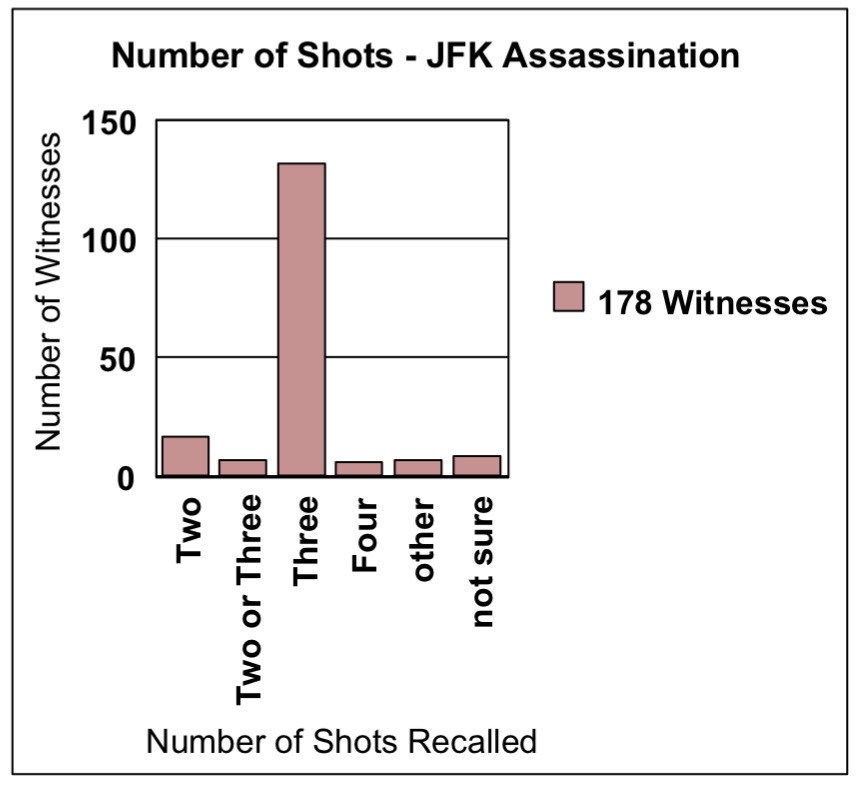
Most witnesses recalled or gave their estimates of the number of shots. Those who gave estimates, like "2 or 3" or "at least 4" should be treated differently than those who gave a definite number. Almost all who gave a definite number said there were three shots. Here is the distribution that includes those who provided guesses or estimates:
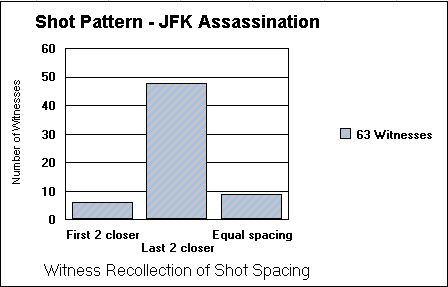
For the shot spacing, the distribution looks like this:
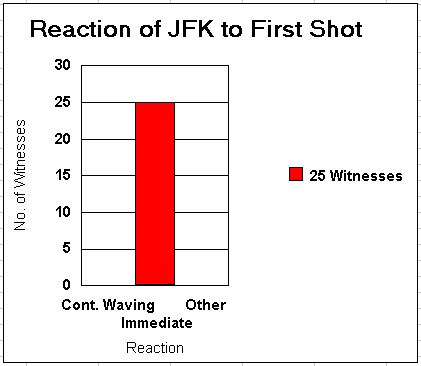
For the witness distribution as to JFK's reaction or lack thereof to the first shot looks like this:
For the time of the first shot the distribution looks like this:
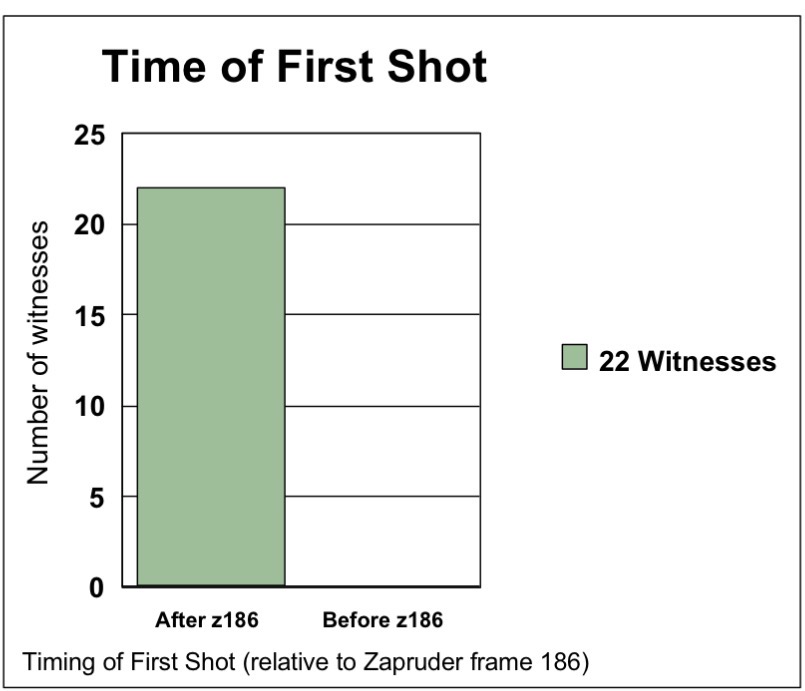
The statistical significance of these distributions should be readily apparent. And what is even more significant is that all the peaks are mutually corroborating. Provided the witness evidence is independent the probability that any one of the peaks does not represent what really occurred is extremely small. The probability that ALL the peaks are wrong is effectively zero.
The numbers are large enough that the possibility that the witnesses were colluding in some way so they are not independent becomes vanishingly small. There is still a higher probability that all the witnesses colluded (as tiny as that would be) than the probability that the peaks represent errors.
Again, this has nothing to do with individual reliability or quality of the witnesses. It has to do with probability and statistics.
 Topic: Mary Woodward said there were 3 shots and the 1st shot missed everything (Read 13215 times)