Are you for real? I didn't say anyone disputed the windshield was damaged. Can you read?
I said I've never met anyone who has denied that windshield damage can be seen in Altgens 6. It can also be seen in Altgens 7. Good grief, Roy Schaeffer noticed and talked about the windshield damage visible in Altgens 6 way back in the 1960s. This has been discussed in many books.
I'm curious: Do you also deny that windshield damage can be seen in a number of Zapruder frames before Z233, especially in the MPI large-format version of the film?
So it's looking like the LNer tactic is going to be to just deny that Altgens 6 and pre-Z233 Zapruder frames show windshield damage. You're gonna say, "I don't see that!" Well, no one can force you to admit seeing what you don't want to admit seeing.
The problem is that you guys have no bullet that can explain the pre-Z256 windshield damage. But, rather than admit this, it looks like you're going to claim that no such damage existed before Z256.
Here's what Dr. Mantik says about the windshield damage in his 2024 book The Assassination of President John F. Kennedy: The Final Analysis:
On Friday, November 20, 2009, I viewed the first generation, large format MPI transparencies of the Zapruder film at the Sixth Floor Museum in Dallas with Sydney Wilkinson, a Zapruder film expert. The MPI transparencies had incredible clarity. The first sign of windshield damage appears at Z-193. This is uncannily consistent with the National Photographic Interpretation Center (NPIC) conclusion that JFK was hit in the throat at Z-190. Quite naïvely, as I examined the MPI images, I had forgotten this NPIC conclusion, so my observations were quite unbiased.
In these MPI images, this windshield site is obscured during Z-203 to Z-214, but the damage is visible (consistently at the same site) in Z-215 to Z-232. It is especially obvious in Z-229 and Z-230, but it is more difficult to see after Z-232. The windshield damage in the Zapruder frames appears at the same site as seen in Altgens 6 and Altgens 7. Roy’s description is also consistent with this.
I would emphasize that if the shot had occurred earlier than Z-222 (i.e., that was Roy’s selected frame), then a windshield transit would have been more likely—because the windshield elevation would have been higher. The Altgens 6 photograph (Figure 5.4) was taken at about Z-255, just thirty frames after Z-225 (i.e., less than two seconds later); it shows windshield damage consistent with a South Knoll shot. Shaeffer was the first to notice this windshield damage that lay very near JFK’s left ear (in the Altgens 6—see Figure 5.4). He observed that “the small spiral nebula has a dark spot at the center, strongly suggesting a through-and-through bullet hole.”
Of note, the official view is that the windshield damage was caused by a fragment from the headshot; that is nonsense, of course—because the headshots occurred after Z-300, far too late to affect the windshield at Z-255.
Figure 5.4: Altgens 6. The circle highlights damage to the windshield. The damage to the windshield can also be seen in Altgens 7 (Figures 5.5 and 5.6), taken as the limousine sped toward the Triple Overpass. (The Assassination of President John F. Kennedy: The Final Analysis, 2024, pp. 289-291)
What a joke you are! It tends to raise a red flag with reasonable people when Jim Fetzer and his collaborators claim to have discovered something new, but with you it seems to automatically become undisputed fact.
Let's turn back time and give the word to Fetzer in Assassination Science (1998).
What [Fetzer collaborator] Schaeffer noticed is that, slightly to the right and barely above the upper-right-hand comer of the center-mounted rear-view mirror (looking toward the vehicle as it is displayed in the photograph), there is something that has the appearance of a small spiral nebula at exactly the location the President's left ear would be visible were it not obscured by a white image. The small spiral nebula has a dark spot at the center, strongly suggesting a through-and-through bullet hole. This is quite different from the windshield that the Secret Service produced, which shows a star-like configuration.
Groden (1993), p. 36, has published photos of both, side by side.
Here's what Groden had to say in The Killing of a President (1993). Notice that even he doesn't see any damage (my emphasis below).
Taken by Ike Altgens just after the first four [sic!] shots, the photo (right) shows the windshield of the President's car with no sign of damage from gunfire.
So what did Fetzer's collaborator discover? See below.
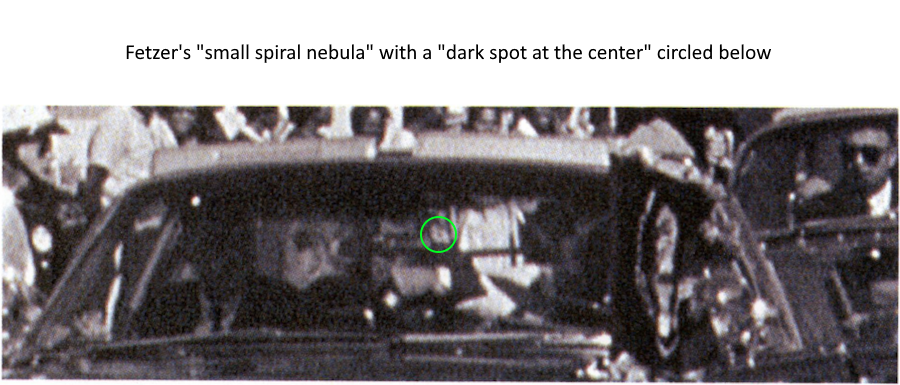
Hmm, that doesn't look entirely convincing to me, but let's hear what serious researchers like Barb Junkkarinen, Jerry Logan & Josiah Thompson think.
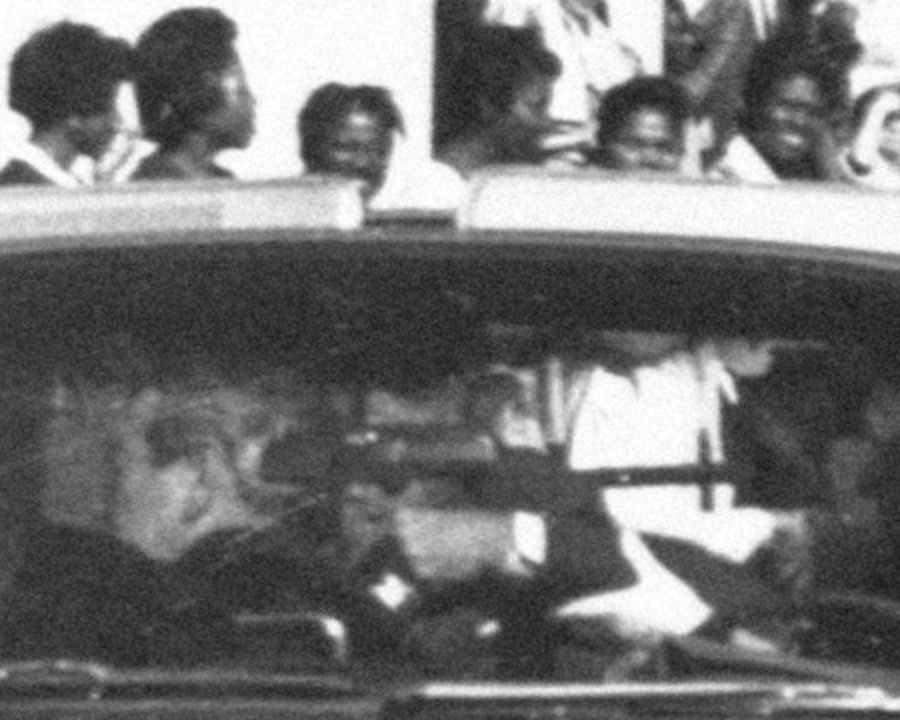
ETERNAL RETURN: A HOLE THROUGH THE WINDSHIELD? (2009)The feature in the photograph that Fetzer believes is a through-and-through bullet hole in the windshield he describes as “a small spiral nebula.” Good copies of the Altgens photo show it to be not a feature of the windshield. Rather it is a pattern formed by the gathering of fabric in the dress of a woman spectator standing in the background. The Altgens #6 photo demonstrates that the limousine windshield is not damaged at Zapruder frame 255.
Since the late 1960s, it has been well-known that Altgens #6 (taken at Z 255) shows an undamaged windshield while Altgens #7 (taken seconds later) shows damage to the windshield. Hence, whatever damage was incurred by the windshield it was incurred during this time interval. More importantly, the location and character of damage to the windshield showing in Altgens #7 matches what we see in a later photo of the windshield taken during Frazier’s examination. A photo of the limousine taken at Parkland Hospital may also show damage to the windshield at the location apparent in the Altgens and FBI photos.
Can you still claim, with a straight face, that it's an undisputed fact that the damage is visible in Altgens 6?
The crop below is from the best scan I have of the image. Gee, could that "nebula" above JFK's left shoulder actually be from the clothing of a person in the background, as suggested by Junkkarinen, et al?
 Topic: Why Altgens 6 Refutes the Lone-Gunman Theory (Read 14760 times)