You don't present all of the witnesses. You ignore the ones who said the shots were evenly spaced and you ignore the ones who said the first two shots were closer together.
No I don't. And you would know that if you had read those 9 pages I posted. Not only do I not ignore them, I quote what they said and provide cites. The fact is there are only three general possibilities of the spacing of three shots and not everyone will recall it correctly.
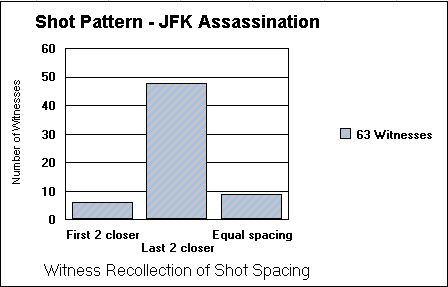
There were six people who seemed to recall the reverse pattern: Nellie Connally, William Newman, Gayle Newman, Ken O'Donnell, Cecil Ault and Steven Wilson. Only the Newmans gave their statements within a short time after the event. The others were months after. William Newman initially (22Nov63) described only two shots 19 H 490:
- "We were standing at the edge of the curb looking at the car as it was coming toward us and all of a sudden there was a noise, apparently gunshot. The President jumped up in his seat, and it looked like what I thought was a firecracker had went off and I thought he had realized it. It was just like an explosion and he was standing up. By this time ha was directly in front of us and I was looking directly at him when he was hit in the side of the head."
Then in his next statement on November 24 (22 H 842), he said he recalled two shots close together for a total of three. He thought the first two were closer together though.
So one is left with having to assess the evidence. I not only found the witnesses as to the 1.....2..3 pattern to be clearer and more descriptive and sure, but I also understood that the probability that the distribution of witnesses was such that it was highly improbable that almost 80% would hear the shots and recall the same distinctive pattern and all agree on the same wrong pattern. If witnesses were generally able to recall the pattern there would be a clear preference for one possibility and the errors would be distributed randomly over the other two possibilities. If everyone were really confused, one would expect a random distribution over all three possibilities. This distribution is what one would expect only if the witnesses correctly recalled that the last two were closer:
On top of that, you ignore what some of the witnesses said about those last two shots. Some said the last two shots were right on top of each other with almost no time between them. That would suggest they heard two sounds from the same shot. That could be an echo. It could be the sound of the impact on JFK's skull. Such impacts on a hard surface can be quite loud. The other possibility is they heard the sonic boom of a supersonic bullet, which also can be quite loud and which the would have heard about 1/10 of a second before hearing the muzzle blast.
https://gunsamerica.com/digest/two-sources-of-sound-when-you-shoot-subsonics-vs-supersonics/
"The crack or sonic boom of the bullet passing just over your head, if you’re close enough, will cause hearing damage."
They would have heard reverberations, not distinct echos. Mary Woodward also said that the shots were on top of each other and explained that the sound of the second had not completely died out before the third shot sounded. That may be why so many recalled those two distinct shots being close together.
At 200 feet, the crack would be heard 77 ms before the muzzle blast and would not be confused with separate shots.
 Topic: Gov. John Connally Grips His White Stetson Hat at Z-272 (Read 87484 times)