Oswald took 10.2 seconds to fire all three shots.

Users Currently Browsing This Topic:
0 Members

Author Topic: Oswald took 10.2 seconds to fire all three shots.  (Read 166752 times)

Online Charles Collins

  • Hero Member
  • *****
  • Posts: 4403
Re: Oswald took 10.2 seconds to fire all three shots.
« Reply #567 on: February 27, 2025, 11:10:54 AM »
Hi Tom, as the WC showed, a full speed bullet striking a human wrist would literally smash the wrist bone therefore for CE399 to only fracture Connally's wrist it must have been travelling slower!


CE399 was partially slowed after moving through the soft tissue of Kennedy's neck, it then went sideways through Connally and after exiting it struck Connally's wrist at an angle hence why it left lead fragments and subsequently CE399 buried itself shallowly in Connally's thigh.

In fact the main provenance for the authenticity of CE399 is the fact that it was discovered before anyone knew the true extent of the injuries, so in other words who could possibly know what condition of bullet to plant?

CE399 was intact when found by Tomlinson.
CE399 shed a small amount of lead and a small amount of lead was discovered in Connally.
CE399 was flattened on one side consistent with it's passage sideways through Connally's ribs and even though a Carcano bullet fired through water will deform it won't exhibit the same flattening on only one side.


Also worth noting is that John Lattimer removed a similar amount of lead from another Carcano bullet and made 41 fragments which easily accounted for the missing lead from CE399.


JohnM


It’s interesting to see in those photos just how thick the copper jacket is on those bullets. Those photos bring out that aspect very well. Thanks!

Online Charles Collins

  • Hero Member
  • *****
  • Posts: 4403
Re: Oswald took 10.2 seconds to fire all three shots.
« Reply #568 on: February 27, 2025, 11:16:54 AM »
Yet the same type of bullet instantly fragmented when it contacted JFK's skull?

The bullet that shattered Connally's wrist also fragmented.
CE399 was introduced into the chain of evidence after it had passed from Chief Rowley to SA Elmer Todd.


Yes, that would be expected and consistent with a high speed bullet hitting an object as hard as the skull head-on.


The bullet that shattered Connally's wrist also fragmented.

If that were the case, then there should have been damage to the limo in the area just past JBC’s wrist (aka: the back of the front seat). There was no damage to the limo in that area found.

Online Andrew Mason

  • Hero Member
  • *****
  • Posts: 1668
    • SPMLaw
Re: Oswald took 10.2 seconds to fire all three shots.
« Reply #569 on: February 27, 2025, 03:16:21 PM »

The bullet that shattered Connally's wrist also fragmented.

If that were the case, then there should have been damage to the limo in the area just past JBC’s wrist (aka: the back of the front seat). There was no damage to the limo in that area found.
Not necessarily. The direction of the fragments would depend on the angle at which the bullet struck the radius.

If it struck the radius while the pronated wrist was pressed against the chest, the only direction would be up and forward. The windshield was struck by a fragment. The top of the windshield was struck by a fragment. And James Tague was struck. And all the evidence is that this occurred on the second shot.

Online Andrew Mason

  • Hero Member
  • *****
  • Posts: 1668
    • SPMLaw
Re: Oswald took 10.2 seconds to fire all three shots.
« Reply #570 on: February 27, 2025, 11:17:36 PM »

It’s interesting to see in those photos just how thick the copper jacket is on those bullets. Those photos bring out that aspect very well. Thanks!
The copper thickness is a bit misleading.

I just measured one of mine  with a ruler (sorry about the scratches) and it looks like the thickness of jacket at the base is about 1 mm:


But that is because there is a lip of copper around the edge of the lead at the base.

The exact specifications from Western Cartridge company would be helpful but someone on the old newsgroup made the effort to disassemble and measure everything.  The thickness of the jacket varied with the thickest copper at the tip (.937 mm).  The thickness at the base was .627 mm so the actual thickness is a bit less than 2/3 that apparent thickness. 

WCC jacket thickness- (measured with a point micrometer)
Base thickness- .627mm (or .0247")
Mid-body thickness- .607mm (or .0239")
Upper body thickness- .607mm (or .0239")
Jacket tip- .937mm (or .0369")
« Last Edit: February 27, 2025, 11:18:14 PM by Andrew Mason »

Online Charles Collins

  • Hero Member
  • *****
  • Posts: 4403
Re: Oswald took 10.2 seconds to fire all three shots.
« Reply #571 on: February 28, 2025, 12:11:16 AM »
The copper thickness is a bit misleading.

I just measured one of mine  with a ruler (sorry about the scratches) and it looks like the thickness of jacket at the base is about 1 mm:


But that is because there is a lip of copper around the edge of the lead at the base.

The exact specifications from Western Cartridge company would be helpful but someone on the old newsgroup made the effort to disassemble and measure everything.  The thickness of the jacket varied with the thickest copper at the tip (.937 mm).  The thickness at the base was .627 mm so the actual thickness is a bit less than 2/3 that apparent thickness. 

WCC jacket thickness- (measured with a point micrometer)
Base thickness- .627mm (or .0247")
Mid-body thickness- .607mm (or .0239")
Upper body thickness- .607mm (or .0239")
Jacket tip- .937mm (or .0369")


Thanks that is interesting and helpful!

Do you have the respective weights of the jacket and the core handy?
« Last Edit: February 28, 2025, 12:12:58 AM by Charles Collins »

Offline Dan O'meara

  • Hero Member
  • *****
  • Posts: 3774
Re: Oswald took 10.2 seconds to fire all three shots.
« Reply #572 on: February 28, 2025, 12:22:20 AM »
According to the autopsy doctors, the bullet that struck JFK's head hit near its hardest part -- the External Occipital Protuberance.

This is what happens when people don't think things through.
According to you the bullet that hit JFK's head because it "hit near it's hardest part", the EOP ("near" it? Doesn't that mean it missed that part of the skull - d'uhhh)
The radial bone is far thicker and more dense than "near" the EOP so, BY YOUR OWN LOGIC, the bullet must fragment when it strikes JBC's radial bone. ::)
As a Nutter you must now indulge in some mental gymnastics to make your "logic" work.
Good luck with that.

Talking of mental gymnastics...John posted this:

Hi Tom, as the WC showed, a full speed bullet striking a human wrist would literally smash the wrist bone therefore for CE399 to only fracture Connally's wrist it must have been travelling slower!
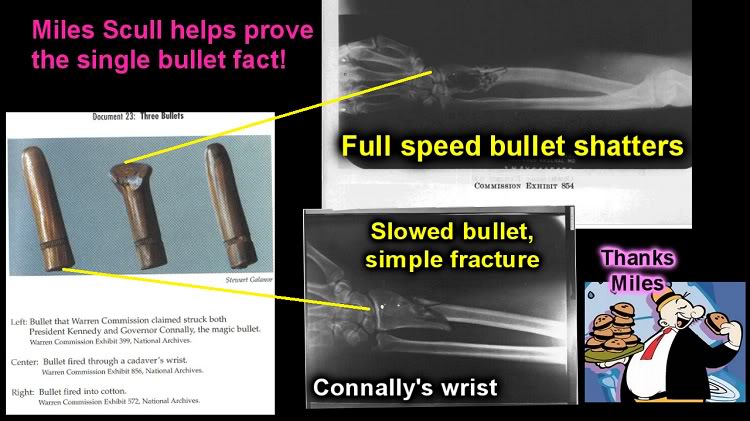


There are two images of wrist x-rays.
One shows where a bullet has clearly passed through the radial bone. It has smashed a hole through the bone as we might expect.
The other image shows an x-ray of JBC's wrist. Although the bone is clearly shattered there is absolutely zero evidence that a bullet has passed through the bone.
The explanation for this discrepancy is that the bullet that passed through JBC's wrist must have been travelling more slowly than the one that blasted a hole in the radial bone!!
 ???
How does a slower moving bullet leave no evidence that it has passed through the bone?
The bone still has to be blasted out of the way the bullet to get through.
Surely the x-ray of JBC's wrist is proof that a bullet didn't pass through it. Isn't that the obvious explanation?
And hasn't it crossed anyone's mind that the exit "slit" on JBC's wrist is far smaller than the entrance wound on the dorsal side of his wrist.
Isn't that suggesting a fragmented bullet to anyone?

Quote
The bullet that struck JBC's wrist (CE-399) did not fragment -- probably because, having passed through JFK and JBC, it had slowed down quite a bit and because it was twirling when it struck said bone.

D'oh

"...twirling when it struck said bone"

 :D
Twirling?
If that was the case it would have blown JBC's hand off at the wrist.
Instead, it left hardly any evidence that a bullet had passed through.
The injuries to Connally and the damage to his clothes demonstrate that there was no such twirling or tumbling.
This idea about a tumbling bullet HAD TO BE INTRODUCED to keep up the lie that CE399 was the bullet. Small fragments of metal were left in the wrist when the bullet fragmented. CE399 could not have left any kind of fragment if it created the wound nose-first as there was no material lost from the nose of the bullet. The only area any such fragments could've come from is the base of the bullet, therefore the idea that it turned around as it traveled had to be introduced.
The 'tumbling' theory is an invention, it is not supported by the evidence.

The bullet struck JBC's radial bone and fragmented. A small part of it passed through his wrist and the larger part lodged itself in his leg.
There is a little known story that when JBC was being moved from his stretcher onto the examination table in Parkland Hospital a bullet or large bullet fragment fell on the floor and was picked up by a nurse who was told by Henry Wade to give it to a police officer, which she did.

Online Tom Graves

  • Hero Member
  • *****
  • Posts: 3517
Re: Oswald took 10.2 seconds to fire all three shots.
« Reply #573 on: February 28, 2025, 01:01:35 AM »
Twirling?

If that was the case it would have blown JBC's hand off at the wrist.

IIRC, Dale Myers created a computer simulation that showed how CE-399 damaged JBC's wrist.

Why don't you watch it?

And speaking of "twirling," why don't go sit on something and . . . aww . . . never mind.