The Nest

Users Currently Browsing This Topic:
0 Members

Author Topic: The Nest  (Read 24066 times)

Online Charles Collins

  • Hero Member
  • *****
  • Posts: 4402
Re: The Nest
« Reply #7 on: April 07, 2023, 09:30:37 PM »
This article is about how to use a bench rest support. While the sniper’s nest didn’t have a bench rest support, the boxes apparently served as the bench. And practically every bench rest shooting event that I have seen has the shooters seated in chairs or some sort of seat. Anyway, it is all about having the best stable support possible. And I believe that is what the sniper’s nest boxes are all about.


https://shoot-on.com/bench-rest-shooting-fundamentals/


Online Gerry Down

  • Hero Member
  • *****
  • Posts: 1170
Re: The Nest
« Reply #8 on: April 07, 2023, 09:39:26 PM »
Nice model. Where did you get the dimensions for the size and location of the vertical steam pipe? And can you share those dimensions here?

Online Charles Collins

  • Hero Member
  • *****
  • Posts: 4402
Re: The Nest
« Reply #9 on: April 08, 2023, 01:07:24 AM »
Nice model. Where did you get the dimensions for the size and location of the vertical steam pipe? And can you share those dimensions here?


Thanks Gerry, I got the specs for the piping from these posts by Jerry Organ (in the “Why the first shot missed” thread):
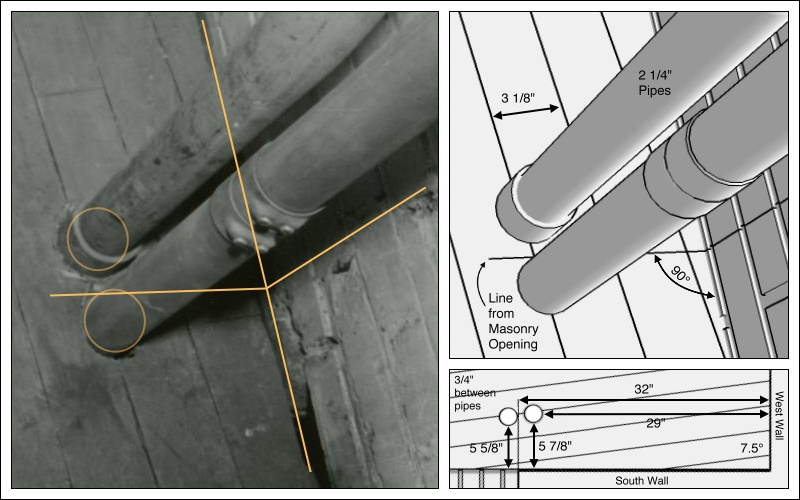


Sorry, Charles. I haven't forgotten your request. My placement of the pipes is a visual guess. Obviously use at own risk.

I sent the Sixth Museum a request for measurements, and the curator, who's really helpful, told me just now that he will get back to me with true measurements when they access that area for maintenance. I'll PM those to you when I get them. Meanwhile you can use what I am using or build off it.

The westward pipe is a simple vertical. As I have it, the total height of the coupling is 3 1/4". I have the bottom of the coupling 8 13/16" above the floor (just make it 8 3/4" or 9", whatever). The coupling doesn't interfere with a hypothetical shooter; I put the coupling in there for the sake of completeness and haven't bothered with the bolts.

For the east pipe, I drew straight lines and angled them and placed them where I thought the center of the pipe ran. I then used SketchUp's "Follow-Me" tool to create the pipe by having a 2" circle follow the "path" of the lines. The Sketchup Tool decided I needed two elbows at each of the two bends. The closest any part of the first bend is to the floor is 13".

There is something wrong with my measurements. If the pipes are 2", then the planks have to be about 3". Or the planks are correct and the pipes needs to be a bit wider. Anyway, the key is how the westward pipe is relative to the window's masonry opening, which I think is fairly close now. That's the pipe that interferes.


Sniper Nest measurements from Stephen Fagin.

  • Circumference of pipe = 7”
  • Width of floorboard = 3.25”
  • Corner to edge of brick at window = 33”

Corner --> Southeast interior corner.
Brick at window --> east edge of window's masonry opening.


And here is my post describing my assessment of the diameter of the pipe:


Thanks Jerry! And thanks to Stephen Fagin for obtaining and sharing the measurements! The pipe is 2.23” in diameter if my arithmetic is correct! 😎


James Hackerott measured the distances from the walls where the flush-cut pipes are exposed on the seventh floor. And they are somewhat different from Jerry’s estimated distances. But it appears that the seventh floor exterior walls are offset inwards slightly (at least from the outside appearance, remember the ledge above the sixth floor windows). So Jerry’s estimates are what I used. Thanks to Jerry, James, and Stephen Fagin of the Sixth Floor Museum for the information.
« Last Edit: April 08, 2023, 01:16:10 AM by Charles Collins »

Online Charles Collins

  • Hero Member
  • *****
  • Posts: 4402
Re: The Nest
« Reply #10 on: April 08, 2023, 04:11:16 PM »
Getting back to shooting positions, I think that Craig Boddington, and his experiences in the field hunting, are more applicable to the situation in the sniper’s nest than bench rest shooting is. Here is a snip from one of his articles:

Field shooting is not necessarily a game of utmost precision. The vital zone must be hit, but it’s a pretty large “X-Ring.” Getting a bullet into it is always a matter of achieving adequate steadiness, but time and distance are major factors. You always want to get as steady as you can, but generally speaking, the shorter the distance the less stability is required—and the less time you usually have to get into position before the opportunity is lost. As we’ve discussed, there are fast-breaking close-range situations where the only chance for a shot is to stand and shoot unsupported. You hope that doesn’t happen, but it’s wise to practice a whole lot just in case! However, given enough time and a clear path to the target, my default setting is to rest over a pack.
In part this is because I almost always carry some kind of a pack. Not everybody does, but as an occupational hazard I always carry two cameras and often a telephoto lens. Add a water bottle, raingear or an extra layer, and perhaps a spotting scope and tripod, a pack is almost mandatory. As we’ve seen, solid objects like rocks and logs make excellent field rests, but they’re even better when you throw a nicely padded pack on top! …

… Almost universal when shooting over a pack (or any solid rest) is what to do with the supporting hand. If the fore end is firmly rested, then you don’t really need it to hold the rifle (I’ll come back to that initial “if”). I usually default to proper benchrest position, curling the supporting hand under the buttstock and using it to snug the butt into the shoulder and make slight height adjustments if necessary.

Just be absolutely certain your fore end is firmly rested before you turn loose of it! A few seasons back, near Roseburg, Oregon, I had a great Columbia blacktail standing at about 275 yards. I crawled in behind a big oak, took off my pack, and shifted right. There was some underbrush, so I had to plump up the pack to get the rifle high enough. So far so good, everything perfect. As usual, I curled my right (supporting) hand under the butt, got good and steady, and squeezed the trigger. As the trigger broke, the rifle literally fell off the pack. I couldn’t call the bullet back, and I missed that buck by a matter of several feet. So my systems aren’t always perfect, and it’s best to learn what works for you!


https://www.boone-crockett.org/pack

Here’s a photo of Craig where he is prone and using a pack for support. But he also is using his supporting hand on the fore stock. With the exception of a sitting position (on box D), in lieu of the prone position, this seems to me to be a probable set up for the sniper’s nest arraingement.


« Last Edit: April 08, 2023, 04:13:52 PM by Charles Collins »

Online Gerry Down

  • Hero Member
  • *****
  • Posts: 1170
Re: The Nest
« Reply #11 on: April 08, 2023, 05:40:09 PM »

Thanks Gerry, I got the specs for the piping from these posts by Jerry Organ (in the “Why the first shot missed” thread):


And here is my post describing my assessment of the diameter of the pipe:


James Hackerott measured the distances from the walls where the flush-cut pipes are exposed on the seventh floor. And they are somewhat different from Jerry’s estimated distances. But it appears that the seventh floor exterior walls are offset inwards slightly (at least from the outside appearance, remember the ledge above the sixth floor windows). So Jerry’s estimates are what I used. Thanks to Jerry, James, and Stephen Fagin of the Sixth Floor Museum for the information.

Thanks 👍

Online Charles Collins

  • Hero Member
  • *****
  • Posts: 4402
Re: The Nest
« Reply #12 on: April 10, 2023, 01:45:45 PM »
Now that we have touched on a few basic shooting positions, here is an article about rifle scopes that I think some will find interesting. It would be nice to know exactly how much LHO understood about scopes, but sadly we will never know that. The sections on parallax and eye relief are of particular interest. The simple 4X fixed magnification scope that was on the Carcano rifle didn’t have adjustments for parallax or variable magnification. And the parallax error involved in the distances of the shots in Dealey Plaza wouldn’t have made a significant difference. But for those who like to know as much as possible about such things, the article might be enlightening.

https://shoot-on.com/optics-411-zeroing-in-on-rifle-scopes/

« Last Edit: April 10, 2023, 01:51:06 PM by Charles Collins »

Online Charles Collins

  • Hero Member
  • *****
  • Posts: 4402
Re: The Nest
« Reply #13 on: April 10, 2023, 11:19:05 PM »
Now that we have touched on a few basic shooting positions, here is an article about rifle scopes that I think some will find interesting. It would be nice to know exactly how much LHO understood about scopes, but sadly we will never know that. The sections on parallax and eye relief are of particular interest. The simple 4X fixed magnification scope that was on the Carcano rifle didn’t have adjustments for parallax or variable magnification. And the parallax error involved in the distances of the shots in Dealey Plaza wouldn’t have made a significant difference. But for those who like to know as much as possible about such things, the article might be enlightening.

https://shoot-on.com/optics-411-zeroing-in-on-rifle-scopes/


For those who might be curious, I found that the scope on the Carcano rifle found on the sixth floor of the TSBD has a fixed parallax setting of 100-yards. Here is a photo that shows that information on the bottom of the page of instructions.