U.S. Politics

Users Currently Browsing This Topic:
John Corbett, Jarrett Smith

Author Topic: U.S. Politics  (Read 802740 times)

Offline Rick Plant

  • Hero Member
  • *****
  • Posts: 8177
Re: U.S. Politics
« Reply #588 on: May 16, 2022, 02:48:12 PM »
The Buffalo Shooter Isn’t a ‘Lone Wolf.’ He’s a Mainstream Republican

The right-wing extremists who control the modern GOP are all gripped by a racist delusion. The shooter is just the latest to act on it


There’s no such thing as a lone wolf — an appellation often given, in error, to terrorists who act alone, particularly those of the white supremacist variety. There are only those people who, fed a steady diet of violent propaganda and stochastic terror, take annihilatory rhetoric to its logical conclusion.

Such was the case on Saturday, when a teenaged white supremacist named Payton Gendron opened fire in a supermarket in a Black neighborhood in Buffalo, New York, killing 10 people, while livestreaming the carnage on the live-video site Twitch. Prior to the shooting, he had posted a 180-page manifesto in which he laid out his rationale clearly: He was an adherent of what is called Great Replacement Theory, the idea that white people, in the United States and white-majority countries around the world, are being systematically, deliberately outbred and “replaced” by immigrants and ethnic minorities, in a deliberate attempt to rid the world of whiteness. It’s a conspiracy theory that has inspired terror attacks in New Zealand and Pittsburgh, San Diego, and El Paso – an ideology that marries demographic panic with the idea of a cunning, nefarious plot. Reading through the document, what struck me hardest, however, was how very close the killer’s ideas were to the American mainstream – the white-hot core of American politics.

Five years ago, when white supremacists walked down the streets of Charlottesville, Virginia, chanting “Jews will not replace us!” and carrying tiki torches, few people understood their intent – the fact that they were referring to replacement theory. The idea seemed outlandish, even incomprehensible; at the time, it was a fairly obscure rallying cry, based around a 2012 book by French novelist Renaud Camus fearmongering about a nonwhite-majority Europe, absorbed into the fetid stew of white-supremacist cant, where it acquired a vicious antisemitism. For many white supremacists, it is Jews who are orchestrating the “reverse colonization,” as Camus put it, of white countries, in order to more easily manipulate a nonwhite and therefore more malleable general populace. In Gendron’s manifesto, after explaining in detail why he picked the particular supermarket he did — it was in a majority-Black neighborhood with a majority-Black clientele — he felt the need to explain why he did not choose to attack Jews. “[Jews] can be dealt with in time, but the high fertility replacers will destroy us now, it is a matter of survival we destroy them first,” he wrote, before listing his weaponry in detail with price points included — a manual for future murders. While Gendron’s choice to engage in mass slaughter puts him on the radical fringe of those who enforce their beliefs with bullets, and his overt antisemitism differs slightly from vaguer blame of “elites,” “Democrats” and “globalists,” his fixation on white birthrates and demographic change are neither fringe nor particularly unusual. The gnawing fear of a minority-white America has utterly consumed conservative politics for the past half-decade, creating a Republican party whose dual obsessions with nativism and white fertility have engendered a suite of policies engineered to change the nature of the body politic. What unites murderers like Gendron, and the long list of white supremacist attackers he cited with admiration, with the mainstream of the Republican party is the dream of a white nation.

the population considered white is shrinking. This change is occurring faster than anticipated, thanks to the relative ages of white and nonwhite populations in the country — the nonwhite population trends significantly younger — and all national population growth is being driven by nonwhite groups, according to an analysis by Brookings. This confluence of death, birth, and immigration is in and of itself morally neutral, a matter of the natural ebb and flow of populations over time. But as the era of the white majority nears its end, a revanchist, racist right has treated the facts of demography as an occasion for a sweeping, violent moral panic.

Donald Trump’s ascendance was a key marker of the force of white racial panic; from the moment he launched his candidacy, his overt racism set the party’s agenda, and from the very first, his rhetoric directly provoked racist violence. Far from ebbing as Trump has ceased to be the party’s sole center, however, the tide of white animus has become even more central to a new crop of Congresspeople and candidates.

The Republican Party’s embrace of nativism has been more of a full-on dash than a slow slide, and it has been catalyzed by the vast constellation of right-wing media. Chief among these is the juggernaut that is Fox News. As a New York Times analysis revealed, the network’s flagship prime-time show, Tucker Carlson Tonight, has an obsession with replacement theory: In more than 400 shows the newspaper analyzed, Carlson evoked the idea of forced demographic change through immigration and other methods. Carlson is not alone: A Media Matters examination of Fox’s rhetoric throughout 2021 found that the network fulsomely embraced replacement theory, or, as it is more commonly known among extremists, “white genocide.” Such fears have become commonplace campaign talking points among Republican candidates: Ohio senatorial candidate J.D. Vance recently declared that Democrats are “bringing in a large number of new voters to replace those that are already here”; in Arizona, far-right state senator Wendy Rogers responded to an article about migrants with the ominous message, “We are being replaced and invaded.” Just hours after the mass shooting in Buffalo, Senate candidate Blake Masters posted a video appearance in which he declared that Democrats’ electoral strategy involves bringing in “millions” of immigrants to vote for them. Congresswoman Marjorie Taylor Greene rode extremism into Congress, long after sharing a video that declared that an “unholy alliance of leftists, capitalists, and Zionist supremacists has schemed to promote immigration and miscegenation, with the deliberate aim of breeding us out of existence in our own homelands.” This clamor — from politicians and pundits, candidates and conspiracy theorists — has become the radioactive center of the right’s policy.

Once you understand an obsession with racial composition and white fertility to be the driving engine of Republican politics, a number of seemingly disparate movements begin to fit together into an ugly whole. Some aspects are obvious: The anti-immigrant movement that has seen U.S. refugee admissions at historic lows and asylum seekers marooned in purgatorial camps in Mexico continues to dominate the right-wing airwaves. Historic levels of gerrymandering are ensuring that a diversifying populace remains beholden to the views of a white minority — alongside openly antidemocratic restrictions on voting and changes in election administration.

Other aspects are more veiled, but no less vitriolic. Years of fearmongering about transgender rights, and in particular their influence on youth, are linked to fears of waning fertility: anti-trans demagogues like Abigail Shrier describe trans bodies as “maimed and sterile,” and, as such, a chief motivation for the legion of anti-trans laws passed by state legislatures is the future fertility of trans children born female. The violent antifeminism of a far-right movement that sees women principally as vessels for breeding a new white generation expresses itself in a fixation on a return to “traditional” gender roles. And the culmination of generations of right-wing activism, which will secure the “domestic supply of infants,” as Justice Samuel Alito memorably put it, is poised to arrive in the form of the dissolution of Roe v. Wade. Payton Gendron, and those like him, are listening: like Brenton Tarrant, the mass shooter at a mosque in Christchurch, New Zealand, Gendron opened his manifesto with a screed on the supposedly apocalyptic consequences of “sub-replacement fertility rates” among white women.

In his manifesto, Gendron claims to have acted alone, while in the same breath admitting, “I’ve had many influences from others.” The 180 pages of the document reveal the breadth of those influences: it is largely pastiche, with page upon page of racist and antisemitic memes compiled in repulsive collages; collections of scientific studies of I.Q. differentials between racist groups; screenshots and links to news articles that confirm his prejudices; and segments of other manifestos, including Tarrant’s, bloat a thin line of racist scrawl. He may have, as he claims, become radicalized by over-enthused browsing of the Internet’s sewers, principally 4chan. But his fixations mirror those of the right wing more broadly, from violent transphobia to a loathing of immigration to a preoccupation with the possibility of civil war.

When the rhetoric of an entire movement devolves into Manichaean demonization of their political foes; when demographic shifts are represented as apocalyptic; and when a party can appeal to nothing but the consolidation of white power, it is an inevitability that such rhetoric will leave bodies in its wake. The Republican Party caters chiefly now to those who claim that to be born the wrong color is an act of genocide, and act with appropriate fervor. There has never been a lone wolf when it comes to racist terror in the United States; it suffuses every aspect of our politics and policy, and in latter years the mass howl of fear at change comes from a jaw that drips with blood. As long as we fail to recognize the wellspring of racial animus that animates the right wing in this country, the corpses will continue to accrue.

https://www.rollingstone.com/politics/political-commentary/buffalo-shooter-white-supremacist-great-replacement-donald-trump-1353509/

Offline Rick Plant

  • Hero Member
  • *****
  • Posts: 8177
Re: U.S. Politics
« Reply #589 on: May 16, 2022, 11:41:56 PM »
In Idaho governor’s race, a far-right candidate leans into extremism

Lt. Gov. Janice McGeachin’s campaign, whether it’s successful or not on Tuesday, has become a flashpoint in the discussion of extremism in state politics — and White women’s role in it.


In 2019, just months into her job as Idaho’s lieutenant governor, Janice McGeachin posted a photo of herself outside her statehouse office with two men linked to a militia group. Weeks later, she delivered an oath to militia members that is often reserved for state military.

McGeachin’s embrace of extremism would continue: In October 2020, she appeared in a libertarian group’s video against state COVID-19 restrictions, placing a gun on top of a bible. In February, she agreed to a pretaped speech at a conference hosted by the white nationalist Nick Fuentes. This month, McGeachin told an anti-vaccine conspiracy theorist that “God calls us to pick up the sword and fight, and Christ will reign in the state of Idaho.”

McGeachin is challenging Gov. Brad Little in Tuesday’s primary for governor, arguing her candidacy better reflects the values of a state where former President Donald Trump received more than 60 percent of the vote in 2020. Idaho has a history of anti-government sentiment, which has gradually created factions within its Republican Party between far-right populists like McGeachin and more traditional conservatives like Little.

Like many GOP candidates across the country, McGeachin has highlighted her opposition to COVID-19 mitigation efforts as well as teachings about racism in schools. But McGeachin has taken these issues further than many in the Republican Party by not only sowing doubt about the 2020 election results but also supporting “state sovereignty” that actively rejects areas of federal government oversight.

Whether McGeachin’s long-shot bid in a crowded primary is successful or not, her attempt to unseat Little has become a flashpoint in the discussion of extremism in state politics — and White women’s role in it.

“What happens on the far right is that there’s a way in which White women are kind of the velvet glove on the iron fist,” said Jessie Daniels, a researcher on extremism and author of “Nice White Ladies.” “They soften in some ways the real brutality of these policies.”

McGeachin, a business owner who was elected lieutenant governor in 2018 after a brief stint away from serving in the statehouse, has campaigned on a platform of challenging the 2020 election. At a campaign rally this month, the 59-year-old described her vision as “protecting individual liberty, defending your health freedom and upholding your constitutional rights.”

“It includes defending Idaho’s state sovereignty, reducing Idaho’s financial dependence on federal dollars and strengthening our economy through the development of our state’s many resources,” she said.

She has also embraced many of the issues propelling the right. At the same campaign rally, McGeachin committed to “fixing” Idaho’s education system, “eradicating” critical race theory — a catch-all phrase used by some Republicans to describe certain lessons about race — and what she calls “other forms of Marxist indoctrination.” Last year, McGeachin announced a task force that would target “indoctrination” in schools. And after a leaked U.S. Supreme Court draft indicated Roe v. Wade will be overturned, McGeachin called for a special legislative session to end exemptions to abortion that include cases of rape and incest. Such exemptions have been widely supported by conservatives who oppose abortion.

Little, a sheep and cattle rancher, has tried to frame his campaign around cutting taxes and state regulations. But he also signed into law a ban on abortion after six weeks of pregnancy this year. In 2020 he signed anti-trans legislation into law.

However McGeachin has also chosen to publicly associate with media personalities who hold views about the pandemic, immigration, elections and race that are outside mainstream conservatism. McGeachin defended her speech at the America First Political Action Conference — hosted by Fuentes, who participated in the 2017 white supremacist rally in Charlottesville and has denied the Holocaust — by claiming she didn’t know who he is. McGeachin also said she wanted to reach young conservative people.

“There’s a growing number of conservatives, young conservatives all across the country, that are really concerned about the direction that our country is headed,” she told television station KTVB in February.

McGeachin, whose campaign did not return a request for an interview, has also not shied away from other far-right figures. Her May 4 rally was attended by Stew Peters, who has pushed anti-vaccine conspiracy theories, and Michelle Malkin, who has been described by the ADL as supportive of white supremacists. Wendy Rogers, an Arizona senator who was censured by fellow state lawmakers in part because she, too, recorded a message for Fuentes’ conference and suggested the hangings of unspecified “traitors,” was also in attendance.   

Kelly J. Baker is an author who has studied religion and white supremacist movements. She noted that McGeachin sometimes echoes language used by far-right personalities but can also be ambiguous about it. Trump, who has endorsed McGeachin, took a similar tactic, refusing at times to denounce white supremacists who supported him.

“When she’s speaking at something organized by white nationalists or participating in events with far-right figures, she isn’t disavowing them,” Baker said. “But that kind of ‘winking in that direction’ is a strategy that I think works to get voters who are sympathetic.”

Baker added that McGeachin’s self-described identity as a mother, coupled with being a White woman, may be advantageous to her campaign and has echoes of politicians like Sarah Palin and her bid for vice president more than a decade ago.
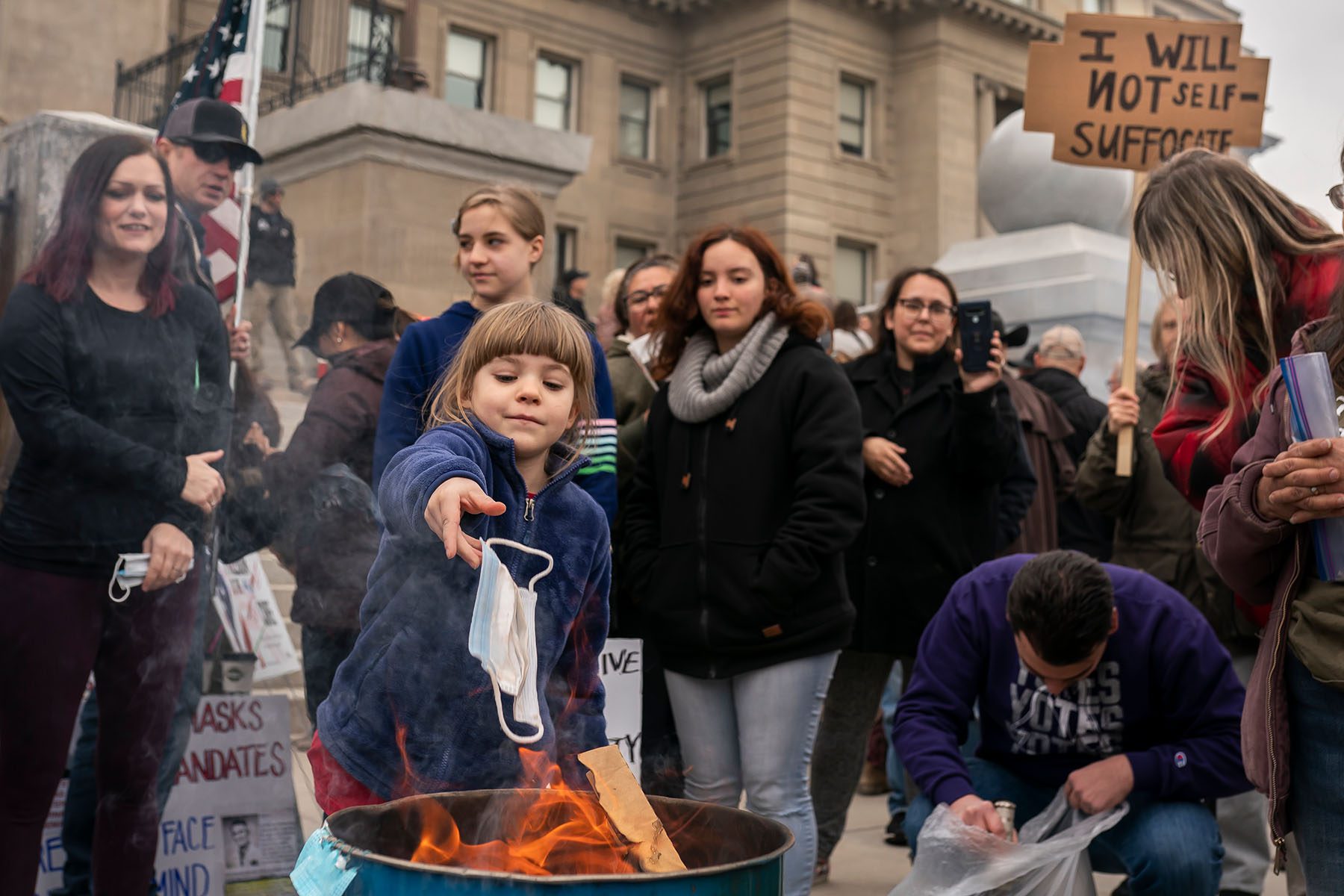

A child tosses a surgical mask into a fire during a mask burning event at which Lt. Gov. Janice McGeachin was a speaker. (NATHAN HOWARD/GETTY IMAGES)

“Their rhetoric is still rough, right? And the things they are saying are pretty bombastic and controversial,” Baker said. “But I do wonder if there’s something about gender roles that are working for them — that they’re able to play into this somewhat in a way that White men don’t have the option to.”

Heath Druzin is an Idaho-based journalist who hosts the “Extremely American” podcast covering militia groups and politics. He has reported on McGeachin for years and noted that other far-right women candidates are running campaigns in Idaho, including for lieutenant governor and secretary of state. Many of them have been elected to office before their current bids.

“It’s not that they appeared out of nowhere,” Druzin said. “They have been leaders in the far-right movement in Idaho for a while. But it’s more that the far right just gained a lot more prominence recently, especially with the pandemic. And they were sort of there ready to step into the spotlight.”

In Idaho, candidates for governor and lieutenant governor run on separate tickets in both the primary and general election. The fissures between McGeachin and Little started soon after the two were elected. McGeachin would gain acting governor status when Little was out of the state, and several times she used that authority to try to change state policies. Her informal oath to two members of a militia group happened during one such stint.

Some of her administrative actions focused on pandemic measures: In May 2021, McGeachin signed an executive order banning mask mandates. Little rescinded the order and called it an “irresponsible, self-serving political stunt.” Then in October, she signed an executive order banning COVID-19 vaccine mandates and testing. Little again quickly rescinded the order.

Druzin said his reporting indicates the effects of COVID-19 restrictions gave far-right movements and its supporters new talking points.

"Without the pandemic, Janice McGeachin might still be running,” he said. “But I think she would be getting a lot less oxygen.”

McGeachin’s campaign is being tracked as one indicator of Trump’s ongoing political power as he eyes a 2024 presidential run. He endorsed her in November, something McGeachin has featured heavily in her promotional materials, including on social media. Trump’s snub of Little has not weakened the incumbent’s public support for the former president — and it may not be hurting him either. Little has a substantial lead over McGeachin in both polling and fundraising.

Jaclyn Kettler, an associate professor of political science at Boise State University, said that while McGeachin’s pandemic-related actions appears to have boosted her popularity, it still may not be enough to best an incumbent.

“She clearly had some strong support, but whether or not that’s enough to mobilize against the incumbent governor, was probably going to be a fairly large task,” Kettler said.

Without the pandemic, Janice McGeachin might still be running,” he said. “But I think she would be getting a lot less oxygen.”

McGeachin’s campaign is being tracked as one indicator of Trump’s ongoing political power as he eyes a 2024 presidential run. He endorsed her in November, something McGeachin has featured heavily in her promotional materials, including on social media. Trump’s snub of Little has not weakened the incumbent’s public support for the former president — and it may not be hurting him either. Little has a substantial lead over McGeachin in both polling and fundraising.

Jaclyn Kettler, an associate professor of political science at Boise State University, said that while McGeachin’s pandemic-related actions appears to have boosted her popularity, it still may not be enough to best an incumbent.

“She clearly had some strong support, but whether or not that’s enough to mobilize against the incumbent governor, was probably going to be a fairly large task,” Kettler said.

Robert Boatright, a political science professor at Clark University in Massachusetts, has studied the intersectionality between primaries and extremism. He cautioned against making too many assumptions about what a primary outcome in a state with a history of conservative infighting means for other areas of the country.

“It’s important to put these things in context so that we don’t draw these giant lessons from it,” he said. “We can make an idiosyncratic race this giant national narrative about what is happening in our politics, and sometimes, that’s a little bit of an over interpretation.”

Others see McGeachin’s bid as a possible preview of future election dynamics elsewhere. Melissa Ryan, a consultant who works to combat disinformation and extremism and writes a newsletter on the subject, said gerrymandering, as politicians draw more safe seats for both major parties, could lead to more extreme views from candidates as they don’t have to court voters with as many perspectives. She specified the Republican Party’s gerrymandering tactics.

“I think it’s really important to point out that what’s happening in Idaho is happening in races all across the country, everywhere from city council to U.S. Senate,” she said. “The trend is going to get worse before it gets better.”

And it’s not just American politics. Daniels noted the gradual political rise of other far-right women in countries like France, where the far-right candidate Marine Le Pen lost against President Emmanuel Macron in April but by a smaller margin than her previous attempt in 2017. Le Pen took a more moderate approach this time, focusing on economic issues. It’s possible more women with extreme views outside of mainstream conservatism will pick up the mantle. Daniels recommended people hold their elected officials accountable when that happens.

“I think that the Idaho governor’s race is really going to be a harbinger of what comes next on the national and international stage,” she said.

https://19thnews.org/2022/05/idaho-governor-race-extremism-election-2022/

Offline Rick Plant

  • Hero Member
  • *****
  • Posts: 8177
Re: U.S. Politics
« Reply #590 on: May 17, 2022, 01:37:27 PM »
GOP Senate Candidate Kathy Barnette Spotted Marching With Proud Boys on Jan. 6


Photos from Jan. 6 reveal that “ultra-MAGA” Pennsylvania Senate candidate Kathy Barnette marched alongside Proud Boys toward the U.S. Capitol on Jan. 6. Though there has been no evidence that Barnette ever entered the Capitol building, some Proud Boys in the photo were later arrested and indicted for breaking in and assaulting police, NBC News reports. Barnette’s campaign told NBC: “Kathy was in DC to support President Trump and demand election accountability. Any assertion that she participated in or supported the destruction of property is intentionally false. She has no connection whatsoever to the proud boys.”

https://www.thedailybeast.com/gop-senate-candidate-kathy-barnette-spotted-marching-with-proud-boys-on-jan-6


GOP's Kathy Barnette paid for 3 busloads of Jan. 6 'patriots' for '1776 moment'


On Monday, CNN revealed that Kathy Barnette, the rising dark horse candidate for Pennsylvania's Republican Senate nomination, paid to bus people to D.C. on January 6, 2021.

"Calling it 'our 1776 moment,' Barnette promised those attending the rally would make their voices heard, according to previously unreported comments from the time reviewed by CNN's KFile," reported Andrew Kaczynski and Em Steck. "In another interview before the rally, Barnette said she helped bring three buses to Washington."

"'You're gonna see a bunch of pi**ed off patriots that are like, 'We're not having this anymore,'' Barnette told radio host and conservative activist Ed Martin on January 5, 2021," said the report. "'You're gonna have to hear our voices. And so I'm so very grateful that Americans are not rolling over. Democrats are used to, you know, being loud, whining, calling us names and then our side of the aisle, simply roll over and play dead. I am so proud that there are an innumerable number of Americans who are just like, no, we are not rolling over. We're not going back to sleep. You're gonna have to hear us.'"

This comes after NBC News confirmed that Barnette was photographed marching toward the Capitol on January 6 with members of the extreme-right Proud Boys, some of whom were charged with trespassing in the Capitol and assaulting police officers. Barnette denies any affiliation with the Proud Boys and denies having entered the Capitol herself.

Barnette, who has called for abolishing Islam and claimed transgender people are "deformed," is not the only major Pennsylvania GOP candidate with apparent ties to the Capitol insurrection. Doug Mastriano, the Trump-backed frontrunner for the gubernatorial nomination, also paid to bus people to the Capitol on January 6 and was on the complex during the attack, but denies actually participating in the attack himself.

Other candidates challenging Barnette for the Senate nomination include Dr. Mehmet Oz, a controversial daytime TV show host who has Trump's endorsement, and David McCormick, a former Treasury Department official and hedge fund executive.

https://www.cnn.com/2022/05/16/politics/kathy-barnette-1776-moment-january-6-kfile/index.html

Offline Rick Plant

  • Hero Member
  • *****
  • Posts: 8177
Re: U.S. Politics
« Reply #591 on: May 17, 2022, 02:02:13 PM »
Karine Jean-Pierre makes history at White House


Karine Jean-Pierre on Monday will become the new face of President Biden’s White House — marking a historic change that some have been waiting to see for years.

Jean-Pierre will be the first Black and the first openly LGBTQ person to serve as White House press secretary.

For years, a small group of influential Black communicators has quietly lobbied several administrations to appoint an African American to the podium.

The hit television show “Scandal” is based on Judy Smith, a former George H.W. Bush press aide who became the first Black spokesperson to hold a briefing at the White House in 1991 and went on to become a crisis management expert. She never served as press secretary.

The nation elected the first Black president in 2008 in Barack Obama, and during his administration deputy press secretary Bill Burton was considered for the role. He was ultimately passed over, and three white men served as press secretary under Obama.

Now, Jean-Pierre will break the ceiling in the Biden administration in a moment that many will celebrate.

“You can’t understate how huge this is, how important it’s going to be to so many people of color who have and are working so hard in the communications field to see a black LGBTQ woman representing the president of the United States at the podium,” said Democratic strategist Rodell Mollineau. 

The change has also been noted within the administration.

“Twenty years ago, it was pretty hard to find a Black press secretary to a U.S. senator, Cabinet secretary or presidential candidate,” said Jamal Simmons, who serves as communications director to Vice President Harris. “Now there will be a Black press secretary at the White House podium. President Biden has broken one more barrier for African Americans in politics.”

Jean-Pierre is taking over for veteran Democratic communicator Jen Psaki, whose official last day was Friday. She has served as Psaki’s deputy for the last 16 months, sometimes briefing reporters from the podium or aboard Air Force one.

“I think being a White House press secretary is one of the hardest jobs in politics,” said Alex Conant, a Republican strategist who served as a spokesman in the George W. Bush White House. “If there’s good news to announce you let the president do it, if there’s bad news, that falls to the press secretary.”

Those who know Jean-Pierre well say she’s up to the job.

“She’s a remarkable woman. She has a lot of experience. But the thing about White House press secretary is that your constituency is actually the American people,” said Donna Brazile, former acting Democratic National Committee chairwoman. “This is probably a different job than any job she’s ever done.”

Jean-Pierre brings to the table some different experience than her predecessor Psaki, who said last week that she has spent more time in the White House than anywhere else in her career.

Psaki also has more foreign policy experience, having served as a State Department spokeswoman. 

Democrats who have risen through the ranks with Jean-Pierre say she will bring a different tenor to the White House press office and to the podium.

“For starters, she’s a political person. She’s an organizer,” said one Democrat who has known Jean-Pierre for years. “Psaki was born and bred as a flack. That’s not Karine.”

“Her personal style is more close to the vest,” the source said. “She’s not going to go for the jugular.”

The source said Jean-Pierre is a good fit for the podium job as the midterm elections approach.

“She can deliver a political message without the sharp elbows, without it seeming over the top,” the source said.

Democratic strategist Karen Finney added that because of Jean-Pierre’s organizing background, “she’ll bring a different perspective about how to frame some of these issues and talk about some of these in a way that will keep the conversation resonating with the American people.

“Bringing that sensibility to the conversation is a real service,” Finney added.

Jean-Pierre first got to know the Bidens in Obama’s White House and while working on the Obama and Biden campaigns. She also served as a spokesperson for the progressive group MoveOn and as an MSNBC commentator. A graduate of Columbia University’s School of International and Public Affairs, Jean-Pierre also returned to the college to teach for several years.

Ester Fuchs, a professor of international and public affairs at Columbia who taught Jean-Pierre and also helped her get the teaching position, described her former student as “tough as nails,” well-prepared, smart, and driven. Fuchs recalled Jean-Pierre pushing to teach the course on political campaigning solo, despite her suggestion that she might try doing so as part of a team.

“She literally said to me, ‘No. I really want to do it myself,’” Fuchs said. “And I was really quite taken aback.”

It hasn’t always been smooth sailing for Jean-Pierre.

After Biden hired her to be chief of staff to Harris during the presidential election, she and the running mate often clashed, sources say. Some staffers on the campaign felt as though Jean-Pierre remained powerless in the role throughout the general election campaign. When Biden won, she moved over to his team in the West Wing.

Like her predecessor, Jean-Pierre is sure to become a target at times for attacks from Republicans.

Not long after Jean-Pierre was named, some conservatives criticized her over old tweets she wrote about Republican Georgia Gov. Brian Kemp’s election over Democrat Stacy Abrams being “stolen.” She also referred to Trump’s election in 2016 as a “stolen election,” referencing the Russian hack of Democrats’ emails.

Jean-Pierre’s allies say she should pay no attention to the criticism.

“I would not allow Republicans to color anybody with crayons, because all they’re doing is throwing slime,” Brazile said.

Finney added that anyone in the administration will be a target of the right wing “because they are looking for ways to drive their very divisive, at times racist, sexist, bigoted agenda of using issues to divide people.”

“We’ve seen particularly despicable attacks against Black women, from the vice president to [the Justice Department’s] Kirsten Clark and Judge [Ketanji Brown] Jackson, so she’s in very esteemed company,” Finney added.

It’s not clear how different the regular briefings will be under Jean-Pierre, though she did commit Friday to holding daily briefings — something the Biden White House resurrected after four years of inconsistent press briefings under former President Trump.

Psaki acknowledged last week that Jean-Pierre would “bring her own style” to the job. She also offered some words of advice for her successor: Ask Biden a lot of questions and sit in on a lot of policy meetings.

“It is not about — and this is just broad advice to everybody, right, who’s doing this job in the future — this is not about reading talking points from a book,” Psaki told reporters at a Christian Science Monitor Breakfast last week.

“It is about understanding policies to a level of depth that you can explain them to your mother-in-law, to your friend on the street, and answer the ninth question reporters may have about them.”

https://thehill.com/news/administration/3488091-karine-jean-pierre-makes-history-at-white-house/

Offline Rick Plant

  • Hero Member
  • *****
  • Posts: 8177
Re: U.S. Politics
« Reply #592 on: May 17, 2022, 02:15:30 PM »
Major US baby formula producer agrees with regulators on restarting production


Abbott warned that it will take six to eight weeks to get baby formula back on the shelves even afer it resumes production at its facility in Sturgis, Michigan

Washington (AFP) - Amid a US shortage of baby formula, officials announced Monday a previously closed manufacturer would re-open and encouraged foreign companies to apply to import their products -- although it will take weeks to see more stock back on store shelves.

A "consent decree" agreement between the Food and Drug Administration (FDA) and major formula manufacturer Abbott outlines steps needed to restart production at the company's plant in Michigan, which was shut down due to a recall, Abbott said in a statement.

"Once the FDA confirms the initial requirements for start-up have been met, Abbott could restart the site within two weeks," the statement said.

However, the company cautioned that "from the time Abbott restarts the site, it will take six to eight weeks before product is available on shelves."

Abbott, which produces the popular Similac brand used by millions of American families, announced a voluntary recall on February 17 after the death of two babies.

In a separate move, the FDA also said Monday it plans to accept applications from international baby formula manufacturers "who don't normally distribute their infant formula products in the US," FDA Commissioner Robert Califf said in a statement.

Currently, the United States produces about 98 percent of the formula it consumes.

Import applications

The FDA plans to work to quickly review such applications, especially ones that come from "countries that have health and safety inspection systems similar" to the United States, according to a senior White House official.

The process would also prioritize applications showing "clear quality and safety and nutritional adequacy," a different senior administration official added.

According to Califf, foreign-made baby formula could appear on US shelves within "weeks."

The Biden administration was also reaching out to US manufacturers to offer help with logistical challenges, such as shipping, the officials said.

US families have grown increasingly desperate for formula amid a perfect storm of supply chain issues and the massive recall.

The average out-of-stock rate for baby formula hit 43 percent earlier this month, according to Datasembly, which collected information from more than 11,000 retailers.

Abbott's agreement with the FDA to restart production at the plant in Sturgis, Michigan also needs to be reviewed by a federal court after the Justice Department filed a complaint on Monday.

The complaint says the facility "failed to comply with regulations designed to ensure the quality and safety of infant formula, including protection against the risk of contamination from bacteria."

"The actions we are announcing today will help to safely increase the supply of baby formula for families," US Attorney General Merrick Garland said in a statement.

Robert Ford, chairman and chief executive officer of Abbott said he regretted the situation and that the company already had begun "working to implement improvements and take corrective action."

"We know millions of parents and caregivers depend on us and we're deeply sorry that our voluntary recall worsened the nationwide formula shortage," he said in the statement.

The FDA and White House officials reiterated Monday that parents who are concerned about running out of baby formula should talk to their child's doctor, and that it is not safe to water down existing formula or to make your own at home.

© Agence France-Presse

Offline Rick Plant

  • Hero Member
  • *****
  • Posts: 8177
Re: U.S. Politics
« Reply #593 on: May 17, 2022, 02:31:03 PM »
President Biden's infrastructure plan has 4,300 projects

Six months after the signing of President Joe Biden's $1 trillion infrastructure package, the government said Monday there are 4,300 projects underway with more than $110 billion in funding announced — milestones the administration is publicly heralding as midterm politics intensify.

White House senior adviser Mitch Landrieu, the former mayor of New Orleans, said the roads, bridges and other projects are laying "a foundation for tremendous growth into the future." Landrieu said Biden and members of his administration have made more than 125 trips to highlight the bipartisan investments in infrastructure.

"I think that if Americans step back, we will all have to admit that for the last 50 years we've had the need to do this and we haven't found the will or the way to get it done," Landrieu told reporters. He added that this is a "wonderful down payment" on infrastructure needs in the country that total roughly $7 trillion.

The administration made a strategic calculation that delivering results would help Democrats retain control of the House and the Senate in this year's elections. Infrastructure was a rare source of bipartisan unity as Biden struck a deal that attracted several Republican senators. The law contains money to expand internet access and replace lead water pipes and for rail and public transit projects and investments to address climate change.

When Biden signed the law on Nov. 15, he pledged to voters that "America is moving again and your life is going to change for the better."

Of the $110 billion announced so far, $52.5 billion is for federal highway funding this fiscal year and $20.5 billion for public transit. There is another $27 billion over five years for bridges, as well as money for safety, rural highways, airports, ports, drought resilience and other programs.

The infrastructure spending is also one area where political leaders will have to share credit with each other. Governors and mayors are responsible for 90% of the expenditures in the law, while the federal government accounts for 10% of the spending. The administration has actively tried to help state and local governments compete for the money, with Landrieu noting that even Republican critics are generally eager to receive the funding.

"Some really smart person said, you know, even those people that voted no want the dough," he said. "This is as close to consensus in my political life that I have seen."

The Commerce Department last week called on states to begin the process of submitting their plans for universal access to high-speed internet. Biden has also taken steps to maximize the likelihood that construction materials are made domestically, as the money has started to go out.

Landrieu said the two biggest challenges of coordinating the spending have involved offering technical assistance to smaller governments and enabling workforce development to fill the jobs being created. There are 7.6 million construction jobs in the U.S., with employers advertising about 400,000 openings in the sector.

Landrieu said that those challenges are also "an unbelievable opportunity to get right something that we actually haven't been collectively very good at in the country."

If the government succeeds with coordination and future administrations follow suit, Landrieu said, "America is going to grow exponentially faster and winning the 21st century is not going to be a challenge for us."

AFP

Offline Rick Plant

  • Hero Member
  • *****
  • Posts: 8177
Re: U.S. Politics
« Reply #594 on: May 17, 2022, 04:21:23 PM »
Backed by Murdoch and Koch, Pennsylvania Senate GOP campaigns spend over $55 million on primary ads

Data shows that the campaigns of former Bridgewater Associates CEO Dave McCormick and veteran physician Dr. Mehmet Oz spent more than $20 million, combined, on ads.

The stretch of ads during the final weeks of the election have been funded in part by a wide array of business leaders and special interests.

In April, News Corp Executive Chairman Rupert Murdoch donated $200,000 to the pro-McCormick group Honor Pennsylvania.


The Pennsylvania Senate Republican primary on Tuesday could be one of the most expensive races in the 2022 election cycle, with candidates and political action committees spending more than $55 million on television and radio ads, according to ad tracker Medium Buying.

Data shows that the campaigns of former Bridgewater Associates CEO Dave McCormick and veteran physician Dr. Mehmet Oz spent more than $20 million, combined, on attack ads and other advertising. Honor Pennsylvania, a super PAC backing McCormick, has spent just over $17 million for its candidate, while the pro-Oz American Leadership Action PAC has invested over $3 million in the race. Oz, McCormick and their allied super PACs have combined to raise over $50 million, according to Federal Election Commission filings.

Super PACs can accept and spend unlimited amounts of money backing a single candidate or issue so long as the funds aren’t directly controlled by the candidate.

Some of Wall Street’s billionaires have donated big money toward backing either McCormick or Oz, including Ken Griffin, the CEO of Chicago-based investment firm Citadel, and Nelson Peltz, the co-founder of investment firm Trian Partners.

Representatives for McCormick and Oz did not respond to requests for comment before publication.

Despite all that money, Kathy Barnette, a conservative political commentator running for the same Senate seat, has surged in recent polls to nearly tie Oz and McCormick. All three are among the candidates vying for Pennsylvania’s open Senate seat that is being vacated by retiring Republican Sen. Pat Toomey.

A Fox News poll of Pennsylvania Republican primary voters conducted May 3-7 shows Barnette with a 19% approval rating, just three points behind Oz, who leads that survey with 22% support. Her campaign has raised over $1.7 million, including over $180,000 in April, mainly from small-dollar donors, records show. The campaign has spent over $197,000 on ads throughout the entire election, according to AdImpact, which also tracks campaign spending.

That surge by Barnette has led to outside groups backing Oz and McCormick to run anti-Barnette spots in the final days of the election, Medium Buying said.

The stretch of ads during the final weeks of the election have been funded in part by a wide array of business leaders and special interests.

News Corp Executive Chairman Rupert Murdoch donated $200,000 in April to the pro-McCormick group Honor Pennsylvania, according to FEC records. After raising over $2.8 million that month, the organization has gone on air to take aim at Barnette. A representative for News Corp did not respond to requests for comment.

News Corp owns newspapers around the world, including The Wall Street Journal and the New York Post. Murdoch is also the chairman of Fox Corp., the controlling company of Fox News. Sean Hannity, a network anchor and ally of Trump’s, supported Oz’s candidacy. Laura Ingraham, a fellow conservative network host, called Trump’s endorsement of Oz a “mistake.”

Oz’s campaign saw a $5,800 donation from Julia Koch last month, the widow of the late billionaire David Koch. Julia Koch’s website says she’s on the board of the massive conglomerate Koch Industries, a company her husband ran with his brother Charles Koch. Julia Koch declined to comment, but a person familiar with the contribution said it was tied to her longtime friendship with Oz and his wife, Lisa.

McCormick’s campaign, meanwhile, saw donations from more Wall Street titans during the final weeks of the election, including $5,800 from Howard Lutnick, the chairman and CEO of financial advisory firm Cantor Fitzgerald, and $2,900 from Marc Rowan, the CEO of investment firm Apollo Global.

Representatives for Rowan and Lutnick did not respond to requests for comment.

https://www.cnbc.com/2022/05/16/backed-by-murdoch-and-koch-pennsylvania-senate-gop-campaigns-spend-over-55-million-on-primary-ads.html