This article is from last year in Aprill 2022, but you can see how President Biden's policies has made America even better since then with nearly 13 million new jobs, record low unemployment, and a manufacturing boom all over the country. And don't forget all of this incredible success happened during a global pandemic and then with global inflation.
Biden’s Jobs Boom: How Policies Boosted the Labor Market Recovery in 2021APR 28, 2022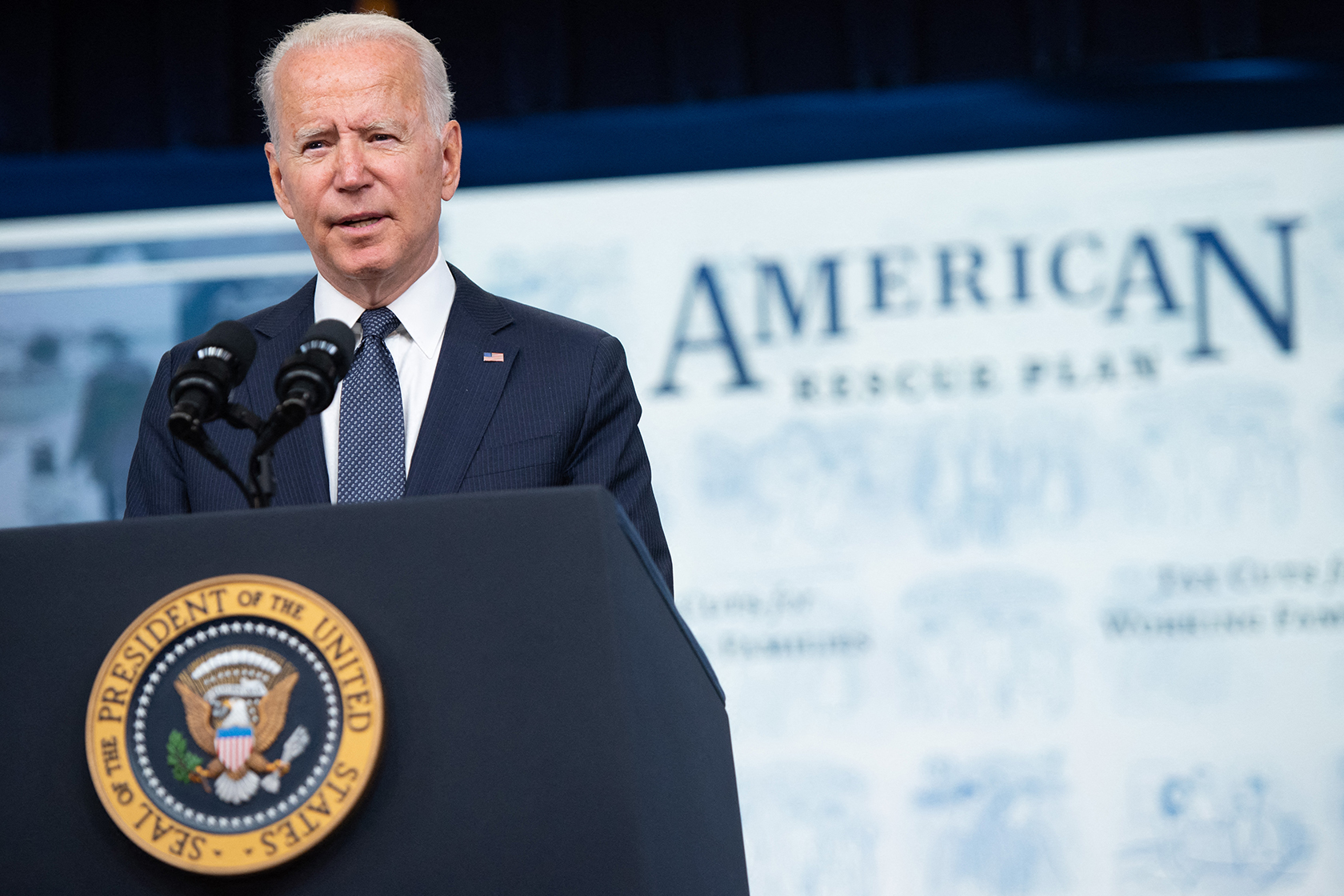
President Biden’s signature legislation, the American Rescue Plan Act, accelerated the economic recovery when it lost momentum; further fiscal steps are necessary to maintain this momentum and reduce economic inequality.
The latest data from the U.S. Bureau of Labor Statistics show that the labor market has added 7.9 million jobs since President Joe Biden took office in January 2021. His administration has made the revival of a flagging economy its top priority, with an emphasis on providing more assistance to struggling families. In early March 2021, Congress passed the administration’s American Rescue Plan Act (ARPA). In the 13 months from March 2021 through March 2022, the economy added 7.2 million jobs.
Were President Biden’s policies the cause of this boom? This much is clear: The data show that his fiscal policies directly accelerated job growth, with the ARPA leading to the creation of 1 million to more than 4 million additional jobs since it went into effect. Now, it is time for Congress to build on these progressive accomplishments by enacting further measures, paid for by a more progressive tax system, to maintain jobs momentum and reduce persistent inequality.
There has been an unprecedented jobs boom since President Biden took office. Indeed, the labor market added 6.7 million jobs in the first 12 months of his administration. No other president since World War II saw such strong growth in their first—or any—year in office.
Even in relative terms, the 4.7 percent increase in jobs created during President Biden’s first 12 months in office marks the fastest start in terms of jobs growth for any presidency since Jimmy Carter’s first year. Likewise, the recent 2.4 percentage-point drop in the unemployment rate, from 6.4 percent in January 2021 to 4 percent in January 2022, is the fastest decrease in unemployment during the first year of any presidential term since World War II.
Thanks to this jobs boom, the labor market is now nearing its pre-pandemic level: The total number of nonfarm jobs in March 2022—151 million—was equal to 99 percent of the 153 million jobs held in February 2020.6 Overall, the labor market has now recovered 92.8 percent of the jobs lost during the pandemic. To put this in context, following the Great Recession, it took the labor market until October 2013—almost four years after the recession started—to reach 99 percent of the employment level before the recession.7 This time around, millions of people got their jobs back much sooner. Indeed, President Biden and Congress seemingly learned from the last recession, when Congress enacted stimulus measures that helped the United States climb out of the depths of the recession but were nonetheless insufficient for a rapid recovery—all while Republicans in Congress and state governments imposed austerity measures.
This experience taught policymakers that the risk of doing too little comes with enormous pains for ordinary Americans. But with a more effective response, the current labor market is recovering at an unprecedented speed.
Policy intervention and its effect on jobsThe recent jobs market boom followed the enactment of the ARPA, an aggressive fiscal policy intervention to meet the moment. As a general rule, successful policy interventions that can create short-term economic and jobs market momentum need to be large enough to make a difference, targeted to those in need, and able to provide the necessary spending in rather quick order.
President Biden’s signature legislation met those criteria. Congress allocated a total of $1.9 trillion to this effort, which followed large fiscal policy interventions in 2020. The ARPA provided help to people still struggling with the fallout from the pandemic—in particular, through sending stimulus checks, expanding child tax credit payments, and providing rental assistance and additional unemployment insurance benefits.9 It also supported necessary state and local government services in education, health care, and transportation, all of which had experienced some revenue losses and increased demand.
Moreover, several of the measures in the legislation took effect immediately. Congress enacted the law on March 11, 2021, and the U.S. Treasury started sending out stimulus checks—officially known as Economic Impact Payments (EIPs)—within a week. These EIPs alone came to an initial disbursement of an estimated $242 billion. And importantly, a substantial share of the relief spending immediately went into people’s pockets.
Yet the strong recovery that followed was never assured without renewed policy interventions amid the massive challenges and uncertainties of the pandemic. This was especially apparent at the end of 2020 and in early 2021. Some continued jobs recovery was expected as the pandemic gradually lost its grip on the world, but a lot of economic uncertainty over the speed and momentum of this recovery persisted—especially in winter 2021, when a massive new and deadly wave of COVID-19 held back consumption, disrupted supply chains, and overwhelmed health systems around the world.
The ARPA’s investments in people’s financial security quickly paid offAs a result, monthly job growth had stalled by the end of 2020, and the number of jobs actually fell by 115,000 in December 2020. Calculations based on data from the U.S. Bureau of Labor Statistics show that average job growth during the three months leading up to President Biden’s inauguration—from November 2020 to January 2021—was 246,000 jobs per month, and average job growth during the three months before the ARPA was enacted, from December 2020 to February 2021, was 372,000 jobs per month. In comparison, the three-month average job growth in late summer 2020, after an initial burst of people returning to work, was more than 1 million jobs per month. By the time President Biden took office in January 2021, invigorated public health measures—especially vaccinations—had somewhat contained the impact of the virus on the economy. But with millions of people still out of work and looking for a job, President Biden pushed for his first signature legislation to help people and the economy get back on their feet.
The relief legislation was meant to invigorate the labor market. But did it actually do that? It is difficult to know, since there is no world in which Congress did not pass such legislation against which to measure the ARPA’s effects. But it is possible to ascertain a rough sense of the legislation’s impact by considering reasonable alternatives of what might have happened without it.
Importantly, uncertainty over the pandemic and the concomitant economic fallout persisted. This took its toll on the labor market in winter 2021, and it became clear that renewed policy interventions were necessary for the labor market to recover its momentum. Without these interventions, the labor market may have just lumbered along, as it did after the Great Recession of 2008 and 2009. As noted above, calculations based on employer data from the Bureau of Labor Statistics show that the labor market added 372,000 jobs per month in the three months before the enactment of the ARPA. If the labor market had continued to grow at this rate, there would have been 2.4 million fewer jobs in March 2022 than was actually the case.
In other words, the labor market in reality grew 49 percent faster from March 2021 to March 2022 than would have been expected based on its performance in the months before President Biden took office and Congress passed the ARPA. Importantly, this calculation only considers the likely impact of fiscal measures, not the possible impacts of Biden’s public health measures that went into effect sooner.
Comparing the actual labor market outcome with forecasts from independent analysts before the ARPA went into effect suggests a similar effect. The Congressional Budget Office (CBO), for example, estimated in February 2021—after President Biden was elected but before Congress passed the ARPA—that job growth from the first quarter of 2021 to the first quarter of 2022 would total 5.5 million jobs.19 Instead, during this time, the number of jobs grew by 6.7 million, or more than 1 million additional jobs.
In comparison, Moody’s Analytics estimates that the ARPA added more than 4 million jobs in 2021.20 Moreover, Moody’s estimates reflect the serious nature of the slowdown in winter 2021, which the ARPA helped keep from turning into something even more dire.
Simply put, these investments in people’s financial security quickly paid off as businesses created millions of additional jobs.
The economic benefits of a quick labor market recoveryPrioritizing job growth had measurable economic benefits. As a result of the ARPA and other targeted policy interventions, millions of people did not have to wait years to get a new job. Strong nominal wage growth also accompanied much of the recent job surge, especially initially in many low-wage sectors such as restaurants and hotels.
The combined effect of more employment and higher wages shows up as more labor income from more people working and earning more. Indeed, average per-capita inflation-adjusted wage income totaled $32,982 in February 2022, the last month for which data are available, while average per-household wage income in inflation-adjusted terms came to $85,942 in February 2022, the last month for which these data are available. These are the highest levels on record since World War II; they also reflect increases of 4.4 percent in per-capita wage income from March 2021 to February 2022 and of 3.3 percent in per-household wage income from March 2021 to December 2021. By winter 2021, both measures of average wage income exceeded the levels recorded before the pandemic started—that is, average wage income has outgrown both population growth and inflation since President Biden took office, even as inflation has increased. In comparison, average inflation-adjusted household and per-capita wage income did not exceed its level from before the Great Recession—in December 2007—until August 2014. Indeed, wage income recovered almost five years sooner this time around than it did after the last deep recession.
The strong labor market gains also meant that the economic pain was much less severe than it was after the Great Recession. For instance, the share of people who fell behind on paying their mortgages stood at 2.3 percent in the fourth quarter of 2021, almost identical to the 2.4 percent recorded in the fourth quarter of 2019, just before the pandemic hit. In comparison, this share soared from an already elevated 3.3 percent in the fourth quarter of 2007 to a whopping 11.4 percent in the first quarter of 2010.23 In fact, it took until June 2018—more than a decade after the recession started—before this indicator of household financial insecurity reached its pre-recession level. Likewise, according to U.S. Census Bureau data,24 the share of renters or homeowners who either deferred or delayed paying their rent or mortgage fell from about 10 percent in January and February 2021 to below 8 percent by April 2021, staying below or at 8 percent since then.
The strong labor market recovery after COVID-19, to a large degree, benefited those who were left far behind during the recovery after the Great Recession.Moreover, the pandemic came with a lot of mental stress associated with health and financial challenges—which in turn could have increased health care and financial costs. Fortunately, mental stress, too, has slowly subsided alongside the strengthening economic recovery in 2021. By the end of 2020, more than 40 percent of people showed signs of anxiety or depressive disorders, as calculations based on Census Bureau data show.25 Yet by May 2021, this share had dropped to less than 30 percent; since then, it has hovered at still-high levels of between 31 percent and 32 percent. Clearly, there could be meaningful benefits to ensuring that people can quickly get back into a job after a recession.
The strong labor market recovery following COVID-19, to a large degree, benefited those who were left far behind during the recovery after the Great Recession. To gauge this effect, Figure 2 compares employment by race, ethnicity, disability, and education during this recovery and during the recovery after the Great Recession. To make this an apples-to-apples comparison, though, it is important to look at similar points in the two recoveries. The current recovery started in April 2020, which means the period from March 2021 to March 2022 equals month 11 to month 23 of the recovery. The corresponding period after the Great Recession is May 2010 to May 2011, since that recovery started in June 2009. The changes in employed shares for a number of population groups during those two periods—May 2010 to May 2011 and March 2021 to March 2022—are shown below.
This time around, employment had already outpaced population growth for all groups. The employed shares of Black and Hispanic or Latino workers, as well as workers with only a high school education, grew even faster than the employed shares of white workers or workers with a college degree over the 13 months from March 2021 to March 2022. In other words, during the current recovery, the groups of workers who are often the last ones to see employment gains benefited from the labor market recovery as much as those who are typically the first job gainers.
For example, in March 2022, the employed share of Black workers was 58.3 percent, or 98.1 percent of the 59.4 percent recorded in February 2020, before the pandemic started. Meanwhile, the employed share of Hispanic or Latino workers had recovered to 98 percent of pre-pandemic levels, and employment for white workers stood at 98.2 percent of pre-pandemic levels. By March 2022, Asian workers had recovered to 99.7 percent of their pre-pandemic employment shares.
In contrast, 23 months after the Great Recession, Black workers had recovered to 88.4 percent of levels recorded in December 2007, while Hispanic or Latino workers had recovered to 90.7 percent of 2007 levels. White workers had recovered to 93.7 percent of those levels, and Asian workers saw slightly higher gains, at 93.9 percent. The current job market recovery has therefore been much faster and has benefited workers of color more equitably than did the past recovery. This does not erase the persistent inequities that continue to exist in the labor market, but the recovery at least has not exacerbated them.
The quick labor market recovery has also accompanied faster economic growth. In 2021, the economy grew by an astonishing 5.7 percent after accounting for inflation, its strongest growth rate in 38 years.26 Faster economic growth in 2021 then boosted hiring and wages, essentially creating a virtuous cycle of economic and labor market momentum that created a stronger recovery than otherwise would have been possible. After all, economic and job market growth had slowed substantially in winter 2021, threatening a “double dip recession.”
Congress needs to maintain strong economic momentumThe experience in the aftermath of the Great Recession showed that without aggressive, proactive government intervention, it can take years longer to get back to, or even near, pre-pandemic employment rates. Fortunately, Congress and President Biden took this key lesson to heart. The result was a large, expeditious, and targeted intervention in the form of the ARPA, which has had the desired effect of helping struggling families get back on their feet.
However, the policy work is not done yet. The labor market before the pandemic left many behind, and those inequities persist in the current environment. For instance, the employed share of those 25 to 54 years old was 80 percent in March 2022, slightly below the 80.5 percent recorded in February 2020 but almost 1 percentage point below the 81.4 percent recorded in December 2000, the last such watershed moment. Notably, an additional 1.8 million people in this age group would have been working in March 2022 had 81.4 percent of prime-age workers been employed then. Moreover, in March 2022, the unemployment rate for Black workers was almost twice as high as the unemployment rate for white workers: 6.2 percent compared with 3.2 percent. Meanwhile, the unemployment rate for disabled workers was more than twice as large as the unemployment rate for nondisabled workers, and the unemployment rate for people without a high school degree was 5.2 percent in March 2022—more than two and a half times the 2 percent rate of workers with a college degree.
Indeed, many people continue to struggle, even as financial hardships and mental stresses have receded from the heights of the pandemic. In particular, the people who are most vulnerable—people of color, disabled workers, and those with less formal education—need the labor market momentum to continue as a first step to real economic security so that they can have a shot at meaningful economic mobility. This will require continued, targeted policy attention to maintain the jobs market momentum.
The alternative would be to rely on private businesses to carry the labor market forward—for instance, by investing more in new offices, manufacturing plants, car parks, and other goods. Yet private business investment declined relative to gross domestic product (GDP) over the course of 2021, even as the economy gained steam and profits remained high, all while the labor market recovered and supply chain bottlenecks persisted. For instance, calculations based on data from the U.S. Bureau of Economic Analysis show that net investment—the capital additions after accounting for things becoming less valuable or even obsolete—fell from 2.3 percent of GDP in the first quarter of 2021 to 2 percent by the fourth quarter of 2021.
Instead of making new investments that would extend the economic momentum, corporations are using their money to keep shareholders happyUnfortunately, instead of putting profits toward new investments that would extend the economic momentum and put it on a stronger foundation, corporations are using their money to keep shareholders happy. Calculations based on Federal Reserve data show that in the fourth quarter of 2021 alone, nonfinancial corporations used all of their after-tax profits and then some—111.5 percent, to be exact—to pay out dividends and buy back their own shares, raising stock prices for shareholders, who are concentrated among the wealthiest households.30 In addition, nonfinancial corporations are hoarding cash, rather than accelerating investments. The same data source shows that the share of nonfinancial corporations’ liquid assets out of all assets increased from 12.7 percent in March 2021 to 13 percent in December 2021, outpacing strong corporate asset growth.31 Indeed, private businesses pursued other priorities rather than maintaining the momentum in the labor market, even though they had the incentives and the resources to invest more.
ConclusionTo be clear, the challenges now are different from those that the country faced in 2020 and 2021. Many people still want and need jobs. They will need those jobs sooner rather than later, though, as costs are going up, as careers have already been disrupted for two years, and as inequality remains high. Therefore, policy interventions must be targeted toward helping the labor market keeps its momentum amid middling private investments and widespread uncertainty. Policymakers also need to ensure that lower-income and middle-income workers are not falling behind and have access to real economic opportunities. But importantly, these investments no longer need to be deficit-financed, as was the case in the middle of a sharp downturn with record low interest rates.
Congress can pay for most or all of these investments by repealing ineffective corporate tax cuts; taxing the windfall profits of oil companies; and gradually increasing taxes on the richest Americans, who have seen their fortunes rise ever faster than those of less wealthy Americans. Creating a stronger, more equitable economy is achievable if Congress has the will to continue its progressive investments and pay for them in an equally progressive way. Indeed, new policy interventions need to buffer the finances of those who are at the highest risk financially while also ensuring continued strong job growth. This means ensuring the continued momentum in the labor market and reducing the massive, persistent inequities in the economy.
To start addressing these goals, Congress needs to support further efforts to get the lingering COVID-19 pandemic under control. Otherwise, people’s lives will remain unnecessarily at risk, and unpredictable economic disruptions will continue. Moreover, policymakers need to invest in addressing known risks, such as climate change, that will lead to further economic disruptions. In the same vein, Congress must invest in measures that make it easier for people to attain and stay in newly created jobs—for example, by expanding and lowering the cost of care for children and other dependents. The past few years have made it abundantly clear that this means building a strong care infrastructure and rebuilding capacity in the child care sector, where employment is down by 117,100 jobs relative to February 2020.33 This effort must also involve substantial investments in home and community-based services for older adults and people with disabilities, so that family caregivers have a better support structure to rely on and so they can pursue careers that fit their skills and talents.
The alternative to sustained attention to stronger job growth and less inequality is ultimately an economy that works for the few but leaves the many behind.
https://www.americanprogress.org/article/bidens-jobs-boom-how-policies-boosted-the-labor-market-recovery-in-2021/ Topic: U.S. And International Politics (Read 1024959 times)