Andrew Mason posted (paraphrased):
"Earlier during the motorcade in the Powers film, Jackie and JFK moved in different directions within a second of each other. Was that a startle reaction, or just normal behaviour?"
Dear Andrew,
I said nothing about "startle reactions."
I was talking about conscious reactions.
Conscious reactions follow "startle reactions."
My point was: How do you know that they are
reactions to anything? We see voluntary actions taken all the time as normal activities during a motorcade.
When two people in close proximity to each other consciously move their heads in opposite directions within a second of each other (wowie zowie!), it doesn't necessarily mean that they're doing so in response to the same stimulus.
It is suggested, however, when more than two people consciously and quickly do it within half-a-second of each other.
Fair enough. If several people make similar actions within half a second of each other, there may be something driving that. Or there may not. One would have to assess how improbable that could happen by chance.
First of all, you are selecting people based on the fact that they moved their heads. But there are many people who could be moving their heads but didn't. In the President's car and follow up car there were 17 people (six + 11 in the follow-up car). Let's assume the driver in each is not going to move their head voluntarily. So that is 15 people who could be acting or reacting. You find 5 out of those 15 who act within a half second. But you are choosing them based on the fact that they did move!
And then you have to factor in the chance of any two people will NOT move their heads within that half second. Let's suppose that all 15 people had been moving their heads from left to right or right to left every 5 seconds, on average, and each move took 1 second. Then for each person head turns that start, continue or finish during that half second would be included. That covers 2.5 seconds, so the probability of another person making a voluntary move within that 1/2 second is about .5.
The probability that 5 people out of 15 possible persons simply moved their head within that 1/2 second is 1-the probability that 11 of them would NOT move their heads during that 1/2 second interval.
We can work that out:
1. The number of ways that 11 people out of 15 would not move their heads within that 2.5 second period multiplied by .5^11 is:the number of ways to select 11 people out of 15 without regard to order, or C(15, 11)=15!/11!4!=15x14x13x12/(4x3x2x1)=15x7x13=
13652. the probability that all persons in a group of 11 people would not move their heads is the probability that each does not turn their head within that half second window: .5^11=.00049
3. Therefore the probability that 11 people out of 15 could be found that don't move their heads is .00049 multiplied by the number of ways to select 11 from 15. That probability is 1365x.00049= .6665
4. Therefore the probability that you will
not find at least 11 not moving their heads (ie. at least 5 people in 15 moving their heads) is 1-.6665 =
.3335So there is a 1 in 3 chance that 5 people will move their heads within half a second of each other.
It is a bit complicated and I may have over-simplified it but you get the idea why this may not be that improbable.
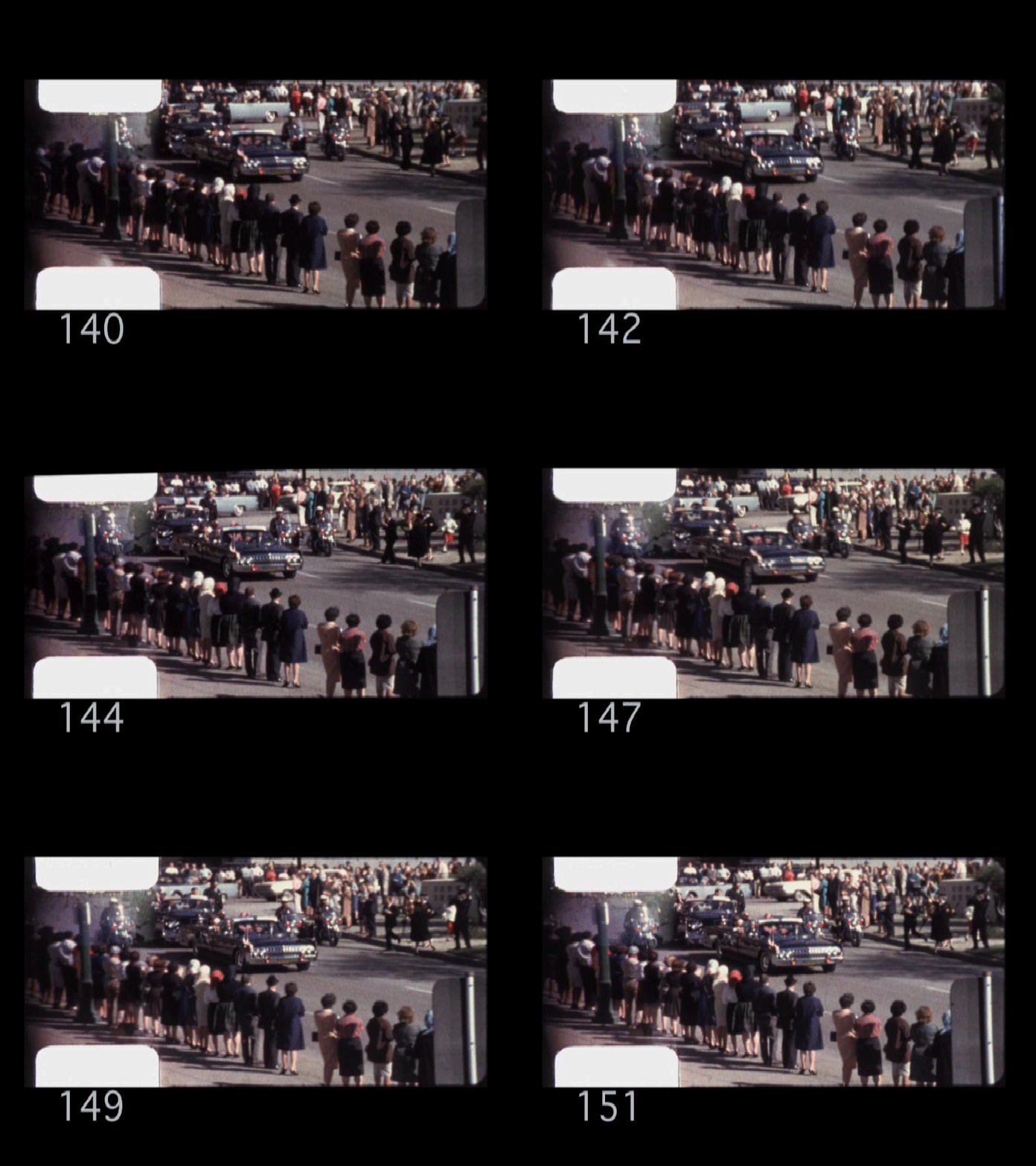
In this case, in addition to JFK and Jackie, three passengers in the limousine consciously and quicky moved their heads within half-a-second of each other.
You seem to think Rosemary Willis, JFK, Jackie, Nellie and Kellerman are moving their heads between 140-150. I don't see that at all. You imagine things that are not visible in the zfilm. Rosemary does not move her head at all, for sure. If you disagree, show us where they move their heads here:
 Topic: The First Shot (Read 629297 times)