Yeah. An incomprehensible quagmire. Just look at this and try to figure out how many shots there were:
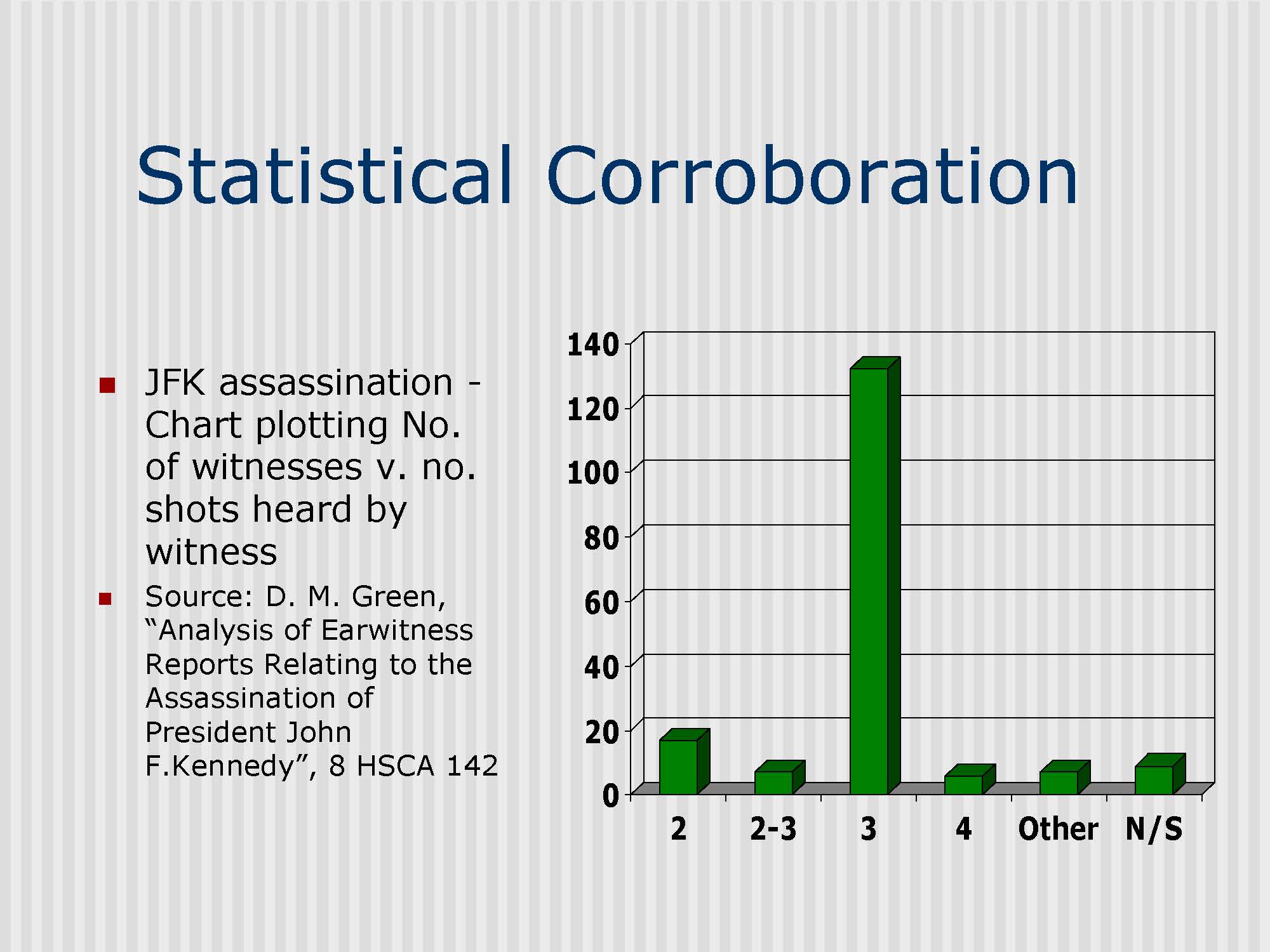 I am not sure what evidence you are referring to. It was determined by the FBI that all three shells had been fired by the C2766 rifle to the exclusion of all other rifles. This was determined by matching the bolt-face and firing pin impressions on the shells with the bolt face and firing pin of C2766 (per: Frazier, 3H416-417). (A snap cap does not recoil back against the bolt face). All three shells are shown to have bolt-face impressions matching C2766. This cannot happen if the shells are from unfired cartridges. Here is an excerpt from the WC testimony of Supt. Nicol's of the Illinois Bureau of Criminal Identification and Investigation (3H505):
Mr. NICOL. Based upon the similarity of the firing-pin impressions and the breech-block markings, as well as ejector and extractor marks, it is my opinion that all three of the exhibits, 545, 543, and 544, were fired in the same weapon as fired Exhibit 557.
Mr. EISENBERG. Mr. Nicol, did you take photographs of the various shells under the microscope?
Mr. NICOL. I took photographs of the specimen which I referred to, or was referred to, as Q-48, which would be this.
Mr. EISENBERG. Yes. That is Commission Exhibit 545.
Mr. NICOL. These were also taken under the comparison microscope in the same fashion as the other specimens.
Mr. EISENBERG. And these were taken by you?
Mr. NICOL. These were taken by me.
(3H508):
Mr. DULLES. What is 543?
Mr. EISENBERG. 543 is a shell found in the TSBD building.
Mr. NICOL. This is a photograph I took of the head-a portion of the head of Q-6, or Commission Exhibit 543.
Mr. EISENBERG. May I have this admitted as 619, Mr. Chairman?
Mr. DULLES. It shall be admitted as 619.
(The photograph described was marked Commission Exhibit NO. 619 and received in evidence.)
Mr. NICOL. It might be well to introduce these, too. These are the same as the ones which are mounted, except that I have cut them for the purpose of matching them.
Mr. EISENBERG. I would like to introduce these two photographs-also taken by you, Mr. Nicol?
Mr. NICOL. Right.
Mr. EISENBERG. Which are similar, or taken from this photograph. That will be 620 and 621, Mr. Reporter.
Mr. DULLES. Exhibits 620 and 621 as described will be admitted.
(The photographs described were marked Commission Exhibits Nos. 620 and 621 and were received in evidence.)
The microscope photos showing these markings on CE543 provided by Nicol (CE619-621) show conclusively that CE543 had been fired.
AND, since there was no empty shell in the rifle when it was found, this means the all three must have been ejected from the rifle chamber.
Nicol also found that the shells had several markings that indicated that, as full cartridges, each had been loaded and ejected at least 2 times before firing and CE543 had been loaded and ejected at least 3 times. This was determined that CE543 had a magazine follower impression made by the Mannlicher magazine on the last bullet in the clip. So this means that CE543 had, at one time, been inserted as the last bullet in the magazine at some time. Since it was not the last bullet in the clip on 22Nov63, this means that at some time it had been part of a clip of bullets in the magazine and then had been removed without firing.
You have never been able to navigate the witness statements. It is a big enough quagmire for you that you felt the need to lie about BRW and James Jarman. Making any headway on why you did this? How about post BRW 11/22 Affidavit and James Jarman's 11/24 affidavit. That would clear it up.
--------------------------------------------------------
The WC thought the likelihood that CE543 was an empty shell so much that it is included in the conclusion along with media influence. But you know this because it has been posted for you numerous times.
Summary from the Warren Commission Report (pages 110-111)
...."It is possible that the assassin carried an
empty shell in the rifle and fired only two shots, with the witnesses
hearing multiple noises made by the same shot. Soon after the three
empty cartridges were found, officials at the scene decided that three
shots were fired, and that conclusion was widely circulated by the
press. The eyewitness testimony may be subconsciously colored by
the extensive publicity given the conclusion that three shots were fired"....
------------------------------
The same Joseph Nicol testified he thought CE543 had been dry fired based on evidence of multiple firing operations.
Mr. EISENBERG. Somebody had done one operation, in your opinion, with this cartridge at three different times?
Mr. NICOL. Right.
Mr. EISENBERG. Now, just to set this in context, I have taken the bolt from Commission Exhibit 139, the rifle found on the sixth floor, and could you show the Commission what the extractor is on this bolt?
Mr. NICOL. The extractor is this semicircular piece extending back in the bolt, and its purpose is to withdraw the cartridge from the chamber at the time that the bolt is drawn back. It rides in the extractor groove, which is machined in the head of the cartridge case. At the time that the weapon is loaded, oftentimes this springs around, it first contacts the rim of the cartridge case, and then springs around the rim of the cartridge and produces marks such as these, or marks such as I have illustrated on the three sets.
Mr. EISENBERG. Now, is it possible that the reason the marks were present on this cartridge but not on the other cartridge case on this cartridge case but not on the other cartridge cases you examined--is because these marks were produced by dry firing as opposed to actual firing?
Mr. NICOL. This is possible. The weight of the empty shell would be different of course from one which had a projectile in it, so that its dynamics might be different, and it might produce a different mark-- although in the absence of accessibility of the weapon, or the absence of these marks on the tests, I really am unable to say what is the precise origin of those marks, except to speculate that they are probably from the extractor, and that the second mark that appears here, which I have indicated with a similar number, is probably an ejector mark. Now, this, I might add, is a different type of ejector mark than the mark found on the rim from the normal firing of these tests and the evidence cartridges.
Mr. EISENBERG. Now, you stated that another mark appeared in all three associated in juxtaposition with the three marks you have been describing?
Mr. NICOL. Yes; and in the same angular relationship to a radii through the center of the head.
Mr. EISENBERG. Now, again, if it is an ejector mark, might the difference have been caused by the fact that it may have been associated with a dry firing rather than an actual firing?
Mr. NICOL. That might be possible.
Mr. EISENBERG. Do you think a person would apply a different bolt pressure in a dry firing as opposed to an actual firing?
Mr. NICOL. Well, since this is a manually operated weapon, it is quite possible that no two operations are done with exactly the same force. However, with reasonable reproduceability, all these marks appear to the same depth and to the same extent, so that it would appear that whatever produced them operated in identically the same fashion.
Mr. NICOL. If we compare 624 and 621 in the same general fashion, again we we have a match of the individual characteristics. So that again the same mechanical operation occurred on this cartridge case, 543, three different times, and in a rather random fashion. They are not the angular relationship between each of these sets of patterns--it is not divisible by any particular number. It is just a random occurrence. Associated with this is another mark that occurs on all three of the positions, however not in any particular relationship to the group. of lines, and perhaps not as definitive. And it was on the basis of the match of these patterns that I would conclude that this cartridge had been introduced into a chamber at least three times prior to its final firing. So that this would represent, you might say, a practice or dry-run loading the gun and unloading it for purpose of either determining its--how it functions, or whether it was in proper function, or just for practice.
Mr. EISENBERG. Just to review this testimony, Mr. Nicol, this is a mark which occurs on the base of the cartridge case, is that correct?
Mr. EISENBERG. Do you have anything you would like to add to your testimony on the rifle bullets or the rifle cartridge cases, Mr. Nicol?
Mr. NICOL. No, sir; I don't think so.
You make a snap cap by pulling the bullet out of the shell with a pair of pliers, pour out the powder, point the rifle in a safe direction and fire the cartridge with the just the primer exploding, similar to a cap gun. Noisy but Bippity Boppety Boop you have a snap cap.
Major Anderson testified about the LHO's Marine Corp training and dryfiring.
--------------------------------------
Mr. SPECTER - What do you mean by live firing, sir?
Major ANDERSON - By live firing I mean any time a live round of ammunition is actually placed in the gun and it is fired.
Mr. SPECTER - Is that distinguished from some other type of firing, or heavy firing?
Major ANDERSON - Yes; it is distinguished from what we call dry firing in that no ammunition is used whatsoever. A man just simulates
Mr. SPECTER - Would you outline the marksmanship training, if any, which a Marine recruit receives in the normal course of Marine training?
Major ANDERSON - He goes through a very intensive 3 weeks training period. During this 3 weeks for the first week he receives a basic training in the care and cleaning of the weapon. He learns sighting and aiming. He learns manipulation of the trigger.
He is exposed to various training aids. He goes through a series of exercises in what we call dry firing in which he assumes all of the positions that he is going to use in the full firing of the rifle over the qualification course
You felt the need to lie about BRW and James Jarman. Making any headway on why you did this? How about post BRW 11/22 Affidavit and James Jarman's 11/24 affidavit. That would clear it up.
--------------------------------------------------------
The WC thought the likelyhood that CE543 was an empty shell so much that it is included in the conclusion along with media influence. But you know this because it has been posted for you numerous times.
Summary from the Warren Comission Report (pages 110-111)
...."It is possible that the assassin carried an
empty shell in the rifle and fired only two shots, with the witnesses
hearing multiple noises made by the same shot. Soon after the three
empty cartridges were found, officials at the scene decided that three
shots were fired, and that conclusion was widely circulated by the
press. The eyewitness testimony may be subconsciously colored by
the extensive publicity given the conclusion that three shots were fired"....
------------------------------
The same Joseph Nicol testified he thought CE543 had been dry fired based on evidence of multiple firing operations.
Mr. EISENBERG. Somebody had done one operation, in your opinion, with this cartridge at three different times?
Mr. NICOL. Right.
Mr. EISENBERG. Now, just to set this in context, I have taken the bolt from Commission Exhibit 139, the rifle found on the sixth floor, and could you show the Commission what the extractor is on this bolt?
Mr. NICOL. The extractor is this semicircular piece extending back in the bolt, and its purpose is to withdraw the cartridge from the chamber at the time that the bolt is drawn back. It rides in the extractor groove, which is machined in the head of the cartridge case. At the time that the weapon is loaded, oftentimes this springs around, it first contacts the rim of the cartridge case, and then springs around the rim of the cartridge and produces marks such as these, or marks such as I have illustrated on the three sets.
Mr. EISENBERG. Now, is it possible that the reason the marks were present on this cartridge but not on the other cartridge case on this cartridge case but not on the other cartridge cases you examined--is because these marks were produced by dry firing as opposed to actual firing?
Mr. NICOL. This is possible. The weight of the empty shell would be different of course from one which had a projectile in it, so that its dynamics might be different, and it might produce a different mark-- although in the absence of accessibility of the weapon, or the absence of these marks on the tests, I really am unable to say what is the precise origin of those marks, except to speculate that they are probably from the extractor, and that the second mark that appears here, which I have indicated with a similar number, is probably an ejector mark. Now, this, I might add, is a different type of ejector mark than the mark found on the rim from the normal firing of these tests and the evidence cartridges.
Mr. EISENBERG. Now, you stated that another mark appeared in all three associated in juxtaposition with the three marks you have been describing?
Mr. NICOL. Yes; and in the same angular relationship to a radii through the center of the head.
Mr. EISENBERG. Now, again, if it is an ejector mark, might the difference have been caused by the fact that it may have been associated with a dry firing rather than an actual firing?
Mr. NICOL. That might be possible.
Mr. EISENBERG. Do you think a person would apply a different bolt pressure in a dry firing as opposed to an actual firing?
Mr. NICOL. Well, since this is a manually operated weapon, it is quite possible that no two operations are done with exactly the same force. However, with reasonable reproduceability, all these marks appear to the same depth and to the same extent, so that it would appear that whatever produced them operated in identically the same fashion.
Mr. NICOL. If we compare 624 and 621 in the same general fashion, again we we have a match of the individual characteristics. So that again the same mechanical operation occurred on this cartridge case, 543, three different times, and in a rather random fashion. They are not the angular relationship between each of these sets of patterns--it is not divisible by any particular number. It is just a random occurrence. Associated with this is another mark that occurs on all three of the positions, however not in any particular relationship to the group. of lines, and perhaps not as definitive. And it was on the basis of the match of these patterns that I would conclude that this cartridge had been introduced into a chamber at least three times prior to its final firing. So that this would represent, you might say, a practice or dry-run loading the gun and unloading it for purpose of either determining its--how it functions, or whether it was in proper function, or just for practice.
Mr. EISENBERG. Just to review this testimony, Mr. Nicol, this is a mark which occurs on the base of the cartridge case, is that correct?
Mr. EISENBERG. Do you have anything you would like to add to your testimony on the rifle bullets or the rifle cartridge cases, Mr. Nicol?
Mr. NICOL. No, sir; I don't think so.
You make a snap cap by pulling the bullet out of the shell with a pair of pliers, pour out the powder, point the rifle in a safe direction and fire the cartridge with the just the primer exploding, similar to a cap gun. Noisy but Bippity Boppety Boop you have a snap cap.
Major Anderson testified about the LHO's Marine Corp training and dryfiring.
Mr. SPECTER - What do you mean by live firing, sir?
Major ANDERSON - By live firing I mean any time a live round of ammunition is actually placed in the gun and it is fired.
Mr. SPECTER - Is that distinguished from some other type of firing, or heavy firing?
Major ANDERSON - Yes; it is distinguished from what we call dry firing in that no ammunition is used whatsoever. A man just simulates
Mr. SPECTER - Would you outline the marksmanship training, if any, which a Marine recruit receives in the normal course of Marine training?
Major ANDERSON - He goes through a very intensive 3 weeks training period. During this 3 weeks for the first week he receives a basic training in the care and cleaning of the weapon. He learns sighting and aiming. He learns manipulation of the trigger.
He is exposed to various training aids. He goes through a series of exercises in what we call dry firing in which he assumes all of the positions that he is going to use in the full firing of the rifle over the qualification course
Dr E Forrest Chapman also states CE543 had been dryfired.
Dr E Forrest Chapman, Michigan Forensic Pathologist, one of three or four civilians allowed to examine evidence from the National Archives.
However, there is strong evidence that CE 543 was not, and could not have been, fired from Oswald's rifle on the day of the assassination. The only marks linking CE 543 to Oswald's rifle are marks from the rifle's magazine follower. According to Dr. Michael Kurtz and others, the case couldn't have received these marks from the magazine follower on the day of the assassination, because the last bullet in the clip must have been the unfired missile in the rifle's chamber (Kurtz, Crime of the Century, pp. 50-51). Dr. Kurtz also notes that CE 543 "lacks the characteristic indentation on the side made by the firing chamber of Oswald's rifle" (Crime of the Century, p. 51). Dr. E. Forrest Chapman studied the shell casings in 1973 and concluded (1) that CE 543 had most likely been dry loaded into a rifle, (2) that it had not been fired from the alleged murder weapon at the time of the shooting, and (3) that the indentation on the base of the case was characteristic only of a case that had been fired empty. Says Dr. Kurtz,
Dr. E. Forrest Chapman, forensic pathologist, who in 1973 was given access to the assassination materials in the National Archives, noted that Case 543 was probably "dry loaded" into a rifle. Since the dent [on the case] was too large for the case to have contained a bullet on November 22, it was never fired from Oswald's rifle. The empty case, however, for some unknown reason could have been loaded into a rifle, the trigger pulled, and the bolt operated. Dr. Chapman discovered this phenomenon through experiments of his own.
Dr. Chapman also noted that Case 543 had a deeper and more concave indentation on its base, at the primer, where the firing pin strikes the case. Only empty cases exhibit such characteristics. The FBI also reproduced this effect. Commission Exhibit 557 is a test cartridge case, fired empty from Oswald's rifle by the FBI for ballistics comparison purposes. It, too, contains the dent in the lip and deep primer impression similar to Case 543.
Dr E Forrest Chapman also states CE543 had been dryfired.
Dr E Forrest Chapman, Michigan Forensic Pathologist, one of three or four civilians allowed to examine evidence from the National Archives.
However, there is strong evidence that CE 543 was not, and could not have been, fired from Oswald's rifle on the day of the assassination. The only marks linking CE 543 to Oswald's rifle are marks from the rifle's magazine follower. According to Dr. Michael Kurtz and others, the case couldn't have received these marks from the magazine follower on the day of the assassination, because the last bullet in the clip must have been the unfired missile in the rifle's chamber (Kurtz, Crime of the Century, pp. 50-51). Dr. Kurtz also notes that CE 543 "lacks the characteristic indentation on the side made by the firing chamber of Oswald's rifle" (Crime of the Century, p. 51). Dr. E. Forrest Chapman studied the shell casings in 1973 and concluded (1) that CE 543 had most likely been dry loaded into a rifle, (2) that it had not been fired from the alleged murder weapon at the time of the shooting, and (3) that the indentation on the base of the case was characteristic only of a case that had been fired empty. Says Dr. Kurtz,
Dr. E. Forrest Chapman, forensic pathologist, who in 1973 was given access to the assassination materials in the National Archives, noted that Case 543 was probably "dry loaded" into a rifle. Since the dent [on the case] was too large for the case to have contained a bullet on November 22, it was never fired from Oswald's rifle. The empty case, however, for some unknown reason could have been loaded into a rifle, the trigger pulled, and the bolt operated. Dr. Chapman discovered this phenomenon through experiments of his own.
Dr. Chapman also noted that Case 543 had a deeper and more concave indentation on its base, at the primer, where the firing pin strikes the case. Only empty cases exhibit such characteristics. The FBI also reproduced this effect. Commission Exhibit 557 is a test cartridge case, fired empty from Oswald's rifle by the FBI for ballistics comparison purposes. It, too, contains the dent in the lip and deep primer impression similar to Case 543.

