The First Shot

Users Currently Browsing This Topic:
0 Members

Author Topic: The First Shot  (Read 451327 times)

Online Andrew Mason

  • Hero Member
  • *****
  • Posts: 1654
    • SPMLaw
Re: The First Shot
« Reply #805 on: March 24, 2022, 09:48:47 PM »
The argument I'm putting forward is extremely simple.
It is an explanation for the unbelievably rapid movement of JFK's left arm
In z224 his left arm is down by his side:


Six Z-frames later (z232) his left arm has extended upwards to a very extreme position:


This movement takes place in approximately 0.33 seconds - one third of a second.
In one third of a second JFK's left arm has gone from a resting position down by his side to a position where his left elbow is extended upwards to, what appears to be, it's fullest extent.
The rapidity of this movement is indicative of a reflex reaction to a stimulus of the nerves controlling the function of the arms.
What is your evidence that a reflex reaction takes 440 ms. (8 x 55 ms) to move from the z224 position to the position in z232?  Keep in mind that the hand doesn't move that much - rather his left elbow rises and his torso slides down and forward.  In any event, that is plenty of time for the elbow to lift and the hand to change position slightly, let alone for the torso to drop a few inches.

Quote
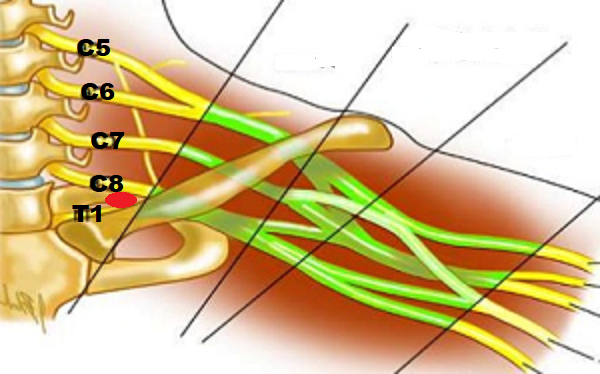
These nerves are collectively known as the Brachial Plexus. It is no coincidence that the bullet which passes through JFK, passes through the Brachial Plexus at the approximate position represented in this graphic by the red dot:


Do you have evidence that increase in pressure over six inch long section of nerves in the brachial plexus can do this?  How much pressure?  Do you even have any evidence of the amount of pressure applied to those nerves during the passage of the bullet through the upper torso?  Do you have evidence as to how long such pressure must be applied before there is a response? 

That is why this is not evidence.  It is just a theoretical possibility without supporting evidence from which anyone could conclude that it could happen, let alone that it did.

Quote
Artwohl makes the following point:

“JFK’s reaction to the neck wound was, for all intents and purposes, instantaneous to the hit at Z-223/224. As the bullet passed through his neck, the pressure cavity caused an immediate and wide spread stimulation of all the nerves in the immediate vicinity, that is of the brachial plexus, the large group of nerves that emerge from C5-T1. These are the nerves that supply motor function to the arms.”

The measurable, extremely rapid movement of JFK's left arm is evidence the nerves of the Brachial Plexus were damaged by a bullet that passed through this large group of nerves. This damage may have been caused by the bullet itself, severing  a nerve, and the effect of cavitation, which may have contributed to further stimulation of the nerves.
What evidence is there that nerves were struck or damaged in JFK due to the passage of the back/neck bullet?

Offline Steve Barber

  • Hero Member
  • *****
  • Posts: 519
Re: The First Shot
« Reply #806 on: March 25, 2022, 02:39:41 PM »
This film with synchronized sound also shows the crowd of witnesses running up the knoll--


 No civilians ran up the knoll until after DPD Officer Haygood followed the order given over the police radio by Chief Curry to "Get men on top of that over-underpass-see what happened up there.  Go up up to that overpass!".  Haygood is clearly shown traveling down Elm Street in the Thomas Atkins film, and suddenly turn his motorcycle to his right, preparing to dismount and follow the order by Curry.  The Robert Hughes film then captures him dismounted and in his first steps away from his motorcycle and begins to enter the knoll.  Not one person is on the knoll until after he's nearly reached the underpass.  People were not running up the knoll because they thought the shots came from there, they ran there because a police officer ran there.  The majority of that crowd rushing up there are people who lined Main and Houston Streets along with some of the few who were in the plaza. There weren't many people in the plaza until AFTER the shooting. The Malcolm Couch and Jimmy Darnell films both prove this.   

Offline John Tonkovich

  • Hero Member
  • *****
  • Posts: 732
Re: The First Shot
« Reply #807 on: March 30, 2022, 02:10:39 AM »
Dan, the diagram map that was posted by Andrew Mason shows a red LOS line going thru the tree at Z195😳

If there are ONLY 3 shots and the 1st shot is a hit at 195 as theorized, and hits ONLY JFK then the 2nd shot that hits Connaly defacto must be at approx z223-225 as it’s quite apparent that Connalys right shoulder is being abruptly rotated counterclockwise.

I’m dubious of 2 separate shots fired unless someone has some evidence of an suppressed shot fired which of course means 2 shooters at least.

And the tree is an obstacle that the SE window shooter is very likely aware of so even if it can be proved that the leaves were less dense in 63 , it’s stiil questionable to choose to take a shot between z186-z210 when the tree branches are an obstruction rather than taking a shot just prior to it just afterwards when there is a clear LOS.

The trajectory for the single shot hitting both JFK and Connolly does NOT have to be a perfect straight line.

There is possibility of slight deflections possible for a bullet going thru 2human bodies.

The only problem really is the apparent anomaly of the insignificant amount of deformation of CE 399.

Willis has the 1st shot fired not earlier than Z205 which is the approximate verified time of his photo taken relative to the Z film location of the JFK limo.

I’m considering the idea also of the3rd shot missed fired 0.5 sec AFTER 313 head shot because my theory is that a semi auto rifle was used and that the shooter after seeing his 1st shot not the kill shot desired, took another 4.8 secs to carefully aim and then squeezed off 2 shots in rapid succession.

The 3rd /last shot was a miss because of muzzle rise just enough that caused that shot to hit the curb near Tague.

The questionable chain of handling of CE399 and how it was “found” and the presence of metallic element uncharacteristic of MC bullet found in the curb section suggest a different type bullet was fired.
" the tree branches are an obstruction"
"Willis...Z205"
« Last Edit: March 30, 2022, 02:14:01 AM by John Tonkovich »

Online Andrew Mason

  • Hero Member
  • *****
  • Posts: 1654
    • SPMLaw
Re: The First Shot
« Reply #808 on: March 30, 2022, 09:43:56 PM »

Willis has the 1st shot fired not earlier than Z205 which is the approximate verified time of his photo taken relative to the Z film location of the JFK limo.
Willis has the first shot fired not later than frame z202.  Frame z202 was exposed at the same time as Willis' photo #6 (slide #8) that he said was taken an instant after the first shot sounded. If he reacted as quickly as possible to the shot sound reaching him (100ms) and the bullet struck 200 feet from the muzzle (100 ms. after leaving the muzzle) and the sound (1130 fps) arrived 200/1130 = 177 ms. after the bullet left the muzzle), this would put the first shot fired 277 ms. before z202 was exposed .  That is 5 frames.  So this puts the trigger pull of the first shot NO LATER THAN z197. And this puts the bullet striking JFK 177 ms or a bit more than 3 frames before z202 was exposed
« Last Edit: March 30, 2022, 09:49:49 PM by Andrew Mason »

Offline Dan O'meara

  • Hero Member
  • *****
  • Posts: 3774
Re: The First Shot
« Reply #809 on: April 04, 2022, 12:07:29 PM »
What is your evidence that a reflex reaction takes 440 ms. (8 x 55 ms) to move from the z224 position to the position in z232?  Keep in mind that the hand doesn't move that much - rather his left elbow rises and his torso slides down and forward.  In any event, that is plenty of time for the elbow to lift and the hand to change position slightly, let alone for the torso to drop a few inches.
Do you have evidence that increase in pressure over six inch long section of nerves in the brachial plexus can do this?  How much pressure?  Do you even have any evidence of the amount of pressure applied to those nerves during the passage of the bullet through the upper torso?  Do you have evidence as to how long such pressure must be applied before there is a response? 

That is why this is not evidence.  It is just a theoretical possibility without supporting evidence from which anyone could conclude that it could happen, let alone that it did.
What evidence is there that nerves were struck or damaged in JFK due to the passage of the back/neck bullet?

There's no point having this conversation. You deliberately "misunderstand" my point as it is yet another nail in the coffin of your own pet theory (which is now more nail than coffin).
Just to clarify for those who may read this thread and who don't already have an entrenched position/agenda that needs defending -
Take a minute to examine this picture:
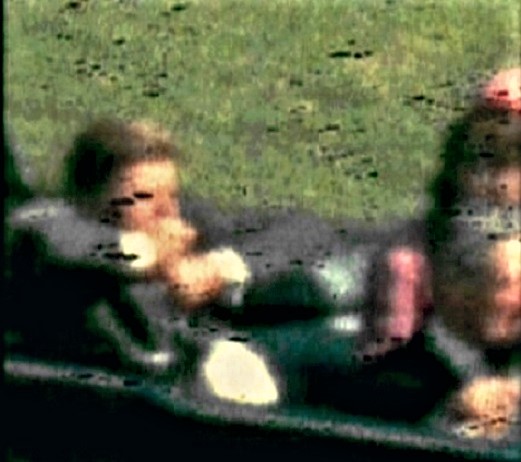


Look at how extreme the posture is, how both elbows are extended to, what appears to be, their fullest extent. In the Z-film, the upper part of JFK's body noticeably stiffens for a moment as his arms shoot up. There are very few who would argue against this extreme movement/posture being a reaction to the throat shot.

The point being made is that 0.44 seconds before this image [not 0.33, as I incorrectly posted] JFK's left arm is down by his side:
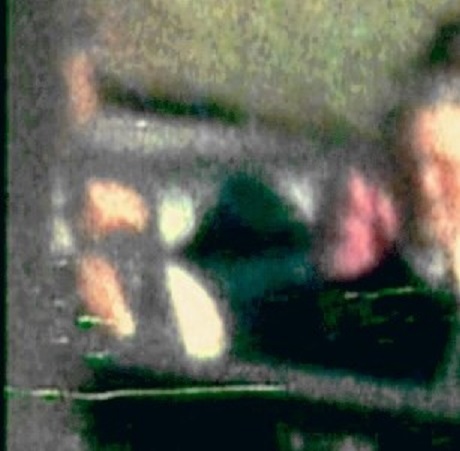


What can explain, not just the incredible rapidity of the movement of his left arm from down by his side, but the extreme posture of his fully extended elbows?
The most coherent explanation is that this is a reflex reaction to being shot through the throat. But how would this explain the radical movement of the arms? This is explained by Artwohl and Strully:

“JFK’s reaction to the neck wound was, for all intents and purposes, instantaneous to the hit at Z-223/224. As the bullet passed through his neck, the pressure cavity caused an immediate and wide spread stimulation of all the nerves in the immediate vicinity, that is of the brachial plexus, the large group of nerves that emerge from C5-T1. These are the nerves that supply motor function to the arms.”

"Before all else, it is necessary to remember that this assassination reveals a sequence of neural responses initiated in the neck by the shock wave and cavitation induced by the bullet in its traverse of the neck.  This traumatized all structures in a 6 inch radius in all directions from the path of passage through the neck.  This spread of forces occurred in a fraction of a second, traumatizing all neural structures in the immediate vicinity within a fraction of a second as determined by the speed of the missile according to ballistic studies.
As a result, contraction of the muscles innervated by nerves closest to the bullet's path took place first; -- right deltoid, left deltoid, right biceps followed by the left biceps and sequential contraction of all muscles in the forearms, hands, chest, abdominal walls and paraspinal muscle groups, with muscles in the lower extremities, farthest from the shock wave, responding last.  All neural structures in the neck were stimulated at the same moment…”


It is no coincidence that the bullet passes through the Brachial Plexus, the nerves that supply motor function to the arms. To imagine the extremely rapid movement and radical posture of JFK's arms is caused by anything other than damage to the nerves of the Brachial Plexus seems unlikely, to say the least.


As far as Andrew's theory is concerned - a first shot at z195. As shown elsewhere in this thread, the first recorded reaction of JFK to being shot is z225, this accords perfectly with an "instantaneous" reflex reaction to a bullet passing through the Brachial Plexus at z223. However, a shot at z195 would require JFK to "wait" for more than one and a half seconds before the radical reaction we see recorded in the Z-film. This is an eternity in terms of reaction times to being shot and does not explain the extreme posture of JFK's extended elbows.
« Last Edit: April 04, 2022, 01:23:12 PM by Dan O'meara »

Offline Jack Nessan

  • Hero Member
  • *****
  • Posts: 1327
Re: The First Shot
« Reply #810 on: April 04, 2022, 03:37:02 PM »
There's no point having this conversation. You deliberately "misunderstand" my point as it is yet another nail in the coffin of your own pet theory (which is now more nail than coffin).
Just to clarify for those who may read this thread and who don't already have an entrenched position/agenda that needs defending -
Take a minute to examine this picture:


Look at how extreme the posture is, how both elbows are extended to, what appears to be, their fullest extent. In the Z-film, the upper part of JFK's body noticeably stiffens for a moment as his arms shoot up. There are very few who would argue against this extreme movement/posture being a reaction to the throat shot.

The point being made is that 0.44 seconds before this image [not 0.33, as I incorrectly posted] JFK's left arm is down by his side:


What can explain, not just the incredible rapidity of the movement of his left arm from down by his side, but the extreme posture of his fully extended elbows?
The most coherent explanation is that this is a reflex reaction to being shot through the throat. But how would this explain the radical movement of the arms? This is explained by Artwohl and Strully:

“JFK’s reaction to the neck wound was, for all intents and purposes, instantaneous to the hit at Z-223/224. As the bullet passed through his neck, the pressure cavity caused an immediate and wide spread stimulation of all the nerves in the immediate vicinity, that is of the brachial plexus, the large group of nerves that emerge from C5-T1. These are the nerves that supply motor function to the arms.”

"Before all else, it is necessary to remember that this assassination reveals a sequence of neural responses initiated in the neck by the shock wave and cavitation induced by the bullet in its traverse of the neck.  This traumatized all structures in a 6 inch radius in all directions from the path of passage through the neck.  This spread of forces occurred in a fraction of a second, traumatizing all neural structures in the immediate vicinity within a fraction of a second as determined by the speed of the missile according to ballistic studies.
As a result, contraction of the muscles innervated by nerves closest to the bullet's path took place first; -- right deltoid, left deltoid, right biceps followed by the left biceps and sequential contraction of all muscles in the forearms, hands, chest, abdominal walls and paraspinal muscle groups, with muscles in the lower extremities, farthest from the shock wave, responding last.  All neural structures in the neck were stimulated at the same moment…”


It is no coincidence that the bullet passes through the Brachial Plexus, the nerves that supply motor function to the arms. To imagine the extremely rapid movement and radical posture of JFK's arms is caused by anything other than damage to the nerves of the Brachial Plexus seems unlikely, to say the least.


As far as Andrew's theory is concerned - a first shot at z195. As shown elsewhere in this thread, the first recorded reaction of JFK to being shot is z225, this accords perfectly with an "instantaneous" reflex reaction to a bullet passing through the Brachial Plexus at z223. However, a shot at z195 would require JFK to "wait" for more than one and a half seconds before the radical reaction we see recorded in the Z-film. This is an eternity in terms of reaction times to being shot and does not explain the extreme posture of JFK's extended elbows.

Dan, If you are going to wrestle with a pig in the mud, always remember the pig likes it.

A lot of people on this forum have explained to Andrew over numerous years and in numerous ways the folly of this theory, yet here it still is. This is all about a proposed shot at Z250 or somewhere in that area that never happened.

Online Andrew Mason

  • Hero Member
  • *****
  • Posts: 1654
    • SPMLaw
Re: The First Shot
« Reply #811 on: April 04, 2022, 06:18:01 PM »
There's no point having this conversation. You deliberately "misunderstand" my point as it is yet another nail in the coffin of your own pet theory (which is now more nail than coffin).
I am not misunderstanding your point, deliberately or otherwise. You are saying that you can tell that JFK's reaction to being shot through the neck BEGINS after z224.  I am simply pointing out that you cannot see JFK before z224 so how do you know that he is not reacting there?  We can see his contorted face in z225 and that his hands have moved from the positions seen in z193 to those seen in z225.  You simply cannot say that the zfilm shows that he was not reacting before z224. You can try to reason, as you have, that what is seen after he emerges is the first reaction but it is not based on evidence. It is based on conjecture that JFK had to react that way within a few frames of being hit. 

Quote
As far as Andrew's theory is concerned - a first shot at z195. As shown elsewhere in this thread, the first recorded reaction of JFK to being shot is z225, this accords perfectly with an "instantaneous" reflex reaction to a bullet passing through the Brachial Plexus at z223. However, a shot at z195 would require JFK to "wait" for more than one and a half seconds before the radical reaction we see recorded in the Z-film. This is an eternity in terms of reaction times to being shot and does not explain the extreme posture of JFK's extended elbows.
BUT YOU CANNOT SEE JFK FROM Z207 TO Z224!!!  You want everyone to believe you can see that he is not reacting before z224!!  I understand your argument.  But it is not based on evidence. It is based on a theory that has no evidentiary support.  As far as JFK's reaction after being hit, I simply point out that the reaction depends on what JFK experienced. If he did not feel any pain or impact but just felt a growing sensation of loss of function, his reaction could have developed over a period of one second or so.  I also point out that you can see the beginning of a reaction with his hand movements before z207.