The First Shot

Users Currently Browsing This Topic:
0 Members

Author Topic: The First Shot  (Read 452383 times)

Online Marjan Rynkiewicz

  • Hero Member
  • *****
  • Posts: 1043
Re: The First Shot
« Reply #602 on: February 10, 2021, 01:51:37 AM »
The general agreement is that it's z255

I agree that the witness statements are very contradictory so I try to rely on the Z-film and see if the witness statements agree with it.
My notes tell me that...
Z123(say) -- Oswald's 1st shot hits signals & road, a fragment glances off JFK's head.
Z133 -- first frame of sequence.
Z196 -- there is a hint of a reaction from an agent standing on the followup limo.
Z201 -- the start of a definite reaction.
Z203 -- two standing agents are starting to look back to Oswald (i reckon that this (or soon after) is Altgens-6).
Z255 -- the agents in the followup limo aint visible (u advise that Z255 is Altgens-6).
Z240 -- standing agents are not visible after Z240 (i think).

Z123 (say) to Z203 would be   80 frames at 18.3 fps which is say 4.3 sec.
Z123 (say) to Z255 would be 132 frames which is say 7.2 sec.

Z218 -- Oswald's 2nd shot possibly, the magic bullet.
Z313 -- Hickey's headshot. Possible simultaneous 3rd shot by Oswald (but unlikely). Tague injured by fragment.

Z123 to Z218 is 95 frames which is say 5.2 sec.
Z218 to Z313 is 95 frames which is say 5.2 sec.
« Last Edit: February 10, 2021, 02:29:06 AM by Marjan Rynkiewicz »

Online Andrew Mason

  • Hero Member
  • *****
  • Posts: 1658
    • SPMLaw
Re: The First Shot
« Reply #603 on: February 10, 2021, 05:15:42 AM »
There is no change in hand position in frames z271 and z272:
Not much change in the hand position, I agree.  But I can't say there is none.  There does appear to be a movement of the hat as in z272 the brim covers part of the jacket cuff. 

Quote
This proves the shot you propose a z271 does not occur.
No. It just proves that the hand did not move much at z271-272.

Quote
Now, as I understand it, you are proposing that the bullet exits JBC's chest, shatters on his wrist and two fragments fly off with enough force to crack the windshield and dent the chrome trim yet this is not enough force to move his hand. The force of the shattering bullet leaves fragments in his wrist but this is still not enough force to move his hand.
The bullet is exiting under the right nipple in a forward direction.  The back of the wrist is against the chest so that the exit point in the jacket pocket and the right jacket cuff are together.  The bullet makes a hole in the jacket and a similar hole at the end of the jacket cuff but a very jagged and long hole in the french cuff above the wrist going across the wrist.  That is consistent with the bullet striking the back of the radius on an oblique angle, which would cause it to deflect up and to the left.

Quote
Anyway...onwards and upwards.
Back to your devastating list of things that refute the unequivocal evidence of the Z-film.
The first two points have demonstrated you are confused about how relative positions change with a changing perspective and are equally confused about blurring.
Jerry has dealt with your wobbly sun visor
How so?  The wind argument? How does the wind blow it forward - and the left more than the right (if the right moves at all)?

Quote
so now we are in the deep weeds of contradictory eye witness testimony - your lawyerly bread and butter.
All I can do with this is examine the quality of the observations of your creaky witnesses.
Up first - Hickey.
You desperately hang on to this guy because he says he sees JFK's hair fly forward at a time you think you can make work in your doomed model. But let's see how accurate his observations are:

"I heard a loud report which sounded like a firecracker. It appeared to come from the right and rear and seemed to me to be at ground level. I stood up and looked to my right and rear in an attempt to identify it. Nothing caught my attention except people shouting and cheering."

This is the moment we see in Altgens 6

"A disturbance in 679X caused me to look forward toward the President's car. Perhaps 2 or 3 seconds elapsed from the time I looked to the rear and then looked at the President. He was slumped forward and to his left,"

679X is the follow-up car Hickey is in. There is some kind of disturbance which causes Hickey to look towards JFK, who is slumped over. An accurate description of JFK after the first shot.

"and was straightening up to an almost erect sitting position as I turned and looked. At the moment he was almost sitting erect I heard two reports which I thought were shots and that appeared to me completely different in sound than the first report and were in such rapid succession that there seemed to be practically no time element between them."

Erm...JFK "was straightening up to an almost erect sitting position"
What?
" At the moment he was almost sitting erect" - Excuse me??
Nothing even remotely resembling this is shown in the Z-film. Once JFK is slumped over to his left he most certainly does not straighten up until he's " almost sitting erect". Nothing like this happens. What's he talking about?
Then he hears two shots that are so close together there is "  practically no time element between them".

It looked to me as if the President was struck in the right upper rear of his head. The first shot of the second two seemed as if it missed because the hair on the right side of his head flew forward and there didn't seem to be any impact against his head.

This is the bit you hang onto. The first of the two shots that are almost simultaneous makes his hair move forward. The slight ruffling of JFK's fringe you insist cannot be this as Hickey is at an impossible angle to see it as JFK's head is turned slightly to the left. But let's not worry about that.
You don't seem to want to deal with his observation.  You say he couldn't see JFK's hair.  Why? He was standing in the follow-up car and able to see JFK's head.  What do you think was blocking his view of JFK? 
Quote
"The last shot seemed to hit his head and cause a noise at the point of impact which made him fall forward and to his left again. - Possibly four or five seconds elapsed from the time of the first report and the last."

Which made him fall forward?
JFK is knocked backwards by the shot, everyone can see this except Hickey.

Hickey fails as a witness. Noticing things that are not there.
That leaves us with Greer  ;)
Ok.  At least you agree that Hickey's evidence indicates a shot before the head shot.  You just think he was mistaken about hearing two shots.  And, I gather, you think he didn't hear the shot after the headshot at all.
« Last Edit: February 10, 2021, 05:19:09 AM by Andrew Mason »

Offline Dan O'meara

  • Hero Member
  • *****
  • Posts: 3774
Re: The First Shot
« Reply #604 on: February 10, 2021, 06:46:54 AM »
My notes tell me that...
Z123(say) -- Oswald's 1st shot hits signals & road, a fragment glances off JFK's head.
Z133 -- first frame of sequence.
Z196 -- there is a hint of a reaction from an agent standing on the followup limo.
Z201 -- the start of a definite reaction.
Z203 -- two standing agents are starting to look back to Oswald (i reckon that this (or soon after) is Altgens-6).
Z255 -- the agents in the followup limo aint visible (u advise that Z255 is Altgens-6).
Z240 -- standing agents are not visible after Z240 (i think).

Z123 (say) to Z203 would be   80 frames at 18.3 fps which is say 4.3 sec.
Z123 (say) to Z255 would be 132 frames which is say 7.2 sec.

Z218 -- Oswald's 2nd shot possibly, the magic bullet.
Z313 -- Hickey's headshot. Possible simultaneous 3rd shot by Oswald (but unlikely). Tague injured by fragment.

Z123 to Z218 is 95 frames which is say 5.2 sec.
Z218 to Z313 is 95 frames which is say 5.2 sec.

Hi Marjan,

You say at z203 " two standing agents are starting to look back to Oswald"

Below is a close up of z207, four frames after z203. It's the last frame we see most of the agents in. I'm sure you'll agree that not one is looking back towards the TSBD, so I don't understand where you are getting the idea from that they are looking back:


From your notes can you reveal where you are getting the idea from there is a shot before z133.

Oh yeah...I asked you before to explain why none of the agents has reacted to a loud, explosive noise for over four seconds. What are your ideas on that?
« Last Edit: January 21, 2022, 12:21:18 PM by Dan O'meara »

Offline Dan O'meara

  • Hero Member
  • *****
  • Posts: 3774
Re: The First Shot
« Reply #605 on: February 10, 2021, 08:15:48 AM »
Not much change in the hand position, I agree.  But I can't say there is none.  There does appear to be a movement of the hat as in z272 the brim covers part of the jacket cuff. 
No. It just proves that the hand did not move much at z271-272.
The bullet is exiting under the right nipple in a forward direction.  The back of the wrist is against the chest so that the exit point in the jacket pocket and the right jacket cuff are together.  The bullet makes a hole in the jacket and a similar hole at the end of the jacket cuff but a very jagged and long hole in the french cuff above the wrist going across the wrist.  That is consistent with the bullet striking the back of the radius on an oblique angle, which would cause it to deflect up and to the left.
How so?  The wind argument? How does the wind blow it forward - and the left more than the right (if the right moves at all)?
You don't seem to want to deal with his observation.  You say he couldn't see JFK's hair.  Why? He was standing in the follow-up car and able to see JFK's head.  What do you think was blocking his view of JFK?  Ok.  At least you agree that Hickey's evidence indicates a shot before the head shot.  You just think he was mistaken about hearing two shots.  And, I gather, you think he didn't hear the shot after the headshot at all.

There is no change in hand position in frames z271 and z272:
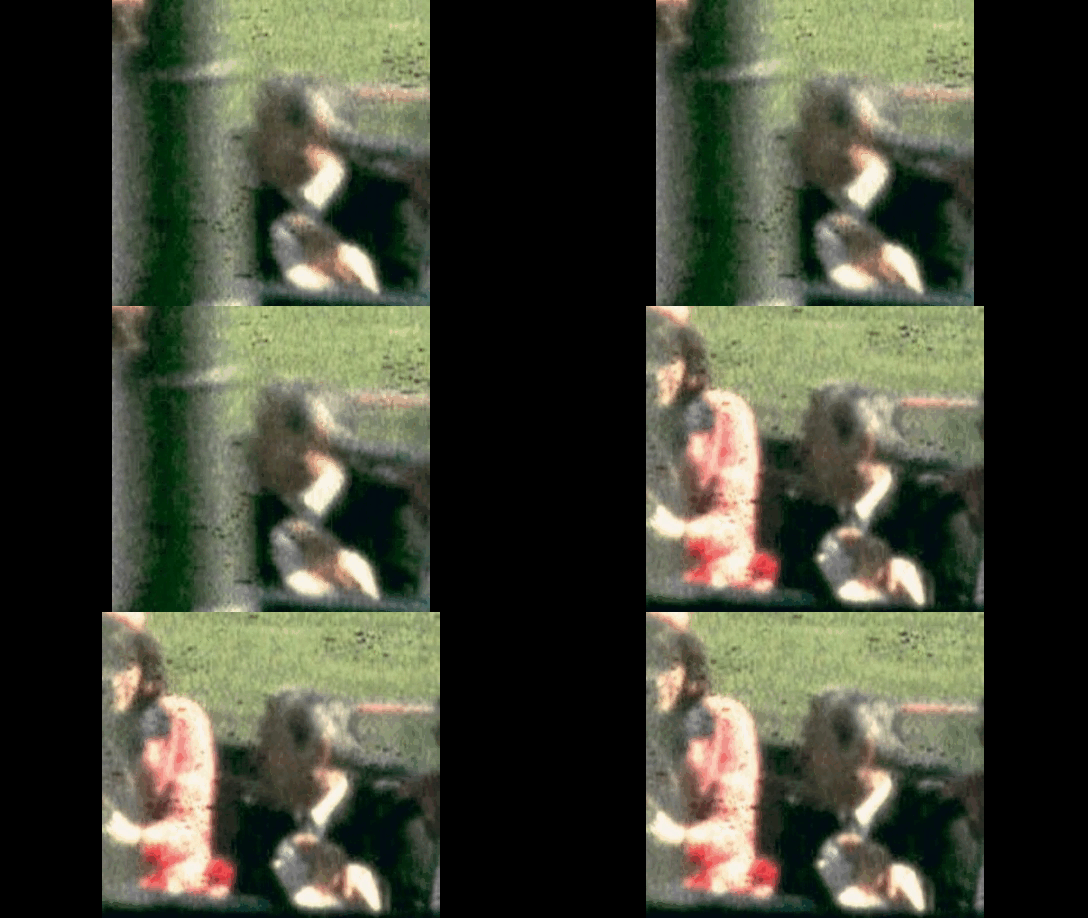


This is the moment you insist a bullet explodes out of JBC's chest.
The moment you insist the bullet shatters on impact with his wrist bone leaving metallic particles in his wrist.
The moment some of these fragments of bullet are deflected off (at what must be close to 90 degrees) and crack the windscreen and dent the chrome trim...
...yet JBC's hand does not move one inch after such a tremendous impact.
It is not only an insult to my intelligence but the intelligence of everyone who views this thread to have to read such garbage.

At least you have the balls to take this vital issue on.
Establishing exactly how the shots occurred during the assassination is of vital importance.
But the model you are proposing - first shot at z195 second shot at z271, third shot at z313 - is over.
It's a pity you don't have the balls to face up to that.

And now you've descended to flat out lying:

"You say he couldn't see JFK's hair. "

This is just a lie. It's not a misunderstanding or misinterpretation. It's just a lie.
Nowhere in my post did I say Hickey couldn't see JFK's hair. He could obviously see the back of JFK's head.
After having to explain to you how relative positions change as perspective changes, after having to explain to you how blurring affects what is observed, I now have to explain the difference between the back and the front of somebody's head? Really?
Hickey couldn't see the front of JFK's head. Do you really not understand that?

"At least you agree that Hickey's evidence indicates a shot before the head shot."

This is just a lie.
You read my post.
It was about how unreliable Hickey's observations are.
He stated JFK sat upright after being slumped to the left. This did not happen. Hickey is wrong about this.
He stated JFK fell forward after being hit in the head. This did not happen. Hickey is wrong about this.
He is an unreliable witness because he is reporting crucial things that did not happen.
And he's your star witness.

It's not too late to have a rethink, it just takes a bit of courage.

Online Marjan Rynkiewicz

  • Hero Member
  • *****
  • Posts: 1043
Re: The First Shot
« Reply #606 on: February 10, 2021, 09:29:31 AM »
Hi Marjan,

You say at z203 " two standing agents are starting to look back to Oswald"

Below is a close up of z207, four frames after z203. It's the last frame we see most of the agents in. I'm sure you'll agree that not one is looking back towards the TSBD, so I don't understand where you are getting the idea from that they are looking back:


From your notes can you reveal where you are getting the idea from there is a shot before z133.

Oh yeah...I asked you before to explain why none of the agents has reacted to a loud, explosive noise for over four seconds. What are your ideas on that?
The Agent's reactions start at S201 & they are definitely starting to look back by Z207 which is where Zapruder pans away & we dont see them again.  Hence the reaction time is Z123(say) to Z203 say, say 80 frames which is 4.4 sec. Altgens-6 is some time after Z207 (perhaps Z230). 
In the meantime JFK reacts at Z140, Jackie at Z142, Hickey at Z144, Connally at Z149.
http://mcadams.posc.mu.edu/scearce.htm
https://www.washingtondecoded.com/site/2007/03/11-seconds-in-d.html
The Agents might have been mainly concentrating on what was happening or not happening in JFK's limo. What was that? Was it a gun shot? Where from (a shot from overhead would be confusing)(especially with echoes)?
« Last Edit: February 10, 2021, 09:39:11 AM by Marjan Rynkiewicz »

Offline Dan O'meara

  • Hero Member
  • *****
  • Posts: 3774
Re: The First Shot
« Reply #607 on: February 10, 2021, 09:51:14 AM »
The Agent's reactions start at S201 & they are definitely starting to look back by Z207 which is where Zapruder pans away & we dont see them again.  Hence the reaction time is Z123(say) to Z203 say, say 80 frames which is 4.4 sec. Altgens-6 is some time after Z207 (perhaps Z230). 
In the meantime JFK reacts at Z140, Jackie at Z142, Hickey at Z144, Connally at Z149.
http://mcadams.posc.mu.edu/scearce.htm

The Agents might have been mainly concentrating on what was happening or not happening in JFK's limo. What was that? Was it a gun shot? Where from (a shot from overhead would be confusing)(especially with echoes)?

In the picture I posted from z207 nobody is looking back. You can see that nobody is looking back.


In their testimonies the agents said they reacted immediately by looking back towards the TSBD. We can see that in this picture:


The agents are reacting to the first shot in this picture, exactly as they state in their testimonies. They react immediately after the first very loud, explosive sound. Up to z207 there is no reaction because the first shot has not been fired. If the first shot was fired before z133 we would see the agents turning round in the Z-film, but they don't because the first shot hasn't been fired yet.
Altgens 6 shows three agents reacting together to the first shot. Altgens 6 is around z255, so the agents are reacting to a shot just before z255. Before z133 is way too early. Do you think the agents stood in the same position for four seconds before they all, at the same time, decided to react?
Does that seem likely?
Not really.
You are wrong to believe there was a shot before z133.
The Z-film and Altgens 6 prove that.
Will you change your mind now you are faced with this evidence or will you just ignore it?

Online Andrew Mason

  • Hero Member
  • *****
  • Posts: 1658
    • SPMLaw
Re: The First Shot
« Reply #608 on: February 10, 2021, 12:53:21 PM »
There is no change in hand position in frames z271 and z272:


This is the moment you insist a bullet explodes out of JBC's chest.
The moment you insist the bullet shatters on impact with his wrist bone leaving metallic particles in his wrist.
The moment some of these fragments of bullet are deflected off (at what must be close to 90 degrees) and crack the windscreen and dent the chrome trim...
...yet JBC's hand does not move one inch after such a tremendous impact.
You seem to have difficulty understanding the physical impact of an oblique strike on the radius.  You continue to talk about a "tremendous impact" but you have made no attempt to quantify it.  I have.  I have given you a reasoned estimate of the momentum transfer to the wrist at 2 N. sec. or about the force of a 2 kg weight applied for a tenth of a second.  You, on the other hand, insist that the bullet made a left-hand turn by striking the back of the radius on the distal side but have never offered an explanation that explains the physics of that miraculous turn.  I am not sure what you think happened to CE399 because you seem to offer no explanation for the near pristine condition of that bullet.

Dealing with your comment, I am not sure what you mean by saying the bullet "exploded" out of his chest.  The bullet does not appear to have fragmented in his chest, judging by the apertures made in his jacket.  It is evident that the holes in the jacket pocket and on the jacket and shirt cuff are all in the same location and pressed together at z271.  His wrist is pressed against his chest and made similar holes in the jacket pocket and jacket cuff. 

However, it made a much longer and very jagged aperture in the middle of and across the width of the back side of his shirt french cuff.  It made no hole in the palm side. The large jagged hole in the french cuff is consistent with the entry of the bullet, the bullet striking the radius followed by the exit of fragments.  This would have caused a force in the direction away from the chest but there was a counter-force of his arm pressing into the chest.

Quote
At least you have the balls to take this vital issue on.
Establishing exactly how the shots occurred during the assassination is of vital importance.
But the model you are proposing - first shot at z195 second shot at z271, third shot at z313 - is over.
It's a pity you don't have the balls to face up to that.
It is not over if the third and last shot was z313.  If that is the case, you would have to agree that there must have been a shot around z271 because of the last two shots being closer together.   So this is not, fundamentally, a disagreement so much about whether there was a shot around z271. It is about whether there was a shot after the headshot. 

Quote
And now you've descended to flat out lying:

"You say he couldn't see JFK's hair. "

This is just a lie. It's not a misunderstanding or misinterpretation. It's just a lie.
Nowhere in my post did I say Hickey couldn't see JFK's hair. He could obviously see the back of JFK's head.
After having to explain to you how relative positions change as perspective changes, after having to explain to you how blurring affects what is observed, I now have to explain the difference between the back and the front of somebody's head? Really?
Hickey couldn't see the front of JFK's head. Do you really not understand that?
I thought you were adopting Jerry's assertion that Hickey could not see JFK's head at all. 

Hickey could certainly see the top of JFK's head and it is apparent from the zfilm that the hair on the right side flies up at z273-276.  What would block that view?  It is rather obvious that Hickey's eyes were several feet above the level of JFK's head.  The QM was higher than the president's car and JFK was seated while Hickey was standing.

Quote
"At least you agree that Hickey's evidence indicates a shot before the head shot."

This is just a lie.
You read my post.
It was about how unreliable Hickey's observations are.
You seem not to have understood my point, which was that you agree that Hickey is stating that he heard a shot just before the head shot - ie. he heard two shots.  You just don't think he is reliable. If you didn't agree, you would not be making the point that he is unreliable.

Quote
He stated JFK sat upright after being slumped to the left. This did not happen. Hickey is wrong about this.
He stated JFK fell forward after being hit in the head. This did not happen. Hickey is wrong about this.
He is an unreliable witness because he is reporting crucial things that did not happen.
And he's your star witness.
I am puzzled why you think he would report on something that did not happen.

Quote
It's not too late to have a rethink, it just takes a bit of courage.
You are, unfortunately, descending into ad hominem argument. It makes your points look desperate when you do that because ad hominems are usually a last resort.