Trump stuck with the D-list as experienced lawyers refuse to help him with FBI investigation
On Tuesday, The Washington Post reported that former President Donald Trump is struggling to find reputable lawyers to assist him as the FBI investigates his unusual retention of highly classified information at his Mar-a-Lago resort in Palm Beach, Florida.
"The struggle to find expert legal advice puts Trump in a bind as he faces potential criminal exposure from a records dispute with the National Archives that escalated into a federal investigation into possible violations of the Espionage Act and other statutes," reported Isaac Arnsdorf, Josh Dawsey, Carol D. Leonnig, Jacqueline Alemany, and Rosalind S. Helderman. "'Everyone is saying no,' said a prominent Republican lawyer, who like some others spoke on the condition of anonymity to discuss confidential conversations."
"Ordinarily, the prestige and publicity of representing a former president, as well as the new and complex legal issues at stake in this case, would attract high-powered attorneys. But Trump’s search is being hampered by his divisiveness, as well as his reputation for stiffing vendors and ignoring advice," said the report. "'In olden days, he would tell firms representing him was a benefit because they could advertise off it. Today it’s not the same,' said Michael Cohen, a former lawyer for Trump who was convicted of tax evasion, false statements, campaign finance violations and lying to Congress in 2018. 'He’s also a very difficult client in that he’s always pushing the envelope, he rarely listens to sound legal advice, and he wants you to do things that are not appropriate, ethically or legally.'"
According to the report, the legal team Trump is stuck with is less than prepared to help him with such a high-profile legal battle.
"People familiar with the search for legal help said the effort includes Susie Wiles, a close adviser to Trump, and attorney Christina Bobb, who was present at Mar-a-Lago during the search and signed for the list of documents taken," said the report. "Former campaign adviser Boris Epshteyn is taking a prominent role, and former White House aide Kash Patel is advising informally. Patel is raising money for a 'legal offense' fund by selling merchandise such as tank tops and beanies emblazoned with the logo 'K$H.'"
"Trump’s other lawyer currently based in Florida is Lindsey Halligan, whose practice, according to a professional biography, focuses on insurance claims at residential and commercial properties," said the report. "She was admitted to the Florida bar in 2014. A search of federal court records found no filings under her name. She did not respond to requests for comment."
Read More Here: https://www.washingtonpost.com/national-security/2022/08/16/trump-lawyers-fbi-raid/Former Trump White House lawyers spoke with the FBI on classified docs taken to Mar-a-Lago: report
The New York Times is reporting that two former White House lawyers to President Donald Trump spoke with the FBI about the classified documents taken to Mar-a-Lago post-presidency.
Pat Cipollone and Patrick Philbin both spoke to investigators about their experiences trying to get the government documents back to the National Archives, according to the new report.
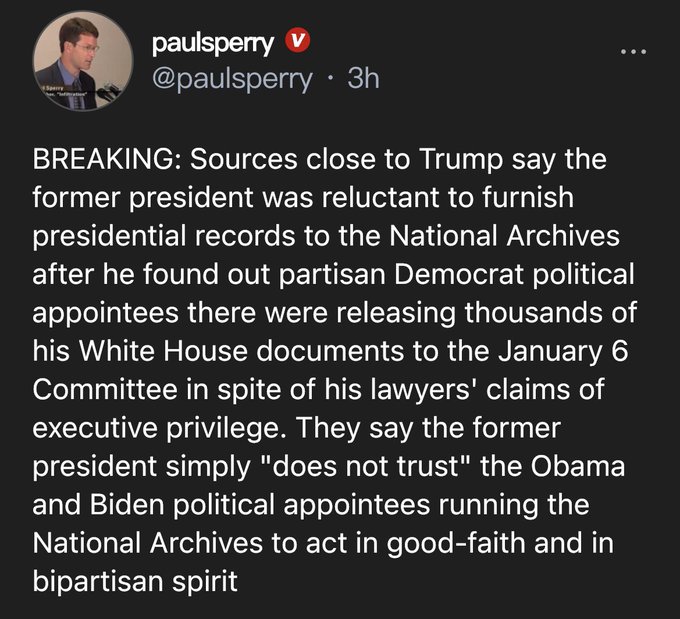
A report on Monday night revealed Philbin, in particular, worked to get the documents. However, they quoted Trump ranting: "It's not theirs, it's mine," advisers told the Times.
Ultimately, Trump did allow 15 boxes to be turned over to the National Archives, with staff taking a truck to Mar-a-Lago to retrieve the documents.
"At that point, at least one Trump lawyer signed a statement saying material with the classified markings had been returned, according to four people familiar with the document," the report continued. "But officials then used a subpoena to obtain surveillance footage of the hallway outside a storage room at Mar-a-Lago and saw something that alarmed them. They also received information from at least one witness who indicated that more material might remain at the residence, people familiar with the investigation said."
Speaking to MSNBC on Tuesday, Andrew Weissmann, former Justice Department prosecutor on special counsel Robert Mueller's team explained the significance of the new report.
"I think it is important for people to know that both those gentlemen were two of seven people who President Trump designated on Jan. 19, 2021, two days before his presidency was over, as his representatives in terms of dealing with presidential records," said Weissmann.
"I think this is part of the reason that you saw in the search warrant the reference to section 1519 of the criminal statute," he continued. "That is an obstruction statute. And that is the kind of thing that the department could have been very focused on false statements and false representations being made to them that everything had been returned. Only to find, in the search, that that was not true. And that kind of crime, I can tell you when I was in the department, that is the kind of crime that really gets people in the department up in arms. It goes to undermining the integrity of the criminal investigation. And that's the kind of thing that has to be deterred if you're in this case, in any case, if you're going to actually have a rule of law."
Andrew Weissmann @AWeissmann_Legally, this is a confession, not a defense, even if Trump thinks this plays to his base.
The more Trump keeps talking, the more he keeps digging his legal grave.
https://twitter.com/AWeissmann_/status/1559637863276445696
Read More Here: https://www.nytimes.com/2022/08/16/us/politics/trump-cipollone-philbin-interviews-fbi.html

