News Analysis: Trump delayed weapons to Ukraine and praised Putin. Did that trigger war?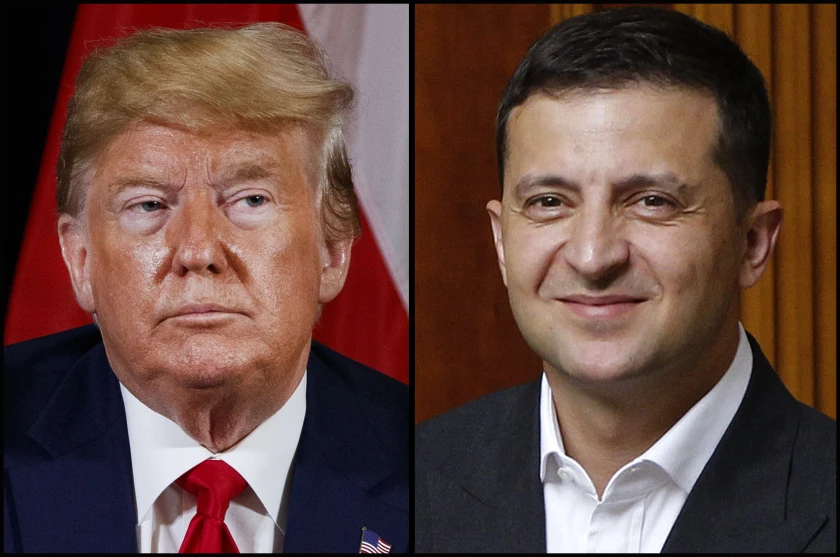
WASHINGTON — The last time (and maybe the first time) most Americans heard of Volodymyr Zelensky, the Ukrainian president was at the center of a scandal that would lead to the impeachment of then-President Trump.
Trump in 2019 threatened to hold up weapons deliveries to Ukraine — caught even then in a simmering war with Russian proxies — unless Zelensky helped him dig up political dirt on rival Joe Biden.
Today, the shadow of that scandal lingers. How much did Trump’s toying with Ukraine, cozying up to Russian President Vladimir Putin and, ultimately, Trump’s acquittal on charges of abuse of power and obstruction of Congress influence Putin’s decision to invade Ukraine?
Putin had already bitten off bits of Ukraine with the illegal annexation of the Crimean peninsula in 2014, and a swath of neighboring Georgia six years earlier. But nothing compared with the massive attack he launched across Ukraine, a former Soviet republic, on Feb. 24.
Numerous experts and current and former officials say Putin was emboldened by the Trump years. The former KGB officer turned president ably manipulated Trump into publicly backing his denials of having interfered — to Trump’s benefit — in U.S. elections. And, according to former aides, Putin convinced Trump to accept his claim that Ukraine was part of Russia.It is impossible to know all of Putin’s thinking as he launched the ferocious war that has already claimed thousands of Ukrainian and Russian lives and obliterated parts of the fledgling democracy that sought to strengthen ties with the West.
By most accounts, Putin stewed in grievances for years — the expansion of NATO farther east into his sphere of influence, the dissolution of the Soviet Union, and a post-Cold War world order that marginalized Russia — waiting for an opportunity to build back his vision of a grand Russian superpower empire.
He sensed that opportunity with the election of cynical, norms-busting
Trump, who at one point declared the North Atlantic Treaty Organization obsolete and has repeatedly, to this day, praised the Russian leader.“I think Putin saw how Trump viewed Ukraine … as a pawn,” Marie Yovanovitch, a former U.S. ambassador to Ukraine who testified against Trump in the impeachment trial, said in a recent TV appearance. Putin saw “that we had an administration that was willing to trade our national security for personal and political gain.”
Fiona Hill, a highly regarded Russia expert who served on Trump’s National Security Council and also testified during the impeachment trial, said the former administration did take steps against Moscow on other issues, expelling diplomats and imposing sanctions. But at a “critical period,” when Ukraine was fighting Russia and needed weapons, Trump had his own political future in mind.
It sent “a message to Putin that Ukraine is a plaything for him … and for the United States. And that nobody’s really serious about protecting Ukraine,” Hill added. “And that was ultimately a sign of weakness.”Putin watched the United States do “just about everything it could to undermine alliances and partnerships under Donald Trump,” former U.S. Ambassador to NATO Ivo Daalder said in a recent conference sponsored by the Council on Foreign Relations. Then, Daalder added, Biden took over and talked about “America being back” and yet struggled, initially, to rebuild those alliances.
Still, Trump’s actions, and the lack of significant consequences he faced, represented a unique opening, a bright green light for Putin in Ukraine.Trump’s impeachment — the first of two — began in the Democratic-led House on Dec. 18, 2019, and ended with a trial and acquittal in the GOP-controlled Senate on Feb. 5, 2020. It stemmed from an infamous call on July 25, 2019, that the then-president made to Zelensky, a fellow novice politician, who had just been elected.
In the call, a transcript of which the White House released after a whistleblower complaint, Zelensky pleaded for more military weaponry — including the Javelin missile systems that are now helping to stall Russian advances on Ukrainian cities. Trump agreed but said that first, he wanted Zelensky to “do us a favor.”
The favor involved investigating Biden’s son Hunter and his lucrative position with the Ukrainian oil conglomerate Burisma. Zelensky resisted, with his staff insisting on a formal request for an investigation if the U.S. wanted one. His staff also emphasized to State Department officials that Zelensky was leery about getting involved in U.S. politics.
Trump had already frozen the aid, a $391-million package of military equipment and other assistance that had been approved by Congress with bipartisan support. At least 25 Ukrainians died in fighting in the east in the weeks that followed, according to an investigation at the time by the Los Angeles Times, although a direct link is impossible to prove.
Only after members of Congress on both sides of the aisle learned about the halt in aid was it finally released on Sept. 11, 2019. It was the first time the U.S. provided lethal military aid to Ukraine, an important, albeit delayed, milestone.
“That chapter, which resulted in the president, former president’s, impeachment, sadly was an encouragement to Putin and weakened Ukraine even in this fight,” said Rep. Adam B. Schiff (D-Burbank), who led the first Trump impeachment inquiry.
“What Americans need to understand about that sordid chapter of our history is Ukraine was even then at war with Russia ... Ukrainians were even then dying every week, sometimes every day,” Schiff said.
“What that told Putin, tragically, is the United States doesn’t care about Ukraine, it doesn’t care about its people, it doesn’t care about its democratic aspirations. It doesn’t care if Ukrainians get killed by Russians. I think that’s the message Trump’s conduct sent, that we would use Ukraine as a political plaything.”
Schiff added that Putin anticipated if he started a broader invasion of Ukraine, he could count on Trump either to praise him or to criticize Biden.
Trump has done both.
Republican Rep. Adam Kinzinger of Illinois, who has been critical of Trump, said it was absurd to excuse the former president or think his presence in the White House would have deterred Putin’s invasion of Ukraine.
“Vladimir Putin, [North Korea’s] Kim Jong Un, Xi [Jinping] of China were getting everything they wanted with Trump,” Kinzinger told CNN on Thursday.
Reuters

