The people who saw the curb mark first, including Deputy Sheriff Walthers, said it clearly, "obviously" looked like a bullet strike.
It does not look “obviously” like a bullet strike to me.
There are two ways that lead smear on the curb could have gotten there:
1. From a bullet or a bullet fragment.
2. From an automobile. A vehicle drifted out of its lane and bumped into the curb. And let’s say the vehicle had a tire and a rim and a lead balancing weight attached to the rim. If this happened there is a fair chance the lead weight would be smeared on the vertical face somewhere, but an even greater chance it would be smeared preciously on the edge of the curb, because the rim of the tire scraping along the curb would guide the lead weight preciously there.
There are thousands of cars that pass by this curb every day. The vast majority did not contact the curb. But neither would most of the bullets fired that day. Indeed, most likely, none. But drivers can be tired and even intoxicated, so one would expect there to be lead smears in Dealey Plaza formed by cars.
If made by a bullet, the mark could have been made anywhere on the curb. As luck would have it, the lead smear was right on the edge, as seen in the following photo:
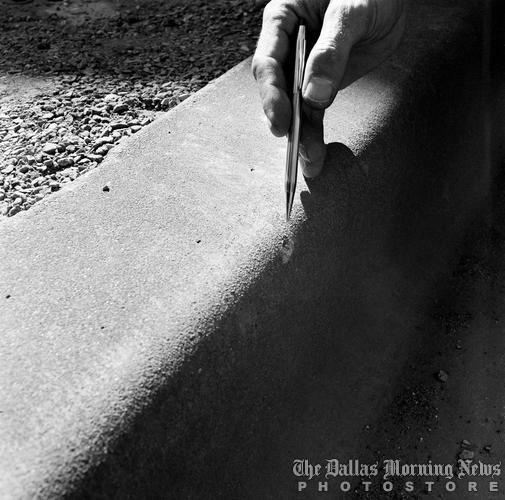
Let’s be generous and say the lead smear was off the edge by a quarter of an inch. I think it was really a good deal less than a quarter of an inch. With the width and height of the curb estimated at 6 inches, the odds of a bullet hitting within a quarter of an inch from the edge varies from 4 to 6 percent, depending on the angle the bullet was travelling relative to the horizon, from 0 to 90 degrees. A fairly remarkable coincidence. And coincidences make a skeptic suspicious. Most likely the lead smear would be on the vertical face or the horizontal face. Not so likely it would be right on the edge.
In contrast, a car which leaves a lead smear has a much greater chance of leaving a lead smear right on the edge. By chance the lead weight might be near its lowest point and leave a lead smear on the vertical face of the curb. But more likely it wouldn’t, and the rim of the tire would guide the lead weight right to the edge.
However, probability arguments are not all we have. Below is a picture of this same curb kept at the National Archives:

I have been told that in this picture, the curb is held “upside-down”, so to speak. The vertical face was really the horizontal face and the horizontal face is really the vertical. This makes sense because we can see curved scratches on the ‘top’ of the curb that were really on the side of the curb. One would only expect curved scratches to be on the side of the curb, because the rim of the tire would leave scratches along the side of the curb, not the top.
What made these curb scratches? What else, except a vehicle? A bullet would not leave curved scratches but a vehicle would.
Also note, one of these curved scratches points directly to the lead smear. Likely made by the same rim of the tire that left the lead smear itself.
A rim can have multiple high sections, separated from each other by a fraction of an inch, hence, the parallel curved arcs.
Questions:
1. Would a bullet leave curved scratches on a curb, just like a rim of a tire would?
2. If we insist on the bullet strike hypothesis. It would be just a big coincidence that the lead smear happened smack on the edge of the curb. It would be a further coincidence that there would be curved scratches on the curb, which must be unrelated to the bullet strike. And yet a further coincidence that one of these curved scratches should just happen to point directly at the lead smear in question. The arguments that lead smear was from a bullet strike are not compelling. The people who looked for it reported as a bullet strike, not a tire rim strike. But they were looking for bullet strikes, and likely to report any lead smear that was found as a bullet strike. If they were looking for tire rim strikes, they likely would report any lead smear on the curb as a tire rim strike.
The fanciful trajectory that has a bullet fragment exiting the skull at a high enough angle to clear the windshield and the roll bar makes it impossible for that fragment to then magically nosedive and somehow still have enough energy to chip the curb or to cut Tague's face.
Not at all. As I recall, the dented frame, and the damaged windshield, deviate from a horizontal straight line from the sniper’s nest through JFK’s head would be deflected by 5 and 9 degrees to the left. A fragment heading toward Mr. Tague would only need to be deflected by 7 degrees to the right.
But I suppose, Mt. Griffith would just regard this near horizontal alignment of a path from the sniper’s nest, through the head of JFK, and onto Mr. Tague, as just another coincidence.
Also, as I recall from reading “The JFK Myths”, over the course of the next 94 yards onto Mr. Tague, a fragment that just cleared the windshield frame and visor would only have to curve downward 16 feet to strike the curb, and considerably less to strike Mr. Tague’s cheek. If the fragment was averaging a speed of 564 feet per second, it would curve downward 4 feet from gravity alone.
While we think of bullets travelling in a pretty straight line, which they certainly do, we forget that they are carefully engineered to do so, with a symmetrical shape designed to cut straight through the air. It rotates about its axis of travel, like a football, to keep it straight. In contrast, a bullet fragment is a highly irregularly shaped, jagged piece of metal, rapidly rotating around a random axis not likely aligned with the path of travel. Such a fragment would curve a significant amount.
Think of a major league pitcher. He can put spin on the ball to make it curve. And it can curve several inches over the course of just 20 yards. And this with a pretty symmetrical sphere. And he can get it to curve even more, with Vaseline, or sandpaper or even just spit, to distort the baseball slightly from being close to a perfect sphere. Now imagine the great ‘curveballs’ he could get throwing a jagged piece of metal, that weight the same as a baseball, and similar size, all without cutting himself. Those would be really awesome curveballs.
A bullet fragment from JFK’s head, just clearing the limousine, could easily reach Mr. Tague’s cheek.
Any article on the wounding of Mt. Tague, that does not state that it is highly likely that the so called “curb strike” was unrelated to the assassination, gets discounted by me.
 Topic: The Wounding of James Tague Refutes the Lone-Gunman Theory (Read 54135 times)