Jack, since this print allegedly was lifted from a 5/8 " diameter round barrel ( with a half circumference of 1 inch ) don't you think the edges of the print should fade. IOW the palm of a man's hand would be in solid contact with the center of the round surface but the top and bottom edges would have less contact with the round surface and gradually fade away.
Walt, to overlay a print lifted from a cylinder vs a flat surface requires correcting for the 3D deformation of the print image. You need to know the diameter and alignment of the cylinder to apply the digital filter that rectifies the deformation. The correction looks like this:
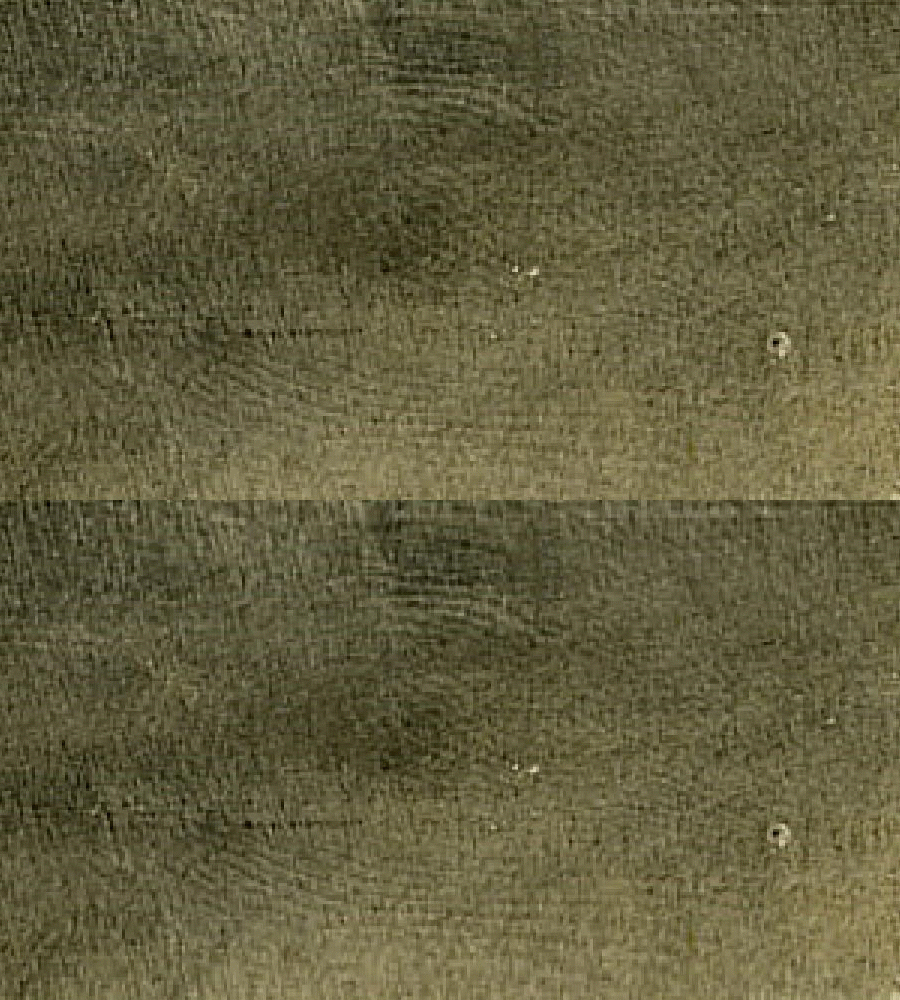
We know that the tape in this lift was one inch wide.....so that tape would wrap half way around the barrel . IMO we should see a good print in the center and less and less of the print at the top and bottom. This print looks like it was lifted from a flat surface.... Question: Would it be possible to place the print on the photo of the 3 X 5 card photographically ? Like a double exposure....First take a photo of a print and then without advancing the film take a photo of the surface on which you want the print to appear? There are probably other ways that the print could be made to appear on a surface...but I think you'll get the idea.
I won't touch this one unless I get a microscopic scan of the palm print on the 3"x5" card. We need enough resolution to identify dermal patterns and scars, etc. that match the inked hand print. Otherwise, I will be spinning my wheels and the only thing I could do would be to determine the probable location of the print on Oswald, the correct scale and orientation of Oswald's hand as he gripped the barrel and correct for the distortion created by lifting the print from a cylinder and taping it to a flat surface. But all that isn't good enough unless the resolution is sufficient to match up specific points on the print like a trained dermatoglyphician does.

